OnlyCuffsOnlyCuffsarchive search
The Forum at Handcuffs.Org

Small Arms Factory cuffs with Interesting History

5 visible archived posts · 5 preserved total · topic ID 1483
Original topic ↗Recovered images
kuffs 01 Sep 2006
#1
<font color=blue> Hi.

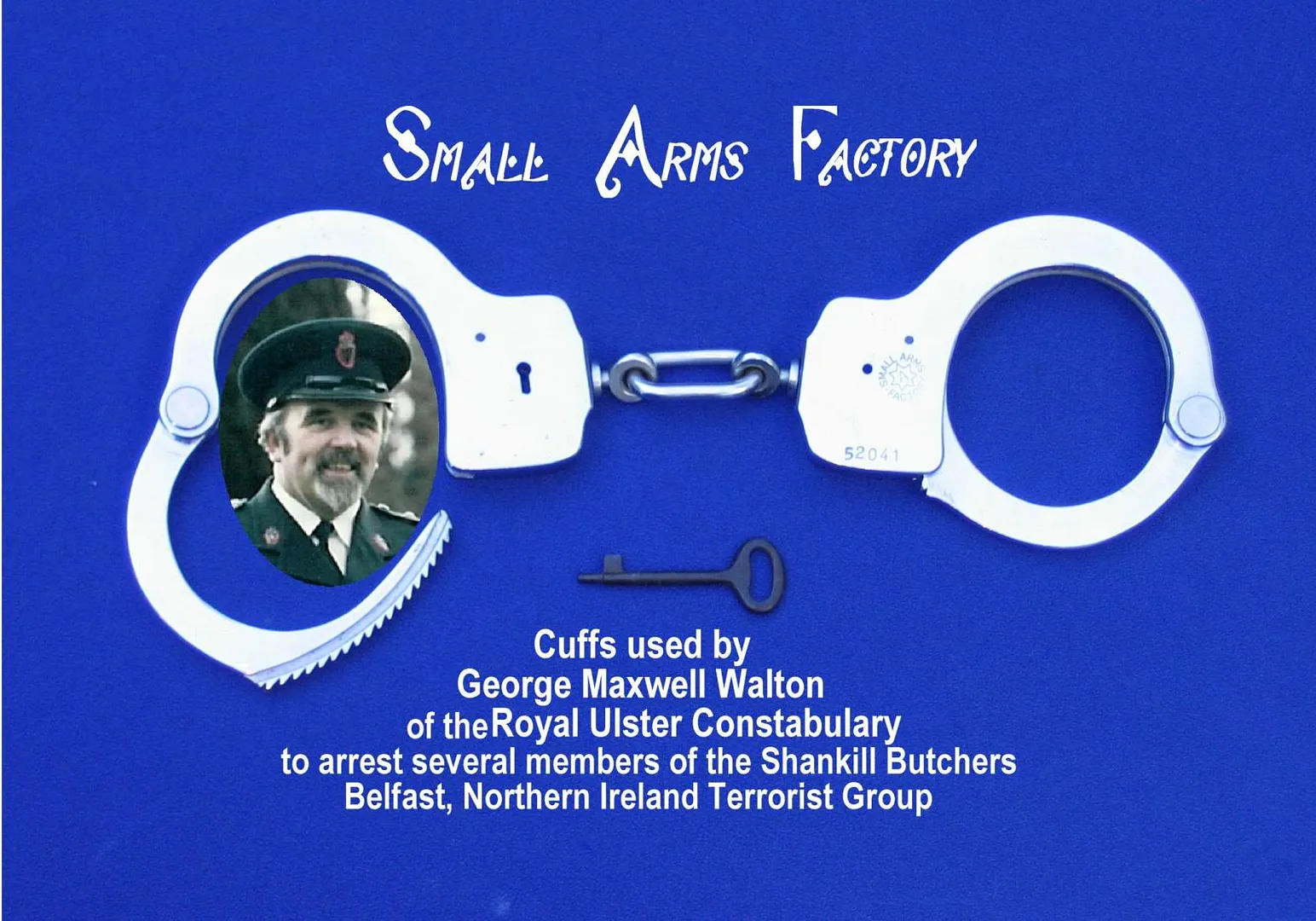
I just got these cuffs on eBay the other day and the only thing that I knew
about them was that they once belonged to the sellers father.
We wrote back and forth for a short while and found out that these cuffs
were used in Belfast, Northern Ireland to arrest some of the members of the
Shankill Butchers. This group of terrorists would stalk and abduct Roman
Catholics who were usually walking home from work or a night out on the
town. Once captured, they were brutally beaten and killed by having their
throats cut. This group did their deeds in the early 1970's and in 1979
they were convicted of 19 murders. It is assumed that up to30 murders
actually took place. More info can be found here:
http://en.wikipedia.org/wiki/Shankill_Butchers

The sellers father was George Maxwell Walton of the Royal
Ulster Constabulary and helped capture some of these gang
members and took them to trial. He was awarded the Queens
Police Medal several times during his career and this photo of
him was taken on 1/1/79 as he was receiving one of the medals.

I will be learning more about "Max" and who he locked up with
my new cuffs. I was very happy to add these cuffs to the
collection and am even more honored to have the cuffs of a
hero and to know the story behind them.

Sorry about the large format photo. I tried to figure out
how to reduce it with no luck. I did learn how to write in
blue however.

m

p.s. There was a thread about this style cuff about two or more months ago.
I was not able to find it. Please direst me to it if any of you can find it. Thank you.


</font>


mark
"Kuffs"
O--O
Dorson 01 Sep 2006
#2
Nice looking cuffs, they look to be a well made copy of 2nd model Peerless.

-Dorson
Steve Gage 02 Sep 2006
#3
<font color=blue> Hi.

I just got these cuffs on eBay the other day and the only thing that I knew
about them was that they once belonged to the sellers father.
We wrote back and forth for a short while and found out that these cuffs
were used in Belfast, Northern Ireland to arrest some of the members of the
Shankill Butchers. This group of terrorists would stalk and abduct Roman
Catholics who were usually walking home from work or a night out on the
town. Once captured, they were brutally beaten and killed by having their
throats cut. This group did their deeds in the early 1970's and in 1979
they were convicted of 19 murders. It is assumed that up to30 murders
actually took place. More info can be found here:
http://en.wikipedia.org/wiki/Shankill_Butchers

The sellers father was George Maxwell Walton of the Royal
Ulster Constabulary and helped capture some of these gang
members and took them to trial. He was awarded the Queens
Police Medal several times during his career and this photo of
him was taken on 1/1/79 as he was receiving one of the medals.

I will be learning more about "Max" and who he locked up with
my new cuffs. I was very happy to add these cuffs to the
collection and am even more honored to have the cuffs of a
hero and to know the story behind them.

Sorry about the large format photo. I tried to figure out
how to reduce it with no luck. I did learn how to write in
blue however.

m

p.s. There was a thread about this style cuff about two or more months ago.
I was not able to find it. Please direst me to it if any of you can find it. Thank you.


</font>


mark
"Kuffs"
O--O
Click to expand...
Hi, I am curious to identifying the manufacturer of this early model. I beleive it is Australian (the logo is) and on my identical cuffs is marked Small Arms Factory Lithgow N.S.W.
Comments please.

Steve
Edgeplay_Cgo 02 Sep 2006
#4
<font color=blue> Hi.

I just got these cuffs on eBay the other day and the only thing that I knew
about them was that they once belonged to the sellers father.
We wrote back and forth for a short while and found out that these cuffs
were used in Belfast, Northern Ireland to arrest some of the members of the
Shankill Butchers. This group of terrorists would stalk and abduct Roman
Catholics who were usually walking home from work or a night out on the
town. Once captured, they were brutally beaten and killed by having their
throats cut. This group did their deeds in the early 1970's and in 1979
they were convicted of 19 murders. It is assumed that up to30 murders
actually took place. More info can be found here:
http://en.wikipedia.org/wiki/Shankill_Butchers

The sellers father was George Maxwell Walton of the Royal
Ulster Constabulary and helped capture some of these gang
members and took them to trial. He was awarded the Queens
Police Medal several times during his career and this photo of
him was taken on 1/1/79 as he was receiving one of the medals.

I will be learning more about "Max" and who he locked up with
my new cuffs. I was very happy to add these cuffs to the
collection and am even more honored to have the cuffs of a
hero and to know the story behind them.

Sorry about the large format photo. I tried to figure out
how to reduce it with no luck. I did learn how to write in
blue however.

m

p.s. There was a thread about this style cuff about two or more months ago.
I was not able to find it. Please direst me to it if any of you can find it. Thank you.


</font>


mark
"Kuffs"
O--O
Click to expand...
The Small Arms Factory in Lithgow is best known for producing .303 SMLE rifles through two world wars. They also manufactured a lot of other things, apparently as fill in projects. This includes handcuffs and sheep shearing equipment. Lithgow cuffs were most probably all produced between the two World Wars. I found the following on the Lithgow Small Arms Museum website.

The Small Arms Factory

In 1908 the Commonwealth Government announced plans to build a small arms factory at Lithgow. The decision was favoured due to Lithgow's proximity to essential resources (eg power, steel, transport, etc) as well as the security benefits afforded by the seclusion provided by the mountains. It is likely that Joseph Cook, formerly a Lithgow coal miner, and at that time, the Federal Minister of Defence, was influential in lobbying for the positioning of the factory inhis home town.

Six men were sent to the United States of America to the firm of Pratt and Whitney to learn how to make rifles. In December of 1909 Mr F.R. Ratcliffe of Pratt and Whitney arrived in Australia to assist in the planning of the factory.

On 10 January 1910, the site of the factory was inspected by Lord Kitchener and was officially opened on 8 June 1912 with Mr. A.C.Wright as the first manager of the factory.

Many of the materials required by the factory were supplied from other industries in Lithgow. Steel required for the production of guns, forexample, was in part supplied by the Hoskins Brothers. Electrical power was initially generated on the site but was later obtained from the NSW Railways' Power Plant.

Increasing demands were placed on the factory during the first World War with production doubling and then later re-doubling. The production of Lee-Enfield .303 rifles increased during this time from 15,000 peryear to 80,000 per year. Over the period of the two world wars a total of 640,000 .303 rifles were made at the Small Arms Factory to assist the war effort (Brown 1989, p.86)

At the end of World War I, production began to decrease due to thedecreased demand for armaments. As a result, the Armaments Factory began to diversify its production to include stream-lined wires and metal aircraft engine parts. By 1931 more than half of the factory's production was linked to sound projection and sheep shearing machinery, Vickers Machine guns were also produced on site (Lithgow Public School 1947).
In the years before World War II items such as golf clubs, handcuffs, rifles and machine guns were made at the factory. When the war in Europe broke, production of armaments was again increased with the production of the Bren Machine Gun. This lead to considerable increases in employment at the factory.

A large forge and die sinking shop were constructed, reputedly the largest in the southern hemisphere, and new laboratories, boiler rooms and heat equipment were also introduced. The workforce at this time rose to 12,000 with the inclusion of increased shiftwork. This included 6,000 in Lithgow as well as an additional 6,000 in feeder factories established at Orange, Bathurst, Young, Forbes, Wellington, Cowra, Dubbo, Parkes, Portlandand Mudgee to assist the Lithgow operations (Lithgow District Historical Society Notes).

The Small Arms Factory was one of the major employers in Lithgow for some time and as a result of the rising work force during World War II a suburb known as Littleton was established with 'Duration Cottages' to house both workers and their families. An additional railway station at Cooerwull was also established to facilitate commuter travel from the Blue Mountains' towns.

After the war, tools, pencil sharpeners, sporting rifles and telephone parts have been produced. Operations at the Small Arms Factory have been significantly scaled down due to increasing government cutbacks.

Lithgow Tourism acknowledges and appreciates the History excerpts taken from the Draft Economic Development Strategy for Lithgow which was researched and compiled by Economic and Community Development Class, University of Sydney October 1996


http://www.lithgow-tourism.com/smallarms.htm


Reproduction of material, which may be copyrighted, is done under the provisions of 17 USC 107, which permits the limited fair use of copyrighted works for purposes such as criticism, comment, news reporting, teaching, scholarship, or research.
Steve Gage 03 Sep 2006
#5
<font color=blue> Hi.

I just got these cuffs on eBay the other day and the only thing that I knew
about them was that they once belonged to the sellers father.
We wrote back and forth for a short while and found out that these cuffs
were used in Belfast, Northern Ireland to arrest some of the members of the
Shankill Butchers. This group of terrorists would stalk and abduct Roman
Catholics who were usually walking home from work or a night out on the
town. Once captured, they were brutally beaten and killed by having their
throats cut. This group did their deeds in the early 1970's and in 1979
they were convicted of 19 murders. It is assumed that up to30 murders
actually took place. More info can be found here:
http://en.wikipedia.org/wiki/Shankill_Butchers

The sellers father was George Maxwell Walton of the Royal
Ulster Constabulary and helped capture some of these gang
members and took them to trial. He was awarded the Queens
Police Medal several times during his career and this photo of
him was taken on 1/1/79 as he was receiving one of the medals.

I will be learning more about "Max" and who he locked up with
my new cuffs. I was very happy to add these cuffs to the
collection and am even more honored to have the cuffs of a
hero and to know the story behind them.

Sorry about the large format photo. I tried to figure out
how to reduce it with no luck. I did learn how to write in
blue however.

m

p.s. There was a thread about this style cuff about two or more months ago.
I was not able to find it. Please direst me to it if any of you can find it. Thank you.


</font>


mark
"Kuffs"
O--O
Click to expand...
Thanks Dennis,
I currently buy handcuffs from this firm (now ADI) for my Department in Queensland. I am curious about these cuffs being used in another country and how they got there, especially that model.

The museum at Lithgow (or factory) lost most information on this subject after a fire or flood many years ago, therefore lack of positive info.

The model displayed, is i beleive the 'first'of its design, i have at least two more models prior to their big change to Saf-Lok (you don't have to guess what Saf stands for).

Saf-Lok now produce a bedcuff (my design) and are endevouring to produce a legiron.

Steve