OnlyCuffsOnlyCuffsarchive search
The Forum at Handcuffs.Org

Darby Leg Irons

9 visible archived posts · 9 preserved total · topic ID 1811
Original topic ↗Recovered images
cuffman69 16 Feb 2007
#1
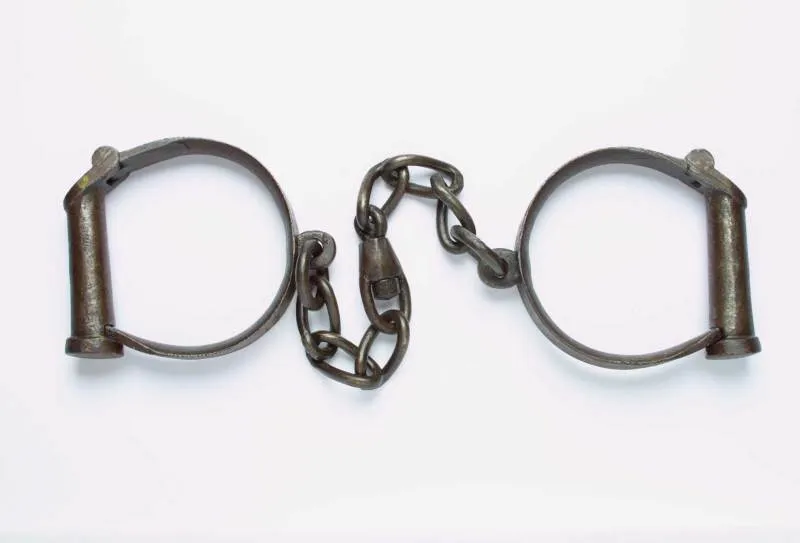
I've recently acquired a pair of unnamed leg irons from a dealer in the States. I believe Stan has a similar pair on his c.d. listed under UK leg irons. These leg irons are unlike others in my collection in as much as they have a flat outer surface with the usual curved radius on the inner surface similar to some plug 8 cuffs which turn up..


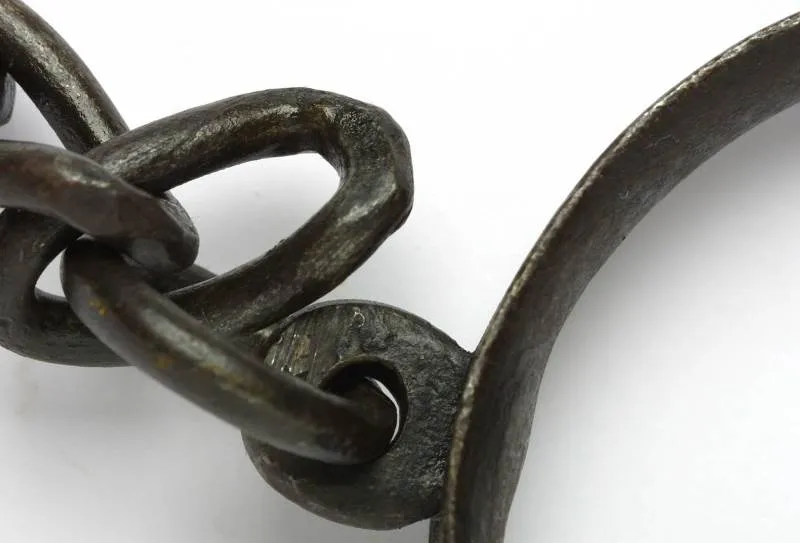
The chain is 9.5 inches long and has hand forged links rather than welded.
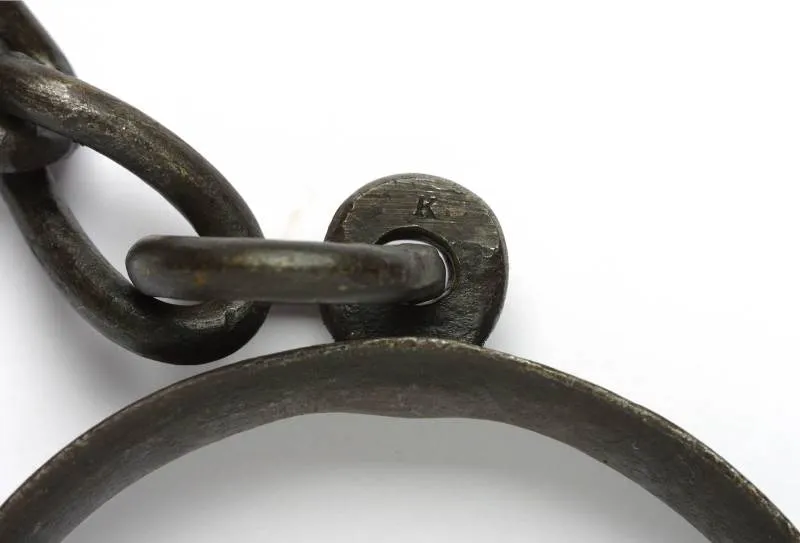
The only marks on the irons are the number 13 which is crudely scratched into the surface and the letter K which is on the chain connector lug.


The bottom of the locks case have plugs which are neither pinned nor stamped as would be normal for Hiatt, Froggatts etc.

If it wasn't for the hand forged links I date them 1940's to 50's as the quality of finish
( file marks etc )is not as good as the earlier models I have.

They came without a key however Darby handcuff keys open them whilst leg iron keys that I have are to large in diameter.

Does anyone fancy putting a name, age or country to them.

Thanks,

RMP ( Mark )
Stan Willis 16 Feb 2007
#2
My Leg iron is very similar to your description, except mine has no markings, and it is very large. The opening measures over 3 1/2 X 3 1/2 inches.
I think it is typically British, but no way to know for sure.
Stan
lauher 17 Feb 2007
#3
I've recently acquired a pair of unnamed leg irons from a dealer in the States. I believe Stan has a similar pair on his c.d. listed under UK leg irons. These leg irons are unlike others in my collection in as much as they have a flat outer surface with the usual curved radius on the inner surface similar to some plug 8 cuffs which turn up..


The chain is 9.5 inches long and has hand forged links rather than welded.
The only marks on the irons are the number 13 which is crudely scratched into the surface and the letter K which is on the chain connector lug.


The bottom of the locks case have plugs which are neither pinned nor stamped as would be normal for Hiatt, Froggatts etc.

If it wasn't for the hand forged links I date them 1940's to 50's as the quality of finish
( file marks etc )is not as good as the earlier models I have.

They came without a key however Darby handcuff keys open them whilst leg iron keys that I have are to large in diameter.

Does anyone fancy putting a name, age or country to them.

Thanks,

RMP ( Mark )
Click to expand...
I would also vote for Britain. But I have no idea who made them.
Joe
Edgeplay_Cgo 17 Feb 2007
#4
I've recently acquired a pair of unnamed leg irons from a dealer in the States. I believe Stan has a similar pair on his c.d. listed under UK leg irons. These leg irons are unlike others in my collection in as much as they have a flat outer surface with the usual curved radius on the inner surface similar to some plug 8 cuffs which turn up..


The chain is 9.5 inches long and has hand forged links rather than welded.
The only marks on the irons are the number 13 which is crudely scratched into the surface and the letter K which is on the chain connector lug.


The bottom of the locks case have plugs which are neither pinned nor stamped as would be normal for Hiatt, Froggatts etc.

If it wasn't for the hand forged links I date them 1940's to 50's as the quality of finish
( file marks etc )is not as good as the earlier models I have.

They came without a key however Darby handcuff keys open them whilst leg iron keys that I have are to large in diameter.

Does anyone fancy putting a name, age or country to them.

Thanks,

RMP ( Mark )
Click to expand...
Those cuffs are fascinating. I can't help you on the origin, but have a question.

The hinge plate, that is fastened to the moveable gate, appears to be folded sheet metal. Is that so, or am I reading the photo wrong?

They look a lot like the Indian knockoff Darbys, but they are obviously of much higher quality. They look to be hand made by a smith. I'm wondering is they're a period piece from that neck of the woods; the prototype model if you will, fort those nasty knockoffs.


- Dennis

--
Of course the game is rigged. Don't let that stop you--if you don't play, you can't win.
cuffman69 18 Feb 2007
#5
I've recently acquired a pair of unnamed leg irons from a dealer in the States. I believe Stan has a similar pair on his c.d. listed under UK leg irons. These leg irons are unlike others in my collection in as much as they have a flat outer surface with the usual curved radius on the inner surface similar to some plug 8 cuffs which turn up..


The chain is 9.5 inches long and has hand forged links rather than welded.
The only marks on the irons are the number 13 which is crudely scratched into the surface and the letter K which is on the chain connector lug.


The bottom of the locks case have plugs which are neither pinned nor stamped as would be normal for Hiatt, Froggatts etc.

If it wasn't for the hand forged links I date them 1940's to 50's as the quality of finish
( file marks etc )is not as good as the earlier models I have.

They came without a key however Darby handcuff keys open them whilst leg iron keys that I have are to large in diameter.

Does anyone fancy putting a name, age or country to them.

Thanks,

RMP ( Mark )
Click to expand...
Hi Denis,

I think it's a bit unfair to blame me for all the rubbish that turns up on eBay. I think its Stan’s Hiatt Flexibles with the suspicious key to blame myself. (Only joking)

I'm not exactly sure what you mean so I've taken some more images of the leg irons as well as some flat topped plug 8 which may help.


The outer radius edge is flat, the inside radius is curved probably for comfort which may give the impression of been folded sheet metal but the only fold is where the end of curved portion is folded back on itself to give sufficient thickness to form it's half of the hinge. I've tried to show the direction of the fold with a red line.


A plausible theory may be to lighten the overall weight which it succeeds in doing or maybe I was easier cheaper or quicker to manufacture.

Hope the images answer your question Denis.

Joe if you read this I think I may have noticed a similar style on your site last night. Also did you get my mail yesterday or it may have end up in your recycle bin as it had some images attached. Or if you're to busy I do understand.

Thanks,

RMP (MARK)
Stan Willis 18 Feb 2007
#6
I've recently acquired a pair of unnamed leg irons from a dealer in the States. I believe Stan has a similar pair on his c.d. listed under UK leg irons. These leg irons are unlike others in my collection in as much as they have a flat outer surface with the usual curved radius on the inner surface similar to some plug 8 cuffs which turn up..


The chain is 9.5 inches long and has hand forged links rather than welded.
The only marks on the irons are the number 13 which is crudely scratched into the surface and the letter K which is on the chain connector lug.


The bottom of the locks case have plugs which are neither pinned nor stamped as would be normal for Hiatt, Froggatts etc.

If it wasn't for the hand forged links I date them 1940's to 50's as the quality of finish
( file marks etc )is not as good as the earlier models I have.

They came without a key however Darby handcuff keys open them whilst leg iron keys that I have are to large in diameter.

Does anyone fancy putting a name, age or country to them.

Thanks,

RMP ( Mark )
Click to expand...
I have a very old Hiatt plug 8 and a Froggatt Plug 8 with the flat outside and rounded inside. The hinges are also very similar to the leg iron. I will ignore the comment about the flexibles. Some were made in the Australian prisons on contact with Hiatt, and the key is more Indian Darby than Hiatt.
Stan
cuffman69 18 Feb 2007
#7
I've recently acquired a pair of unnamed leg irons from a dealer in the States. I believe Stan has a similar pair on his c.d. listed under UK leg irons. These leg irons are unlike others in my collection in as much as they have a flat outer surface with the usual curved radius on the inner surface similar to some plug 8 cuffs which turn up..


The chain is 9.5 inches long and has hand forged links rather than welded.
The only marks on the irons are the number 13 which is crudely scratched into the surface and the letter K which is on the chain connector lug.


The bottom of the locks case have plugs which are neither pinned nor stamped as would be normal for Hiatt, Froggatts etc.

If it wasn't for the hand forged links I date them 1940's to 50's as the quality of finish
( file marks etc )is not as good as the earlier models I have.

They came without a key however Darby handcuff keys open them whilst leg iron keys that I have are to large in diameter.

Does anyone fancy putting a name, age or country to them.

Thanks,

RMP ( Mark )
Click to expand...
Hi Stan,

Thanks for that info I never new that.
Finding any genuine flexible is almost impossible for me without adding Australian varieties to the list. I must have looked at 10,000 Indian copies on eBay in the hope that a genuine pair may be lurking amongst them but alas not.
Do you think it's could then be possible that this Australian style of key could be the influence that the Modern Indian manufactures copied with their modern knock offs or can we now shift the blame onto Ian !!!
I’m sure he wont mind and he'll be to busy settling in to his new home to realise.

I've often wondered about Darby keys. The styles between manufactures in some instances seem to be similar for a given period of production. Could anyone throw any light on the possibility that key's were produced by a different company and supplied to various handcuff manufactures. Early Hiatt and Froggatt keys are similar and in the examples I've seen SM & Co and SF & Co keys seem to be identical.

Regards,

RMP (Mark)

lauher 18 Feb 2007
#8
I've recently acquired a pair of unnamed leg irons from a dealer in the States. I believe Stan has a similar pair on his c.d. listed under UK leg irons. These leg irons are unlike others in my collection in as much as they have a flat outer surface with the usual curved radius on the inner surface similar to some plug 8 cuffs which turn up..


The chain is 9.5 inches long and has hand forged links rather than welded.
The only marks on the irons are the number 13 which is crudely scratched into the surface and the letter K which is on the chain connector lug.


The bottom of the locks case have plugs which are neither pinned nor stamped as would be normal for Hiatt, Froggatts etc.

If it wasn't for the hand forged links I date them 1940's to 50's as the quality of finish
( file marks etc )is not as good as the earlier models I have.

They came without a key however Darby handcuff keys open them whilst leg iron keys that I have are to large in diameter.

Does anyone fancy putting a name, age or country to them.

Thanks,

RMP ( Mark )
Click to expand...
Mark

The evolution of Darby keys is an important topic. I agree with your thought that keys were likely shared between the companies. I always assumed that one big firm, perhaps Hiatt, perhaps an outside company not know for handcuffs, made most of the keys for everyone. This would be particularly true in the later years. early keys seem to be more unique.

Here are some pictures of Hiatt keys. They are all either marked Hiatt or have numbers that match a set a Hiatt cuffs.


Early Hiatt flatt keys, thin and thick.


The evolution of the "round head" key from the mid-19tt century to the 1970s.

Joe

P.S. Mark (RMP) I did not get an email from you.
Edgeplay_Cgo 18 Feb 2007
#9
I've recently acquired a pair of unnamed leg irons from a dealer in the States. I believe Stan has a similar pair on his c.d. listed under UK leg irons. These leg irons are unlike others in my collection in as much as they have a flat outer surface with the usual curved radius on the inner surface similar to some plug 8 cuffs which turn up..


The chain is 9.5 inches long and has hand forged links rather than welded.
The only marks on the irons are the number 13 which is crudely scratched into the surface and the letter K which is on the chain connector lug.


The bottom of the locks case have plugs which are neither pinned nor stamped as would be normal for Hiatt, Froggatts etc.

If it wasn't for the hand forged links I date them 1940's to 50's as the quality of finish
( file marks etc )is not as good as the earlier models I have.

They came without a key however Darby handcuff keys open them whilst leg iron keys that I have are to large in diameter.

Does anyone fancy putting a name, age or country to them.

Thanks,

RMP ( Mark )
Click to expand...
Thanks Mark.

So it's you that started the Indian Handcuff trade!

[WHACK] Owwww!

Seriously, if only for a moment, the idea came to me that all those jillion knockoffs came from somewhere. There were a bunch of general use duty quality Darbys, probably made in Indian shops, that inspired the knockoffs. Since Indian metalworking and small arms industries go way back, it makes sense that sort of item would be locally made.

Thanks for the additional photos. What I was seeing as a parting line between two laysrs of sheet iron, was apparently a file mark on the side of the hinge. From your new photos, it's obvious that the hinges are forged en bloc with the gate.

The plug eight, looks to have the gate body rolled from flat stock. I presume the hinge was forged on or shrunk and staked. Rolling the body would be easier to do with hand tools than forging a cylinder. The hole may be drilled, which implied power machinery. There were hand operated blacksmith drills, but the process was sufficiently laborious that it would not cheerfully be used to create long holes.

The padeye appears to be forge welded to the bow. I'd guess a hole was punched in the bow, and the padeye inserted and welded in place; kind of a bastardy of riveting and welding. Notice that the bow is slightly thicker inder the padeye. On the knockoffs, they cheapened that process into not much more than staking the padeye with a punch. On the more modern Darbys, like the Hiatts and Froggats I've seen, the padeye appears to be forged en bloc with the bow. That is a more sophisticated and expensive process.


Thanks for posting those photos.


- Dennis

--
Of course the game is rigged. Don't let that stop you--if you don't play, you can't win.
-Robert Heinlein