OnlyCuffsOnlyCuffsarchive search
The Forum at Handcuffs.Org

Hiatts Model 1960

9 visible archived posts · 9 preserved total · topic ID 1861
Original topic ↗Recovered images
Dorson 05 Mar 2007
#1
Hello all,
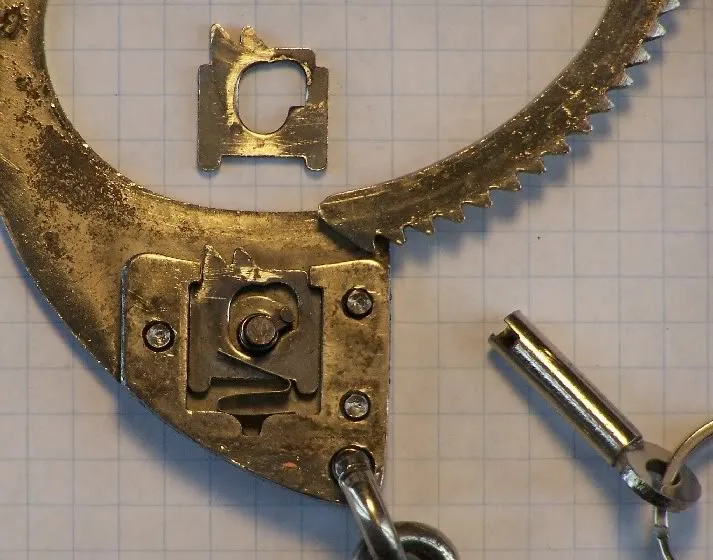
I was playing around today and took apart a model 1960 made by Hiatt and here is what it looks like inside.


What you are seeing is the cleaned up version, there was alot of rust and gunk inside the lock which seems to be common with this cuff. Just my opinion here, but I think this was not one of Hiatts best designs for several reasons. I think some of the rust inside was for 2 reasons, one was the plating process and second was the way the cuffs were used in the field. I did find some evidence of a lubricant but it was dried up and gunky. I also found the stampings to still have excess metal that should have been filed down. Another flaw seems to be the post inside the lock tends to move to one side making it harder to insert the key. Setting all that aside, the cuffs are easier to pick open than standard Peerless and S&W's. A hair pin, tooth pick, any small diameter material that is stiff enough will work. At the bottom of the lock case there is a cutout of sorts and I wonder why that is there, was that left over from a design change. Did they have a different spring than the one used here.

-Dorson
grenchat 07 Mar 2007
#2
I can’t really blame you for sawing the cuff in half like that. The Hiatt 1960 model was one of the vintage cuffs – in near mint condition – that I happily pruned from my collection. How on earth they got by with this insipid model for roughly 10 years is simply beyond me. The lock probably isn’t even as secure as those found on the adult novelty cuffs. No wonder so many constables were reluctant to trade in their Darby cuffs for these. The only thing I ever really liked about them was the swivel.

Jason

Ian McColl 07 Mar 2007
#3
Hello all,
I was playing around today and took apart a model 1960 made by Hiatt and here is what it looks like inside.


What you are seeing is the cleaned up version, there was alot of rust and gunk inside the lock which seems to be common with this cuff. Just my opinion here, but I think this was not one of Hiatts best designs for several reasons. I think some of the rust inside was for 2 reasons, one was the plating process and second was the way the cuffs were used in the field. I did find some evidence of a lubricant but it was dried up and gunky. I also found the stampings to still have excess metal that should have been filed down. Another flaw seems to be the post inside the lock tends to move to one side making it harder to insert the key. Setting all that aside, the cuffs are easier to pick open than standard Peerless and S&W's. A hair pin, tooth pick, any small diameter material that is stiff enough will work. At the bottom of the lock case there is a cutout of sorts and I wonder why that is there, was that left over from a design change. Did they have a different spring than the one used here.

-Dorson
Click to expand...
Nice to see the inside of cuffs, but I hope you don't do it to too many.

I always thought that there was a lack of security by having the bit of the key within the lock and all the key was, was the tool or handle to turn the bit.

In most I have played with, a straight piece of wire could push the (cam) bit section around to open the cuff.

I'd have a darby before this model.

Ian

michael griffin 07 Mar 2007
#4
Hello all,
I was playing around today and took apart a model 1960 made by Hiatt and here is what it looks like inside.


What you are seeing is the cleaned up version, there was alot of rust and gunk inside the lock which seems to be common with this cuff. Just my opinion here, but I think this was not one of Hiatts best designs for several reasons. I think some of the rust inside was for 2 reasons, one was the plating process and second was the way the cuffs were used in the field. I did find some evidence of a lubricant but it was dried up and gunky. I also found the stampings to still have excess metal that should have been filed down. Another flaw seems to be the post inside the lock tends to move to one side making it harder to insert the key. Setting all that aside, the cuffs are easier to pick open than standard Peerless and S&W's. A hair pin, tooth pick, any small diameter material that is stiff enough will work. At the bottom of the lock case there is a cutout of sorts and I wonder why that is there, was that left over from a design change. Did they have a different spring than the one used here.

-Dorson
Click to expand...
HI: great pics of the guts of the 1960. Years ago working a magic double bill with another magician who was performing the metamorphoses. He showed me his 1960's and showed me how they were gimimicked. It was very unusual to me and I am impressed to this day, in fact I have looked for years for one.
The gimick worked by simply pulling the cuffs apart. Doing so pulled the lock cover out and pivoted thus releasing the lock. To secure they were just pushed back in place.
simple and one of the coolest gimiks i ever saw
Hey Ian have you ever made one of these?
michael
Ian McColl 07 Mar 2007
#5
Hello all,
I was playing around today and took apart a model 1960 made by Hiatt and here is what it looks like inside.


What you are seeing is the cleaned up version, there was alot of rust and gunk inside the lock which seems to be common with this cuff. Just my opinion here, but I think this was not one of Hiatts best designs for several reasons. I think some of the rust inside was for 2 reasons, one was the plating process and second was the way the cuffs were used in the field. I did find some evidence of a lubricant but it was dried up and gunky. I also found the stampings to still have excess metal that should have been filed down. Another flaw seems to be the post inside the lock tends to move to one side making it harder to insert the key. Setting all that aside, the cuffs are easier to pick open than standard Peerless and S&W's. A hair pin, tooth pick, any small diameter material that is stiff enough will work. At the bottom of the lock case there is a cutout of sorts and I wonder why that is there, was that left over from a design change. Did they have a different spring than the one used here.

-Dorson
Click to expand...
Hi Michael, no I haven't seen that style of gimmick before, can you send more clearer details, what stops the mechanism from falling out?

Ian
Mikeintightpants 08 Mar 2007
#6
Hello all,
I was playing around today and took apart a model 1960 made by Hiatt and here is what it looks like inside.


What you are seeing is the cleaned up version, there was alot of rust and gunk inside the lock which seems to be common with this cuff. Just my opinion here, but I think this was not one of Hiatts best designs for several reasons. I think some of the rust inside was for 2 reasons, one was the plating process and second was the way the cuffs were used in the field. I did find some evidence of a lubricant but it was dried up and gunky. I also found the stampings to still have excess metal that should have been filed down. Another flaw seems to be the post inside the lock tends to move to one side making it harder to insert the key. Setting all that aside, the cuffs are easier to pick open than standard Peerless and S&W's. A hair pin, tooth pick, any small diameter material that is stiff enough will work. At the bottom of the lock case there is a cutout of sorts and I wonder why that is there, was that left over from a design change. Did they have a different spring than the one used here.

-Dorson
Click to expand...
I remember the first pair of 1960's that I bought just after they first came out - I reckon it was about the year 1970 - don't shoot me down if I'm wrong there, guys, I said 'about'. I was really excited, because they looked so different and they had a very smoothe action. But they allowed the hands to be so far apart - and they were in no way secure! Interestingly, there seem to be quite a number of them on the market right now - offered without keys! Reckon somebody bought up a job lot from one of the UK forces who must have had a clearout of their stores.
But then what did we have after the 1960's - anybody remember those best-forgotten 1970's? Ugh!!
Dorson 09 Mar 2007
#7
Hello all,
I was playing around today and took apart a model 1960 made by Hiatt and here is what it looks like inside.


What you are seeing is the cleaned up version, there was alot of rust and gunk inside the lock which seems to be common with this cuff. Just my opinion here, but I think this was not one of Hiatts best designs for several reasons. I think some of the rust inside was for 2 reasons, one was the plating process and second was the way the cuffs were used in the field. I did find some evidence of a lubricant but it was dried up and gunky. I also found the stampings to still have excess metal that should have been filed down. Another flaw seems to be the post inside the lock tends to move to one side making it harder to insert the key. Setting all that aside, the cuffs are easier to pick open than standard Peerless and S&W's. A hair pin, tooth pick, any small diameter material that is stiff enough will work. At the bottom of the lock case there is a cutout of sorts and I wonder why that is there, was that left over from a design change. Did they have a different spring than the one used here.

-Dorson
Click to expand...
I do, and have a pair still in the original box with all that packing oil on them. They were known for there sharp edges and although the double lock could be engaged on the face of the cuffs. They were still lacking in quality and workmanship compared to the American cuffs. Even today, I am not that fond of Hiatts because they don't round/soften the edges enough.

-Dorson
Mikeintightpants 09 Mar 2007
#8
Hello all,
I was playing around today and took apart a model 1960 made by Hiatt and here is what it looks like inside.


What you are seeing is the cleaned up version, there was alot of rust and gunk inside the lock which seems to be common with this cuff. Just my opinion here, but I think this was not one of Hiatts best designs for several reasons. I think some of the rust inside was for 2 reasons, one was the plating process and second was the way the cuffs were used in the field. I did find some evidence of a lubricant but it was dried up and gunky. I also found the stampings to still have excess metal that should have been filed down. Another flaw seems to be the post inside the lock tends to move to one side making it harder to insert the key. Setting all that aside, the cuffs are easier to pick open than standard Peerless and S&W's. A hair pin, tooth pick, any small diameter material that is stiff enough will work. At the bottom of the lock case there is a cutout of sorts and I wonder why that is there, was that left over from a design change. Did they have a different spring than the one used here.

-Dorson
Click to expand...
"still in the original box with all that packing oil on them" - That says it all, I guess nobody really liked using 'em.
At the risk of getting off-topic, I seem to remember that some pairs of 1970's had stampings on that indicated they were made (or some of the components were made) in USA - but wherever they were made, the quality was no better.
Mike
michael griffin 10 Mar 2007
#9
Hello all,
I was playing around today and took apart a model 1960 made by Hiatt and here is what it looks like inside.


What you are seeing is the cleaned up version, there was alot of rust and gunk inside the lock which seems to be common with this cuff. Just my opinion here, but I think this was not one of Hiatts best designs for several reasons. I think some of the rust inside was for 2 reasons, one was the plating process and second was the way the cuffs were used in the field. I did find some evidence of a lubricant but it was dried up and gunky. I also found the stampings to still have excess metal that should have been filed down. Another flaw seems to be the post inside the lock tends to move to one side making it harder to insert the key. Setting all that aside, the cuffs are easier to pick open than standard Peerless and S&W's. A hair pin, tooth pick, any small diameter material that is stiff enough will work. At the bottom of the lock case there is a cutout of sorts and I wonder why that is there, was that left over from a design change. Did they have a different spring than the one used here.

-Dorson
Click to expand...
Hi Ian and all;
I am attaching a touched up version of the previously mentioned Hiatt 1960 (my apologies to the original poster if offended that I used that pic) in an effort to show Ian how the gimik worked. I would imagine that there were a couple of stop pins milled in to prevent swinging out too far.
It might have been friction as I recall it working snugly but I think some sort of stop pin would be more practical