OnlyCuffsOnlyCuffsarchive search
The Forum at Handcuffs.Org

Plug ball & chain

14 visible archived posts · 14 preserved total · topic ID 1869
Original topic ↗Recovered images
cuffman69 07 Mar 2007
#1
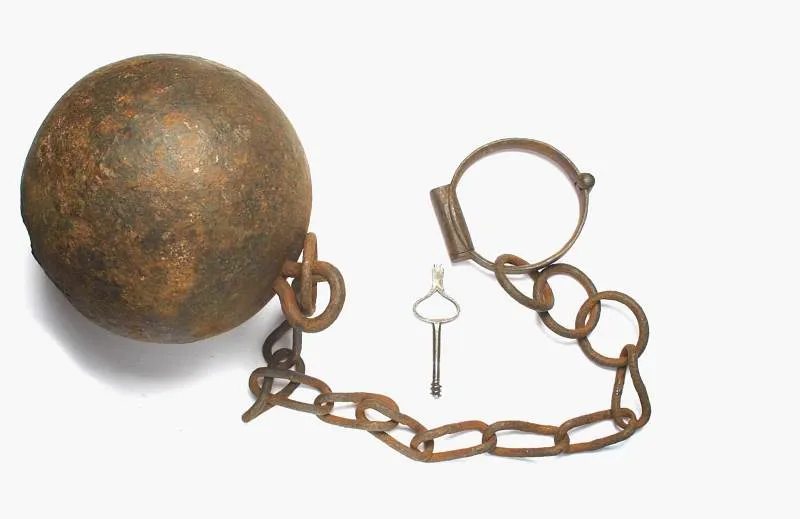
I have a plug leg iron which is connected to a ball and chain.


The ball weighs 42lbs (around 19kgs). The chain is 24 inches. I know that the American ball and chains tend to come with smaller balls but longer chains which may allow greater movement whilst working.

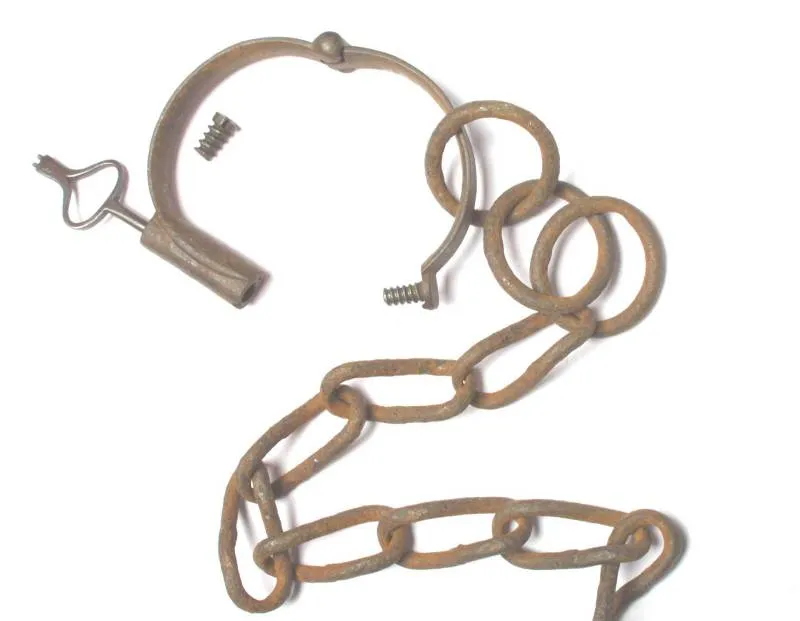
The chain has10 elongated links and the final 3 links are circular. There does not appear to be any signs of shortening the chain but obviously if the chain had been shortened it would not show on the remaining links. The link which attaches to the ball is circular like the last 3 and has been forged like the others. Although the picture doesn't show it there is considerable wearing of the metal where the links rub together. The larger circular end links may be to accommodate a variety of locks or cuffs to be passed though.

The plug leg iron has the flat outer surface and curved inner as seen in the older plug 8 cuffs. It sadly isn't named but does have its plug and the number 1 stamped on. I assume that the leg iron was not permanently attached to the chain to give it more versatility.


It isn't possible to stand upright when lifting the ball which means you have to be bent double when walking. I'd be inclined to think this ball and chain to be genuine and unaltered in length and that it may have been as much a punishment as a means to prevent escape.

Does anyone else have a similar setup in their collection or can you add any more info?
Thanks,

RMP ( Mark)
Franklin 07 Mar 2007
#2
Hi RMP:

I've tried researching the ball and chain and have been able to turn up very little that's reliable or detailed. As far as I know (and I've been wrong lots of times) the only commercial manufacturer of these was Tower; you can see a picture of their advertisement for the things on the Forum's main page under the Tower link.

The few historical references I've found to balls and chains nearly always place them in a military context. For example, in the trial of Henry Wirz, the commandant of the Confederate military prison at Andersonville, there is testimony that Wirz ordered the blacksmith to place recaptured escaped prisoners in a ball and chain as punishment. However, no details were given as to the construction of the articles, other than the suggestion that the blacksmith constructed the items.

The only reliable reference I've ever found to their use in a civilian context is in the schedule of punishments in effect at the Arizona Territorial Prison at Yuma, Arizona (in operation from 1876 to 1909). Recaptured escapees got to wear one for 30 days. As a territory, Arizona was then under U.S. military jurisdiction, so even here there's a military connection.

To me, it makes sense that these items where used mainly for military punishment; after all, where is a civilian blacksmith going to come up with an iron ball? With a military blacksmith, all he had to do was pop by the armory and pick up a cannonball. For the one I've got and the four others I've seen that appear to be authentic, the ball size always corresponds to the sizes of solid shot cannonballs in use during the 18th and 19th century when cannons were rated by the weight of the iron ball it would handle, rather than the diameter of the bore. Here's the scale used:

Weight in pounds Diameter in inches

1 1.92
2 2.42
4 3.05
6 3.49
9 4.00
12 4.40
18 5.04
24 5.55
32 6.11
42 6.68

The second common feature I've seen is that the chain is often not consistent, but is often made up of two or more pieces of different chain types. This simply seems to be the blacksmith's way of recycling old pieces of chain that had become stretched causing the links to sometimes bind, which was rather common with antique wrought iron chains which were softer than modern steel chains. Why waste good chain on something you're locking a prisoner up with? With mine, the links are worn, stretched and they bind. To me, this does not indicate damage done by a prisoner trying to free himself, but that an otherwise useless piece of scrap metal was reused.

The third common feature seems to be that a swivel mechanism is present. If the prisoner needed to move further than the length of the chain, rather than pick the ball up, he just rolled it along the ground. If part of his punishment were to include having to lift the weight, it would be easier to chain him to a log, a rock or some non-spherical weight rather than waste a cannonball. Hence, with the swivel preventing the chain from twisting up while the ball was rolled about, the prisoner could be relatively mobile while on a work gang. Usually, the swivel is incorporated into the chain around the middle. However, in the one I've got, the swivel is mounted into the ball (24 pounds) and the chain attached to the bail of the swivel.

On a related topic, while I've found dozens of period accounts of slaves in America being "shackled" as punishment, I've never found a reference to a ball and chain being used. What was employed was usually a very heavy shackle (along the lines of an Oregon boot), sometimes with a length of heavy chain attached, and occasionally the end of that chain being fastened to a log or other named object, but never a "ball".

As for chain length, six feet seems to be the minimum, which also gives the prisoner a sufficient length to pick up the ball and carry it when it couldn't be rolled, such as when climbing stairs.

With the shackle, they seemed to use whatever they had available, or made one that could be riveted or padlocked together. In your instance, I find the single plug eight shackle interesting in and of itself. With a little bit of imagination, it could have many applications. Also, if you had several, you could easily create a chain gang.

Just because your example has a short chain and lacks a swivel does not mean it was not in fact used as depicted. Other than the Tower ball and chain, all of these were individually crafted and there may have been unknown reasons why yours is the way it is. Just using common sense, finding a 42 pound cannon ball with a length of chain attached to it not something you run across very often. Finding a single plug eight shackle is highly unusual. Finding the two together suggests they've been together for a long time. While there is no way you can ever know for sure exactly what it is you've got, I think you've got something worth keeping.

After all, having a ball and chain around makes cocktail parties much more entertaining.

Anonymous 13 Mar 2007
#3
I have a plug leg iron which is connected to a ball and chain.


The ball weighs 42lbs (around 19kgs). The chain is 24 inches. I know that the American ball and chains tend to come with smaller balls but longer chains which may allow greater movement whilst working.

The chain has10 elongated links and the final 3 links are circular. There does not appear to be any signs of shortening the chain but obviously if the chain had been shortened it would not show on the remaining links. The link which attaches to the ball is circular like the last 3 and has been forged like the others. Although the picture doesn't show it there is considerable wearing of the metal where the links rub together. The larger circular end links may be to accommodate a variety of locks or cuffs to be passed though.

The plug leg iron has the flat outer surface and curved inner as seen in the older plug 8 cuffs. It sadly isn't named but does have its plug and the number 1 stamped on. I assume that the leg iron was not permanently attached to the chain to give it more versatility.


It isn't possible to stand upright when lifting the ball which means you have to be bent double when walking. I'd be inclined to think this ball and chain to be genuine and unaltered in length and that it may have been as much a punishment as a means to prevent escape.

Does anyone else have a similar setup in their collection or can you add any more info?
Thanks,

RMP ( Mark)
Click to expand...
Alright, Mr. Smarty, what about these?????

http://cgi.ebay.com/ws/eBayISAPI.dll?Vi ... &rd=1&rd=1
michael griffin 13 Mar 2007
#4
I have a plug leg iron which is connected to a ball and chain.


The ball weighs 42lbs (around 19kgs). The chain is 24 inches. I know that the American ball and chains tend to come with smaller balls but longer chains which may allow greater movement whilst working.

The chain has10 elongated links and the final 3 links are circular. There does not appear to be any signs of shortening the chain but obviously if the chain had been shortened it would not show on the remaining links. The link which attaches to the ball is circular like the last 3 and has been forged like the others. Although the picture doesn't show it there is considerable wearing of the metal where the links rub together. The larger circular end links may be to accommodate a variety of locks or cuffs to be passed though.

The plug leg iron has the flat outer surface and curved inner as seen in the older plug 8 cuffs. It sadly isn't named but does have its plug and the number 1 stamped on. I assume that the leg iron was not permanently attached to the chain to give it more versatility.


It isn't possible to stand upright when lifting the ball which means you have to be bent double when walking. I'd be inclined to think this ball and chain to be genuine and unaltered in length and that it may have been as much a punishment as a means to prevent escape.

Does anyone else have a similar setup in their collection or can you add any more info?
Thanks,

RMP ( Mark)
Click to expand...
The "ball and chain" with the handle is cobbled together from an old chain and a ballast ball used in ships
I have seen many and owned many original balls and chains they are not made like this
however that is not to say that these arent functional and could have easily seen service in prison camps. I have seen many cobbled pieces that were used for a long time and made from different items whether due to budget constraints or just other necessity's
micahel
Anonymous 13 Mar 2007
#5
I have a plug leg iron which is connected to a ball and chain.


The ball weighs 42lbs (around 19kgs). The chain is 24 inches. I know that the American ball and chains tend to come with smaller balls but longer chains which may allow greater movement whilst working.

The chain has10 elongated links and the final 3 links are circular. There does not appear to be any signs of shortening the chain but obviously if the chain had been shortened it would not show on the remaining links. The link which attaches to the ball is circular like the last 3 and has been forged like the others. Although the picture doesn't show it there is considerable wearing of the metal where the links rub together. The larger circular end links may be to accommodate a variety of locks or cuffs to be passed though.

The plug leg iron has the flat outer surface and curved inner as seen in the older plug 8 cuffs. It sadly isn't named but does have its plug and the number 1 stamped on. I assume that the leg iron was not permanently attached to the chain to give it more versatility.


It isn't possible to stand upright when lifting the ball which means you have to be bent double when walking. I'd be inclined to think this ball and chain to be genuine and unaltered in length and that it may have been as much a punishment as a means to prevent escape.

Does anyone else have a similar setup in their collection or can you add any more info?
Thanks,

RMP ( Mark)
Click to expand...
Hey, I just wanted to say that, that is a pretty nice cobble job. Having that handle would make it so much easier to haul around that heavy ball.

Nice set up, whoever put it together.
joe tanner 13 Mar 2007
#6
I have a plug leg iron which is connected to a ball and chain.


The ball weighs 42lbs (around 19kgs). The chain is 24 inches. I know that the American ball and chains tend to come with smaller balls but longer chains which may allow greater movement whilst working.

The chain has10 elongated links and the final 3 links are circular. There does not appear to be any signs of shortening the chain but obviously if the chain had been shortened it would not show on the remaining links. The link which attaches to the ball is circular like the last 3 and has been forged like the others. Although the picture doesn't show it there is considerable wearing of the metal where the links rub together. The larger circular end links may be to accommodate a variety of locks or cuffs to be passed though.

The plug leg iron has the flat outer surface and curved inner as seen in the older plug 8 cuffs. It sadly isn't named but does have its plug and the number 1 stamped on. I assume that the leg iron was not permanently attached to the chain to give it more versatility.


It isn't possible to stand upright when lifting the ball which means you have to be bent double when walking. I'd be inclined to think this ball and chain to be genuine and unaltered in length and that it may have been as much a punishment as a means to prevent escape.

Does anyone else have a similar setup in their collection or can you add any more info?
Thanks,

RMP ( Mark)
Click to expand...
what a piece of crap, but if it works - it works.... guess you folks missed the part where the chain is just stuck into the handle... now that is the height of a lazy mans way of creating a ball & chain.... the ball is EITHER 1n old time scale weight ball or as MIKE states... BUT they where used down south for many years as baal & chains... althou, the chain was in a sense - permanently attached to the B&C either by running the chain fully thru the handle & looped back to connect (forged) to the chain..... over the years, i have had MANY MANY ball & chains & i am sure many of them were NOT original authentic B&C's, but IF the workmanship was good i accepted it as genuine.... in other words, no big welds or weld residue where the ????? whatever was connected to/into the ball -- same with where chain was connected -- same where shackle was connected to the chain etc etc... yes, the b&c could have several different types & lenghts of chains as that is no big deal etc etc... joe
Franklin 14 Mar 2007
#7
I have a plug leg iron which is connected to a ball and chain.


The ball weighs 42lbs (around 19kgs). The chain is 24 inches. I know that the American ball and chains tend to come with smaller balls but longer chains which may allow greater movement whilst working.

The chain has10 elongated links and the final 3 links are circular. There does not appear to be any signs of shortening the chain but obviously if the chain had been shortened it would not show on the remaining links. The link which attaches to the ball is circular like the last 3 and has been forged like the others. Although the picture doesn't show it there is considerable wearing of the metal where the links rub together. The larger circular end links may be to accommodate a variety of locks or cuffs to be passed though.

The plug leg iron has the flat outer surface and curved inner as seen in the older plug 8 cuffs. It sadly isn't named but does have its plug and the number 1 stamped on. I assume that the leg iron was not permanently attached to the chain to give it more versatility.


It isn't possible to stand upright when lifting the ball which means you have to be bent double when walking. I'd be inclined to think this ball and chain to be genuine and unaltered in length and that it may have been as much a punishment as a means to prevent escape.

Does anyone else have a similar setup in their collection or can you add any more info?
Thanks,

RMP ( Mark)
Click to expand...
Hi:

For once in my life, I can honestly say that damned thing is a fake, as being presented.

That ball thing with the handle is a counterweight used on old sheet metal presses and brakes before hydraulics.

When I saw it on eBay, it brought back some fond memories.

When I was in high school, out in the West Texas oil fields, around 1974, I worked my tail to the ground one weekend hauling junk out of an old machine shop to sell all that stuff for scrap metal.

There were a couple of dozen or more of those things.

The way they were used was to slide the things onto a fulcrum (that's what the slot below the handle is for), then let them drop and raise to let the machinery operate.

Not a great description, but it's the best I can do without pictures.

Well, anyway, I kept one back; thinking I could make a ball and chain device out of it. I don't know why, it just seemed like a cool thing to do. But I never got around to it.

After dragging the thing around for fifteen years or so, a buddy of mine and me decided the thing would make a pretty good boat anchor. So, we did. And it worked great.

The problem was it worked too well. The thing got stuck in the mud at the bottom of the lake and we couldn't haul it up. So, we just cut the rope and left it there.

I have every confidence, that if they ever dredge that lake in East Texas, they will find this rare and unique slave artifact.

While I do not wish to disparage anyone's name or reputation, about all I can say about this particular listing is:

That piece of trace chain might be authentic.

Thanks guys,

Franklin
a/k/a Mr. Smarty
spencer 15 Mar 2007
#8
I have a plug leg iron which is connected to a ball and chain.


The ball weighs 42lbs (around 19kgs). The chain is 24 inches. I know that the American ball and chains tend to come with smaller balls but longer chains which may allow greater movement whilst working.

The chain has10 elongated links and the final 3 links are circular. There does not appear to be any signs of shortening the chain but obviously if the chain had been shortened it would not show on the remaining links. The link which attaches to the ball is circular like the last 3 and has been forged like the others. Although the picture doesn't show it there is considerable wearing of the metal where the links rub together. The larger circular end links may be to accommodate a variety of locks or cuffs to be passed though.

The plug leg iron has the flat outer surface and curved inner as seen in the older plug 8 cuffs. It sadly isn't named but does have its plug and the number 1 stamped on. I assume that the leg iron was not permanently attached to the chain to give it more versatility.


It isn't possible to stand upright when lifting the ball which means you have to be bent double when walking. I'd be inclined to think this ball and chain to be genuine and unaltered in length and that it may have been as much a punishment as a means to prevent escape.

Does anyone else have a similar setup in their collection or can you add any more info?
Thanks,

RMP ( Mark)
Click to expand...
Does anyone have or has seen a picture of a ball and chain that had a Bean shackle instead of a Tower on the end?
joe tanner 15 Mar 2007
#9
I have a plug leg iron which is connected to a ball and chain.


The ball weighs 42lbs (around 19kgs). The chain is 24 inches. I know that the American ball and chains tend to come with smaller balls but longer chains which may allow greater movement whilst working.

The chain has10 elongated links and the final 3 links are circular. There does not appear to be any signs of shortening the chain but obviously if the chain had been shortened it would not show on the remaining links. The link which attaches to the ball is circular like the last 3 and has been forged like the others. Although the picture doesn't show it there is considerable wearing of the metal where the links rub together. The larger circular end links may be to accommodate a variety of locks or cuffs to be passed though.

The plug leg iron has the flat outer surface and curved inner as seen in the older plug 8 cuffs. It sadly isn't named but does have its plug and the number 1 stamped on. I assume that the leg iron was not permanently attached to the chain to give it more versatility.


It isn't possible to stand upright when lifting the ball which means you have to be bent double when walking. I'd be inclined to think this ball and chain to be genuine and unaltered in length and that it may have been as much a punishment as a means to prevent escape.

Does anyone else have a similar setup in their collection or can you add any more info?
Thanks,

RMP ( Mark)
Click to expand...
i have had BALL & CHAINS with various different BEAN leg irons as well as TOWER, MATTATUCK, JUDD, ROMER, LILLY, ETC leg irons attached.... have had them with padlocking type shackles as well as hot revit forged closed shackles.... i have even has a few SMALL ladies size BALL & CHAINS with a HANDCUFF attached... i have a couple of B&C's somewhere out in the garage, so maybe i will look for them & take a couple of photos.... joe
Franklin 15 Mar 2007
#10
I have a plug leg iron which is connected to a ball and chain.


The ball weighs 42lbs (around 19kgs). The chain is 24 inches. I know that the American ball and chains tend to come with smaller balls but longer chains which may allow greater movement whilst working.

The chain has10 elongated links and the final 3 links are circular. There does not appear to be any signs of shortening the chain but obviously if the chain had been shortened it would not show on the remaining links. The link which attaches to the ball is circular like the last 3 and has been forged like the others. Although the picture doesn't show it there is considerable wearing of the metal where the links rub together. The larger circular end links may be to accommodate a variety of locks or cuffs to be passed though.

The plug leg iron has the flat outer surface and curved inner as seen in the older plug 8 cuffs. It sadly isn't named but does have its plug and the number 1 stamped on. I assume that the leg iron was not permanently attached to the chain to give it more versatility.


It isn't possible to stand upright when lifting the ball which means you have to be bent double when walking. I'd be inclined to think this ball and chain to be genuine and unaltered in length and that it may have been as much a punishment as a means to prevent escape.

Does anyone else have a similar setup in their collection or can you add any more info?
Thanks,

RMP ( Mark)
Click to expand...
Well, it seems P.T. Barnum was right.

There is a sucker born every moment.

$340.00 for that worthless item.
silvermy 15 Mar 2007
#11
I have a plug leg iron which is connected to a ball and chain.


The ball weighs 42lbs (around 19kgs). The chain is 24 inches. I know that the American ball and chains tend to come with smaller balls but longer chains which may allow greater movement whilst working.

The chain has10 elongated links and the final 3 links are circular. There does not appear to be any signs of shortening the chain but obviously if the chain had been shortened it would not show on the remaining links. The link which attaches to the ball is circular like the last 3 and has been forged like the others. Although the picture doesn't show it there is considerable wearing of the metal where the links rub together. The larger circular end links may be to accommodate a variety of locks or cuffs to be passed though.

The plug leg iron has the flat outer surface and curved inner as seen in the older plug 8 cuffs. It sadly isn't named but does have its plug and the number 1 stamped on. I assume that the leg iron was not permanently attached to the chain to give it more versatility.


It isn't possible to stand upright when lifting the ball which means you have to be bent double when walking. I'd be inclined to think this ball and chain to be genuine and unaltered in length and that it may have been as much a punishment as a means to prevent escape.

Does anyone else have a similar setup in their collection or can you add any more info?
Thanks,

RMP ( Mark)
Click to expand...
This comes with a single, no attach ring, plug iron. I don't know what those are worth, I don't actually own one. I am sure it's more than worthless.

That said. Someone will own and love this item -- an item that is in fact functional, though not (likely anyway) authentic.

Just my two cents.. - Yossie

P.s. Not saying the leg iron is worth $340 - seem a tad high..
Spencer 15 Mar 2007
#12
I have a plug leg iron which is connected to a ball and chain.


The ball weighs 42lbs (around 19kgs). The chain is 24 inches. I know that the American ball and chains tend to come with smaller balls but longer chains which may allow greater movement whilst working.

The chain has10 elongated links and the final 3 links are circular. There does not appear to be any signs of shortening the chain but obviously if the chain had been shortened it would not show on the remaining links. The link which attaches to the ball is circular like the last 3 and has been forged like the others. Although the picture doesn't show it there is considerable wearing of the metal where the links rub together. The larger circular end links may be to accommodate a variety of locks or cuffs to be passed though.

The plug leg iron has the flat outer surface and curved inner as seen in the older plug 8 cuffs. It sadly isn't named but does have its plug and the number 1 stamped on. I assume that the leg iron was not permanently attached to the chain to give it more versatility.


It isn't possible to stand upright when lifting the ball which means you have to be bent double when walking. I'd be inclined to think this ball and chain to be genuine and unaltered in length and that it may have been as much a punishment as a means to prevent escape.

Does anyone else have a similar setup in their collection or can you add any more info?
Thanks,

RMP ( Mark)
Click to expand...
Franklin stated how hard it is to find information on the ball and chain and I couldn't agree more, however I found book titled "Texas Gulag" by Gary Brown from Republic of Texas Press that makes reference to the ball and chain as well as other restraints used at the Texas state pentitentiary. But before you rush out and spend $20.00 for this book and then cuss at me I must advise that the whole book is not about restraints but does make references to them as they relate to prisiner punishment.
cindi 15 Mar 2007
#13
I have a plug leg iron which is connected to a ball and chain.


The ball weighs 42lbs (around 19kgs). The chain is 24 inches. I know that the American ball and chains tend to come with smaller balls but longer chains which may allow greater movement whilst working.

The chain has10 elongated links and the final 3 links are circular. There does not appear to be any signs of shortening the chain but obviously if the chain had been shortened it would not show on the remaining links. The link which attaches to the ball is circular like the last 3 and has been forged like the others. Although the picture doesn't show it there is considerable wearing of the metal where the links rub together. The larger circular end links may be to accommodate a variety of locks or cuffs to be passed though.

The plug leg iron has the flat outer surface and curved inner as seen in the older plug 8 cuffs. It sadly isn't named but does have its plug and the number 1 stamped on. I assume that the leg iron was not permanently attached to the chain to give it more versatility.


It isn't possible to stand upright when lifting the ball which means you have to be bent double when walking. I'd be inclined to think this ball and chain to be genuine and unaltered in length and that it may have been as much a punishment as a means to prevent escape.

Does anyone else have a similar setup in their collection or can you add any more info?
Thanks,

RMP ( Mark)
Click to expand...
Guys and Gals,
If Y'All get the chance, watch "ANDERSONVILLE" the Movie (DVD). Based on the Civil War Prison in Georgia where I performed last summer. In this film there is a scene where approx. 5 prisoners are shackled by ankles to a HUGE, and I mean HUGE,Ball and Chain. They ALL pull on the chain in unison with all they have in order to scoot this Ball along the ground. Their chains are various lengths to put them in an arrowhead shaped formation as ducks would fly. Trust me, you'll have to rewind when you see this one!


Cin
Spencer 18 Mar 2007
#14
I have a plug leg iron which is connected to a ball and chain.


The ball weighs 42lbs (around 19kgs). The chain is 24 inches. I know that the American ball and chains tend to come with smaller balls but longer chains which may allow greater movement whilst working.

The chain has10 elongated links and the final 3 links are circular. There does not appear to be any signs of shortening the chain but obviously if the chain had been shortened it would not show on the remaining links. The link which attaches to the ball is circular like the last 3 and has been forged like the others. Although the picture doesn't show it there is considerable wearing of the metal where the links rub together. The larger circular end links may be to accommodate a variety of locks or cuffs to be passed though.

The plug leg iron has the flat outer surface and curved inner as seen in the older plug 8 cuffs. It sadly isn't named but does have its plug and the number 1 stamped on. I assume that the leg iron was not permanently attached to the chain to give it more versatility.


It isn't possible to stand upright when lifting the ball which means you have to be bent double when walking. I'd be inclined to think this ball and chain to be genuine and unaltered in length and that it may have been as much a punishment as a means to prevent escape.

Does anyone else have a similar setup in their collection or can you add any more info?
Thanks,

RMP ( Mark)
Click to expand...
I read once but can't remember where that Tower made a ball& chain that had a flat spot on the bottom presumably so that the ball would not roll around when prisoners were being transported by rail car. Has anyone else out there ever heard of this?