
OnlyCuffsOnlyCuffsarchive search
The Forum at Handcuffs.Org

Some of the oldest German handcuffs posted here

16 visible archived posts · 16 preserved total · topic ID 2946
Original topic ↗Recovered images
Steve Santini 24 Mar 2009
#1
For the benefit of our European collectors, and indeed, all other serious collectors, I am posting pics of 2 very old and very rare German handcuffs in my collection.

Both date to the Medieval period.

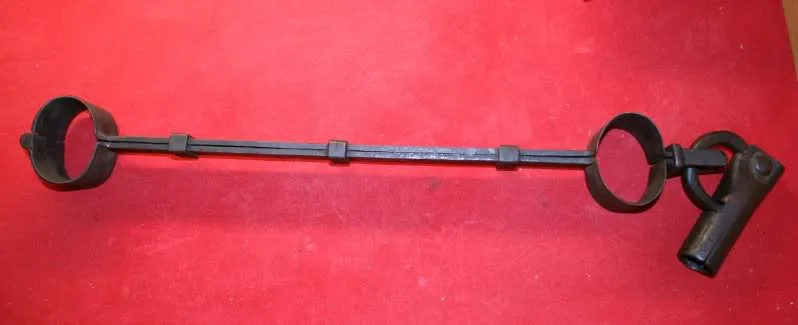
The first is a circa 1600's version of the Lilly iron and originated from the Bamberg region of Germany.

Due to the very small wrist holes it was no doubt intended for use on a woman and given the age of the restraint I am certain it was likely used during the infamous witch hunts which took place in the Bamberg region.

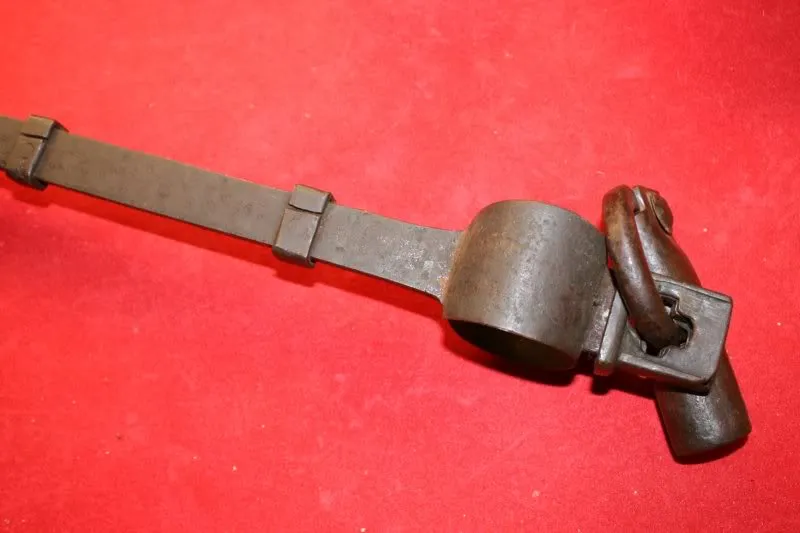
It it fitted with the common Medieval "cup" shackle method of fixing where either a padlock or a length of chain could be fed through the cross shaped end tabs and corresponding sleeve.

Most interesting on this hand iron are the 3 overlapping tabs which prevent the long body of the manacle from twisting from side to side.

Indeed, when the lock and sleeve are removed the entire upper section must be levered to one side free of the tabs before the cuff can be pulled open.

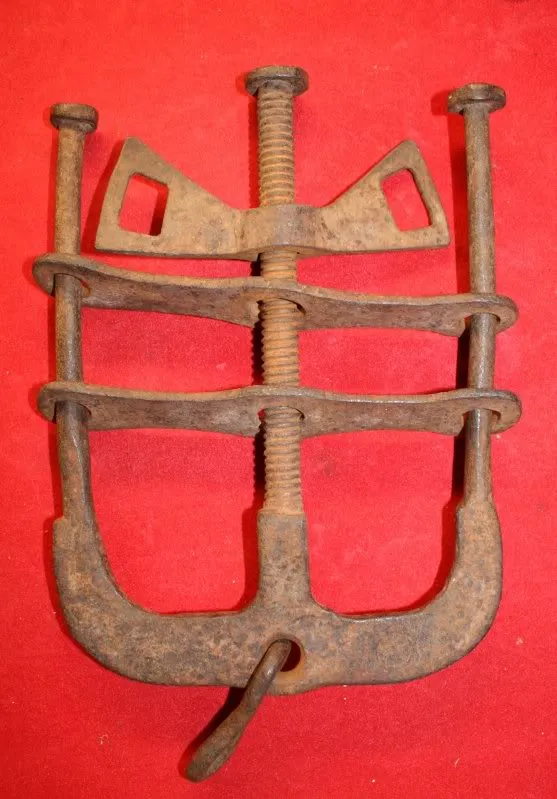
The second set of handcuffs pictured is in fact a combination handcuff/torture finger press device that functions not unlike a very large set of thumbscrews.

They are rare and date to the early 1500's.

The travelling torturer or executioner could use the restraint to lock in both wrists or they could put fingers or toes between the twin crushing plates and use the manacle as a torture instrument.

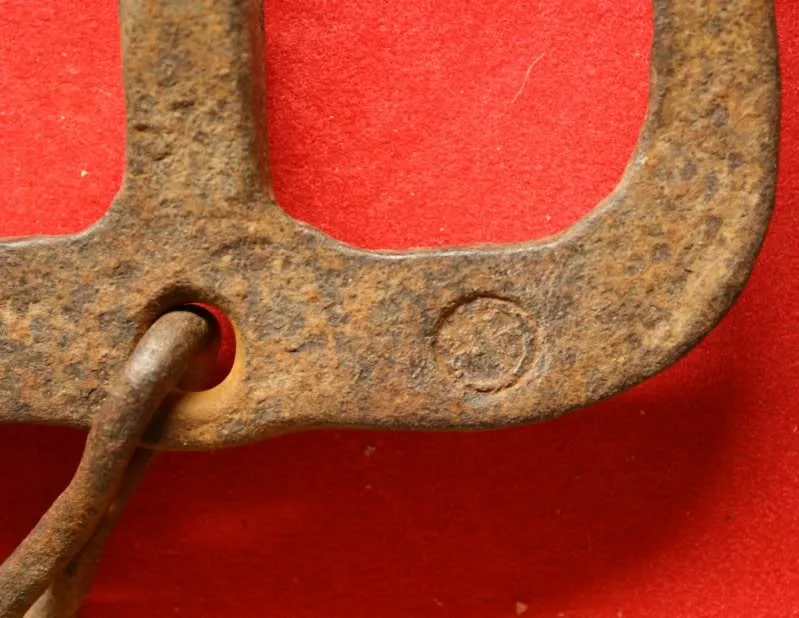
In the second pic you will see a spoked wheel stamp on the body of the restraint.

This design is in fact the "wheel of justice" and denotes that this device was owned by the executioner/torturer for the region.

One ancient form of capital punishment/torture was breaking the bones of a victim while they were spread on a large wheel and so the wheel became a symbol of Medieval justice across Germany. A number of German beheading swords and axes from this period also bear this mark.


Enjoy, Steve Santini


The Amazing Michael 25 Mar 2009
#2
Steve, these restraints are truly remarkable. I really like the Lilly-type cuff, WOW!!! I am more of a Civil War Era-Modern day cuff kind of guy, but these are very nice!!! Thanks for sharing!!! =)

Cheers, Mike D~C/
Steve Santini 25 Mar 2009
#3
For the benefit of our European collectors, and indeed, all other serious collectors, I am posting pics of 2 very old and very rare German handcuffs in my collection.

Both date to the Medieval period.

The first is a circa 1600's version of the Lilly iron and originated from the Bamberg region of Germany.

Due to the very small wrist holes it was no doubt intended for use on a woman and given the age of the restraint I am certain it was likely used during the infamous witch hunts which took place in the Bamberg region.

It it fitted with the common Medieval "cup" shackle method of fixing where either a padlock or a length of chain could be fed through the cross shaped end tabs and corresponding sleeve.

Most interesting on this hand iron are the 3 overlapping tabs which prevent the long body of the manacle from twisting from side to side.

Indeed, when the lock and sleeve are removed the entire upper section must be levered to one side free of the tabs before the cuff can be pulled open.

The second set of handcuffs pictured is in fact a combination handcuff/torture finger press device that functions not unlike a very large set of thumbscrews.

They are rare and date to the early 1500's.

The travelling torturer or executioner could use the restraint to lock in both wrists or they could put fingers or toes between the twin crushing plates and use the manacle as a torture instrument.

In the second pic you will see a spoked wheel stamp on the body of the restraint.

This design is in fact the "wheel of justice" and denotes that this device was owned by the executioner/torturer for the region.

One ancient form of capital punishment/torture was breaking the bones of a victim while they were spread on a large wheel and so the wheel became a symbol of Medieval justice across Germany. A number of German beheading swords and axes from this period also bear this mark.


Enjoy, Steve Santini

Click to expand...
Mike; thanks for the kind words.

As you yourself know, a number of years ago I shifted my personal collecting interests to Medieval and ancient restraints and instruments of torture/punishment.

As it turns out, ancient restraints such as these are VERY hard to find.

Strangely, it seems far easier to find Medieval period leg shackles and irons than it is to find hand manacles and cuffs.

From my research I believe this was because wrist irons must be more adjustable than leg shackles and many prisoners likely had thier hands bound with rope or chain as it could be adjusted to size.

I have other such ancient restraints but until now I have not posted pics to the site.

My oldest to date is a set of late Roman leg irons and padlock very similiar to those found on archaeological digs in Europe.

Luckilly, the set I have were never in the ground and so are in fine condition.

Cheers, Steve

Ron Spitz 25 Mar 2009
#4
For the benefit of our European collectors, and indeed, all other serious collectors, I am posting pics of 2 very old and very rare German handcuffs in my collection.

Both date to the Medieval period.

The first is a circa 1600's version of the Lilly iron and originated from the Bamberg region of Germany.

Due to the very small wrist holes it was no doubt intended for use on a woman and given the age of the restraint I am certain it was likely used during the infamous witch hunts which took place in the Bamberg region.

It it fitted with the common Medieval "cup" shackle method of fixing where either a padlock or a length of chain could be fed through the cross shaped end tabs and corresponding sleeve.

Most interesting on this hand iron are the 3 overlapping tabs which prevent the long body of the manacle from twisting from side to side.

Indeed, when the lock and sleeve are removed the entire upper section must be levered to one side free of the tabs before the cuff can be pulled open.

The second set of handcuffs pictured is in fact a combination handcuff/torture finger press device that functions not unlike a very large set of thumbscrews.

They are rare and date to the early 1500's.

The travelling torturer or executioner could use the restraint to lock in both wrists or they could put fingers or toes between the twin crushing plates and use the manacle as a torture instrument.

In the second pic you will see a spoked wheel stamp on the body of the restraint.

This design is in fact the "wheel of justice" and denotes that this device was owned by the executioner/torturer for the region.

One ancient form of capital punishment/torture was breaking the bones of a victim while they were spread on a large wheel and so the wheel became a symbol of Medieval justice across Germany. A number of German beheading swords and axes from this period also bear this mark.


Enjoy, Steve Santini

Click to expand...
Steve,

Great items and thanks for posting them on the Forum. Too bad your book "Devices of Human Restraint", which is a good reference, does not have more of these older, rare devices. Hopefully you are considering a new or update to the book since the one I have is Volume 1.

I have a set of old Russian cuffs that I think came from your collection several years ago. They are quite different. Will try to get some pictures soon.

Ron
Steve Santini 25 Mar 2009
#5
For the benefit of our European collectors, and indeed, all other serious collectors, I am posting pics of 2 very old and very rare German handcuffs in my collection.

Both date to the Medieval period.

The first is a circa 1600's version of the Lilly iron and originated from the Bamberg region of Germany.

Due to the very small wrist holes it was no doubt intended for use on a woman and given the age of the restraint I am certain it was likely used during the infamous witch hunts which took place in the Bamberg region.

It it fitted with the common Medieval "cup" shackle method of fixing where either a padlock or a length of chain could be fed through the cross shaped end tabs and corresponding sleeve.

Most interesting on this hand iron are the 3 overlapping tabs which prevent the long body of the manacle from twisting from side to side.

Indeed, when the lock and sleeve are removed the entire upper section must be levered to one side free of the tabs before the cuff can be pulled open.

The second set of handcuffs pictured is in fact a combination handcuff/torture finger press device that functions not unlike a very large set of thumbscrews.

They are rare and date to the early 1500's.

The travelling torturer or executioner could use the restraint to lock in both wrists or they could put fingers or toes between the twin crushing plates and use the manacle as a torture instrument.

In the second pic you will see a spoked wheel stamp on the body of the restraint.

This design is in fact the "wheel of justice" and denotes that this device was owned by the executioner/torturer for the region.

One ancient form of capital punishment/torture was breaking the bones of a victim while they were spread on a large wheel and so the wheel became a symbol of Medieval justice across Germany. A number of German beheading swords and axes from this period also bear this mark.


Enjoy, Steve Santini

Click to expand...
I am seriously considering doing a book strictly on Ancient and/or Medieval restraints and related torture instruments.

I have drafted the outline but will ikely not self publish it due to prohibitive costs.

Perhaps Joe Lauher may wish to assist in the creation of such a book as a sort of "Handcuffs.org presents..."

The Annuals are so well done and so excellently printed that perhaps even the name of Joe's printer would be a help.

In Canada it is so darn expensive to self publish a fully pictorial volume, especially one done with full colour graphics and pics.

We shall see what will come of this idea...

Cheers, Steve

lauher 25 Mar 2009
#6
For the benefit of our European collectors, and indeed, all other serious collectors, I am posting pics of 2 very old and very rare German handcuffs in my collection.

Both date to the Medieval period.

The first is a circa 1600's version of the Lilly iron and originated from the Bamberg region of Germany.

Due to the very small wrist holes it was no doubt intended for use on a woman and given the age of the restraint I am certain it was likely used during the infamous witch hunts which took place in the Bamberg region.

It it fitted with the common Medieval "cup" shackle method of fixing where either a padlock or a length of chain could be fed through the cross shaped end tabs and corresponding sleeve.

Most interesting on this hand iron are the 3 overlapping tabs which prevent the long body of the manacle from twisting from side to side.

Indeed, when the lock and sleeve are removed the entire upper section must be levered to one side free of the tabs before the cuff can be pulled open.

The second set of handcuffs pictured is in fact a combination handcuff/torture finger press device that functions not unlike a very large set of thumbscrews.

They are rare and date to the early 1500's.

The travelling torturer or executioner could use the restraint to lock in both wrists or they could put fingers or toes between the twin crushing plates and use the manacle as a torture instrument.

In the second pic you will see a spoked wheel stamp on the body of the restraint.

This design is in fact the "wheel of justice" and denotes that this device was owned by the executioner/torturer for the region.

One ancient form of capital punishment/torture was breaking the bones of a victim while they were spread on a large wheel and so the wheel became a symbol of Medieval justice across Germany. A number of German beheading swords and axes from this period also bear this mark.


Enjoy, Steve Santini


Click to expand...
Publishing and printing a book is the easy part. The hard part is putting together the manuscript. I know . . I am way behind with my own efforts.

Seriously, I would be glad to help Steve or anyone who wants to do a book. All it takes are good ideas, good pictures and lots of time.

Joe.

Edgeplay_Cgo 25 Mar 2009
#7
For the benefit of our European collectors, and indeed, all other serious collectors, I am posting pics of 2 very old and very rare German handcuffs in my collection.

Both date to the Medieval period.

The first is a circa 1600's version of the Lilly iron and originated from the Bamberg region of Germany.

Due to the very small wrist holes it was no doubt intended for use on a woman and given the age of the restraint I am certain it was likely used during the infamous witch hunts which took place in the Bamberg region.

It it fitted with the common Medieval "cup" shackle method of fixing where either a padlock or a length of chain could be fed through the cross shaped end tabs and corresponding sleeve.

Most interesting on this hand iron are the 3 overlapping tabs which prevent the long body of the manacle from twisting from side to side.

Indeed, when the lock and sleeve are removed the entire upper section must be levered to one side free of the tabs before the cuff can be pulled open.

The second set of handcuffs pictured is in fact a combination handcuff/torture finger press device that functions not unlike a very large set of thumbscrews.

They are rare and date to the early 1500's.

The travelling torturer or executioner could use the restraint to lock in both wrists or they could put fingers or toes between the twin crushing plates and use the manacle as a torture instrument.

In the second pic you will see a spoked wheel stamp on the body of the restraint.

This design is in fact the "wheel of justice" and denotes that this device was owned by the executioner/torturer for the region.

One ancient form of capital punishment/torture was breaking the bones of a victim while they were spread on a large wheel and so the wheel became a symbol of Medieval justice across Germany. A number of German beheading swords and axes from this period also bear this mark.


Enjoy, Steve Santini


Click to expand...
Thanks for posting those, Steve.

I'm not understanding your description of the three wrapping bands on the Lilly type iron. It looks like they wrap completely around the bar. In order to open the cuff, they would need to be chiseled off. This would indicate to me, one of two possibilities.

Either the irons had been converted to a static display, sometime in antiquity, or more sinisterly that their last use was for an execution, probably an auto de fa. You wouldn't want to damage an expensive lock in the fire, so forged the cuffs on the victim. They could easily be retrieved after they had cooled, and chiseled apart.

The condition of the bar also indicates to me that the bands were only applied once. I see no chisel marks in the bar, nor do I see evidence that they had been repeatedly twisted apart.

They are definitely neat artifacts.

Iron has the disadvantage for the collector, that it was perishable, expensive, and recyclable. A lot of "junk" was returned to the smithy to be re-forged into other items. A lot more simply rusted away from neglect. So there's not so much of the stuff left to collect.

I would definitely like to see a book on Ancient and/or Medieval restraints. It is an interest of mine.

I have a f(r)iend who is self published on LuLu. He has several volumes out. It is a print on demand outfit that sells through Amazon. You get all the benefits of Amazon marketing. Apparently, it is not very expensive, but his works were all text. I don't even know if they can accommodate a photo intensive book. Being print on demand, you're not up front for all te press-work and warehousing. None of this accounts, however, for the absolutely massive work involved in setting up photo pages. That's something my late wife could have handled, but is way beyond my skill or patience level.

Anyhow, thanks again for posting the pix.

Steve Santini 25 Mar 2009
#8
For the benefit of our European collectors, and indeed, all other serious collectors, I am posting pics of 2 very old and very rare German handcuffs in my collection.

Both date to the Medieval period.

The first is a circa 1600's version of the Lilly iron and originated from the Bamberg region of Germany.

Due to the very small wrist holes it was no doubt intended for use on a woman and given the age of the restraint I am certain it was likely used during the infamous witch hunts which took place in the Bamberg region.

It it fitted with the common Medieval "cup" shackle method of fixing where either a padlock or a length of chain could be fed through the cross shaped end tabs and corresponding sleeve.

Most interesting on this hand iron are the 3 overlapping tabs which prevent the long body of the manacle from twisting from side to side.

Indeed, when the lock and sleeve are removed the entire upper section must be levered to one side free of the tabs before the cuff can be pulled open.

The second set of handcuffs pictured is in fact a combination handcuff/torture finger press device that functions not unlike a very large set of thumbscrews.

They are rare and date to the early 1500's.

The travelling torturer or executioner could use the restraint to lock in both wrists or they could put fingers or toes between the twin crushing plates and use the manacle as a torture instrument.

In the second pic you will see a spoked wheel stamp on the body of the restraint.

This design is in fact the "wheel of justice" and denotes that this device was owned by the executioner/torturer for the region.

One ancient form of capital punishment/torture was breaking the bones of a victim while they were spread on a large wheel and so the wheel became a symbol of Medieval justice across Germany. A number of German beheading swords and axes from this period also bear this mark.


Enjoy, Steve Santini


Click to expand...
The "stabilizer bands" on the Lilly shaped Medieval irons are just that... stabilizers.

They do not wrap all the way around and make a permanent restraint.

For burning at the stake as you mentioned often a chain around the waist or upper body was all that was used and sufficiently held the victim in place.

To use expensive to make irons like this for such a purpose would be too costly.

Irons like these were used in the dungeons, the torture chambers, and when arresting the accused or bringing them before the justice or court.

Particularly on those accused of witch craft as it was believed that only iron restraints, being made of elements that came out of the earth, could "bind" the evil powers of sorcery.

There are rigid types of irons like these still connected to the walls of the torture dungeon in Nuremberg, Germany.

Luckilly I have had the opportunity to see these and handle them firsthand.

Here are some pics of the way the bands on my irons function:


Cheers, Steve Santini


drmatty 25 Mar 2009
#9
For the benefit of our European collectors, and indeed, all other serious collectors, I am posting pics of 2 very old and very rare German handcuffs in my collection.

Both date to the Medieval period.

The first is a circa 1600's version of the Lilly iron and originated from the Bamberg region of Germany.

Due to the very small wrist holes it was no doubt intended for use on a woman and given the age of the restraint I am certain it was likely used during the infamous witch hunts which took place in the Bamberg region.

It it fitted with the common Medieval "cup" shackle method of fixing where either a padlock or a length of chain could be fed through the cross shaped end tabs and corresponding sleeve.

Most interesting on this hand iron are the 3 overlapping tabs which prevent the long body of the manacle from twisting from side to side.

Indeed, when the lock and sleeve are removed the entire upper section must be levered to one side free of the tabs before the cuff can be pulled open.

The second set of handcuffs pictured is in fact a combination handcuff/torture finger press device that functions not unlike a very large set of thumbscrews.

They are rare and date to the early 1500's.

The travelling torturer or executioner could use the restraint to lock in both wrists or they could put fingers or toes between the twin crushing plates and use the manacle as a torture instrument.

In the second pic you will see a spoked wheel stamp on the body of the restraint.

This design is in fact the "wheel of justice" and denotes that this device was owned by the executioner/torturer for the region.

One ancient form of capital punishment/torture was breaking the bones of a victim while they were spread on a large wheel and so the wheel became a symbol of Medieval justice across Germany. A number of German beheading swords and axes from this period also bear this mark.


Enjoy, Steve Santini


Click to expand...
Wow!!!!!

Just love them, and they are girl sized!!!

Dont think i can afford any like these so its off to the forge with some iron.

Would love to see more of your rare restraints

Matthew
http://www.shackledmaidens.com
The Amazing Michael 25 Mar 2009
#10
For the benefit of our European collectors, and indeed, all other serious collectors, I am posting pics of 2 very old and very rare German handcuffs in my collection.

Both date to the Medieval period.

The first is a circa 1600's version of the Lilly iron and originated from the Bamberg region of Germany.

Due to the very small wrist holes it was no doubt intended for use on a woman and given the age of the restraint I am certain it was likely used during the infamous witch hunts which took place in the Bamberg region.

It it fitted with the common Medieval "cup" shackle method of fixing where either a padlock or a length of chain could be fed through the cross shaped end tabs and corresponding sleeve.

Most interesting on this hand iron are the 3 overlapping tabs which prevent the long body of the manacle from twisting from side to side.

Indeed, when the lock and sleeve are removed the entire upper section must be levered to one side free of the tabs before the cuff can be pulled open.

The second set of handcuffs pictured is in fact a combination handcuff/torture finger press device that functions not unlike a very large set of thumbscrews.

They are rare and date to the early 1500's.

The travelling torturer or executioner could use the restraint to lock in both wrists or they could put fingers or toes between the twin crushing plates and use the manacle as a torture instrument.

In the second pic you will see a spoked wheel stamp on the body of the restraint.

This design is in fact the "wheel of justice" and denotes that this device was owned by the executioner/torturer for the region.

One ancient form of capital punishment/torture was breaking the bones of a victim while they were spread on a large wheel and so the wheel became a symbol of Medieval justice across Germany. A number of German beheading swords and axes from this period also bear this mark.


Enjoy, Steve Santini


Click to expand...
Wow, now that got Matthew's attention! LOL!

Steve, you should loan these Lilly style irons to Matthew for a photo shoot.....I would like to see that! =)

BTW, thanks for adding those new pics.....I was having the same problem as Dennis understanding how they worked.

Cheers, Mike D~C/
Steve Santini 25 Mar 2009
#11
For the benefit of our European collectors, and indeed, all other serious collectors, I am posting pics of 2 very old and very rare German handcuffs in my collection.

Both date to the Medieval period.

The first is a circa 1600's version of the Lilly iron and originated from the Bamberg region of Germany.

Due to the very small wrist holes it was no doubt intended for use on a woman and given the age of the restraint I am certain it was likely used during the infamous witch hunts which took place in the Bamberg region.

It it fitted with the common Medieval "cup" shackle method of fixing where either a padlock or a length of chain could be fed through the cross shaped end tabs and corresponding sleeve.

Most interesting on this hand iron are the 3 overlapping tabs which prevent the long body of the manacle from twisting from side to side.

Indeed, when the lock and sleeve are removed the entire upper section must be levered to one side free of the tabs before the cuff can be pulled open.

The second set of handcuffs pictured is in fact a combination handcuff/torture finger press device that functions not unlike a very large set of thumbscrews.

They are rare and date to the early 1500's.

The travelling torturer or executioner could use the restraint to lock in both wrists or they could put fingers or toes between the twin crushing plates and use the manacle as a torture instrument.

In the second pic you will see a spoked wheel stamp on the body of the restraint.

This design is in fact the "wheel of justice" and denotes that this device was owned by the executioner/torturer for the region.

One ancient form of capital punishment/torture was breaking the bones of a victim while they were spread on a large wheel and so the wheel became a symbol of Medieval justice across Germany. A number of German beheading swords and axes from this period also bear this mark.


Enjoy, Steve Santini


Click to expand...
And the only way he is getting the loan of any of my collection is if I am there onsite when he does his shoot.

Sort of as a "technical advisor".

Yeah,... that's it... "technical advisor".

LOL!

Steve

bookings@thedarkmaster.com
drmatty 25 Mar 2009
#12
For the benefit of our European collectors, and indeed, all other serious collectors, I am posting pics of 2 very old and very rare German handcuffs in my collection.

Both date to the Medieval period.

The first is a circa 1600's version of the Lilly iron and originated from the Bamberg region of Germany.

Due to the very small wrist holes it was no doubt intended for use on a woman and given the age of the restraint I am certain it was likely used during the infamous witch hunts which took place in the Bamberg region.

It it fitted with the common Medieval "cup" shackle method of fixing where either a padlock or a length of chain could be fed through the cross shaped end tabs and corresponding sleeve.

Most interesting on this hand iron are the 3 overlapping tabs which prevent the long body of the manacle from twisting from side to side.

Indeed, when the lock and sleeve are removed the entire upper section must be levered to one side free of the tabs before the cuff can be pulled open.

The second set of handcuffs pictured is in fact a combination handcuff/torture finger press device that functions not unlike a very large set of thumbscrews.

They are rare and date to the early 1500's.

The travelling torturer or executioner could use the restraint to lock in both wrists or they could put fingers or toes between the twin crushing plates and use the manacle as a torture instrument.

In the second pic you will see a spoked wheel stamp on the body of the restraint.

This design is in fact the "wheel of justice" and denotes that this device was owned by the executioner/torturer for the region.

One ancient form of capital punishment/torture was breaking the bones of a victim while they were spread on a large wheel and so the wheel became a symbol of Medieval justice across Germany. A number of German beheading swords and axes from this period also bear this mark.


Enjoy, Steve Santini


Click to expand...
"And the only way he is getting the loan of any of my collection is if I am there onsite when he does his shoot. "

Deal,,,,, just bring them over!!!!

that goes for anyone in the UK with interesting cuffs,, loan for,,,,, errr, tech advice.

Shame we missed out on this auction
http://www.telegraph.co.uk/news/uknews/ ... ammer.html
I found out what they sold for and cried

Matthew
http://www.shackledmaidens.com
Dorson 26 Mar 2009
#13
For the benefit of our European collectors, and indeed, all other serious collectors, I am posting pics of 2 very old and very rare German handcuffs in my collection.

Both date to the Medieval period.

The first is a circa 1600's version of the Lilly iron and originated from the Bamberg region of Germany.

Due to the very small wrist holes it was no doubt intended for use on a woman and given the age of the restraint I am certain it was likely used during the infamous witch hunts which took place in the Bamberg region.

It it fitted with the common Medieval "cup" shackle method of fixing where either a padlock or a length of chain could be fed through the cross shaped end tabs and corresponding sleeve.

Most interesting on this hand iron are the 3 overlapping tabs which prevent the long body of the manacle from twisting from side to side.

Indeed, when the lock and sleeve are removed the entire upper section must be levered to one side free of the tabs before the cuff can be pulled open.

The second set of handcuffs pictured is in fact a combination handcuff/torture finger press device that functions not unlike a very large set of thumbscrews.

They are rare and date to the early 1500's.

The travelling torturer or executioner could use the restraint to lock in both wrists or they could put fingers or toes between the twin crushing plates and use the manacle as a torture instrument.

In the second pic you will see a spoked wheel stamp on the body of the restraint.

This design is in fact the "wheel of justice" and denotes that this device was owned by the executioner/torturer for the region.

One ancient form of capital punishment/torture was breaking the bones of a victim while they were spread on a large wheel and so the wheel became a symbol of Medieval justice across Germany. A number of German beheading swords and axes from this period also bear this mark.


Enjoy, Steve Santini


Click to expand...
Apparently the reporter has a few facts wrong, as the location in Germany isn't near Berlin but down river from Mainz.... And I know this because I have been there several times...
Edgeplay_Cgo 26 Mar 2009
#14
For the benefit of our European collectors, and indeed, all other serious collectors, I am posting pics of 2 very old and very rare German handcuffs in my collection.

Both date to the Medieval period.

The first is a circa 1600's version of the Lilly iron and originated from the Bamberg region of Germany.

Due to the very small wrist holes it was no doubt intended for use on a woman and given the age of the restraint I am certain it was likely used during the infamous witch hunts which took place in the Bamberg region.

It it fitted with the common Medieval "cup" shackle method of fixing where either a padlock or a length of chain could be fed through the cross shaped end tabs and corresponding sleeve.

Most interesting on this hand iron are the 3 overlapping tabs which prevent the long body of the manacle from twisting from side to side.

Indeed, when the lock and sleeve are removed the entire upper section must be levered to one side free of the tabs before the cuff can be pulled open.

The second set of handcuffs pictured is in fact a combination handcuff/torture finger press device that functions not unlike a very large set of thumbscrews.

They are rare and date to the early 1500's.

The travelling torturer or executioner could use the restraint to lock in both wrists or they could put fingers or toes between the twin crushing plates and use the manacle as a torture instrument.

In the second pic you will see a spoked wheel stamp on the body of the restraint.

This design is in fact the "wheel of justice" and denotes that this device was owned by the executioner/torturer for the region.

One ancient form of capital punishment/torture was breaking the bones of a victim while they were spread on a large wheel and so the wheel became a symbol of Medieval justice across Germany. A number of German beheading swords and axes from this period also bear this mark.


Enjoy, Steve Santini


Click to expand...
Thanks, Steve. The workings of the bands are perfectly clear to me now. And I agree with your conclusions.

For practical purposes, a rope would be adequate restraint for a burning. By the time the rope burned, the victim would be toast. That leaves out the superstitious aspects, of course.

Dorson 27 Mar 2009
#15
For the benefit of our European collectors, and indeed, all other serious collectors, I am posting pics of 2 very old and very rare German handcuffs in my collection.

Both date to the Medieval period.

The first is a circa 1600's version of the Lilly iron and originated from the Bamberg region of Germany.

Due to the very small wrist holes it was no doubt intended for use on a woman and given the age of the restraint I am certain it was likely used during the infamous witch hunts which took place in the Bamberg region.

It it fitted with the common Medieval "cup" shackle method of fixing where either a padlock or a length of chain could be fed through the cross shaped end tabs and corresponding sleeve.

Most interesting on this hand iron are the 3 overlapping tabs which prevent the long body of the manacle from twisting from side to side.

Indeed, when the lock and sleeve are removed the entire upper section must be levered to one side free of the tabs before the cuff can be pulled open.

The second set of handcuffs pictured is in fact a combination handcuff/torture finger press device that functions not unlike a very large set of thumbscrews.

They are rare and date to the early 1500's.

The travelling torturer or executioner could use the restraint to lock in both wrists or they could put fingers or toes between the twin crushing plates and use the manacle as a torture instrument.

In the second pic you will see a spoked wheel stamp on the body of the restraint.

This design is in fact the "wheel of justice" and denotes that this device was owned by the executioner/torturer for the region.

One ancient form of capital punishment/torture was breaking the bones of a victim while they were spread on a large wheel and so the wheel became a symbol of Medieval justice across Germany. A number of German beheading swords and axes from this period also bear this mark.


Enjoy, Steve Santini


Click to expand...
In that article about the dungeon equipment that was auctioned off, I have some doubts as to how authentic the stuff really is... Something about the fabrication of some of the items seem more modern and other little details make me question. I'm thinking some of the stuff is reproduction items that might have been created for amusement purposes than actual use.
Steve Santini 27 Mar 2009
#16
For the benefit of our European collectors, and indeed, all other serious collectors, I am posting pics of 2 very old and very rare German handcuffs in my collection.

Both date to the Medieval period.

The first is a circa 1600's version of the Lilly iron and originated from the Bamberg region of Germany.

Due to the very small wrist holes it was no doubt intended for use on a woman and given the age of the restraint I am certain it was likely used during the infamous witch hunts which took place in the Bamberg region.

It it fitted with the common Medieval "cup" shackle method of fixing where either a padlock or a length of chain could be fed through the cross shaped end tabs and corresponding sleeve.

Most interesting on this hand iron are the 3 overlapping tabs which prevent the long body of the manacle from twisting from side to side.

Indeed, when the lock and sleeve are removed the entire upper section must be levered to one side free of the tabs before the cuff can be pulled open.

The second set of handcuffs pictured is in fact a combination handcuff/torture finger press device that functions not unlike a very large set of thumbscrews.

They are rare and date to the early 1500's.

The travelling torturer or executioner could use the restraint to lock in both wrists or they could put fingers or toes between the twin crushing plates and use the manacle as a torture instrument.

In the second pic you will see a spoked wheel stamp on the body of the restraint.

This design is in fact the "wheel of justice" and denotes that this device was owned by the executioner/torturer for the region.

One ancient form of capital punishment/torture was breaking the bones of a victim while they were spread on a large wheel and so the wheel became a symbol of Medieval justice across Germany. A number of German beheading swords and axes from this period also bear this mark.


Enjoy, Steve Santini


Click to expand...
Hi Dorson,

I was in touch with the auction house prior to the sale and saw some detailed pics of the devices.

By and large most of the items were reproductions.

Not made in the last 10 years and older certainly but no doubt fakes all the same.

Steve Santini