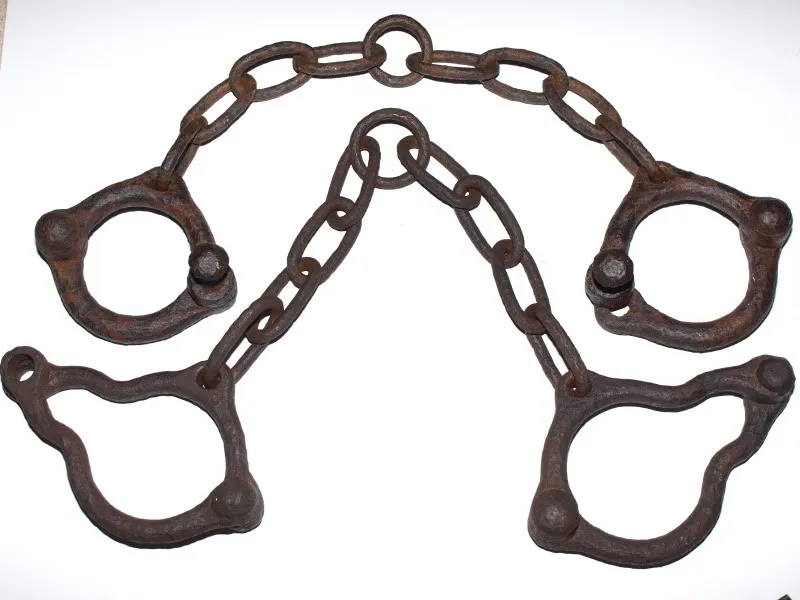
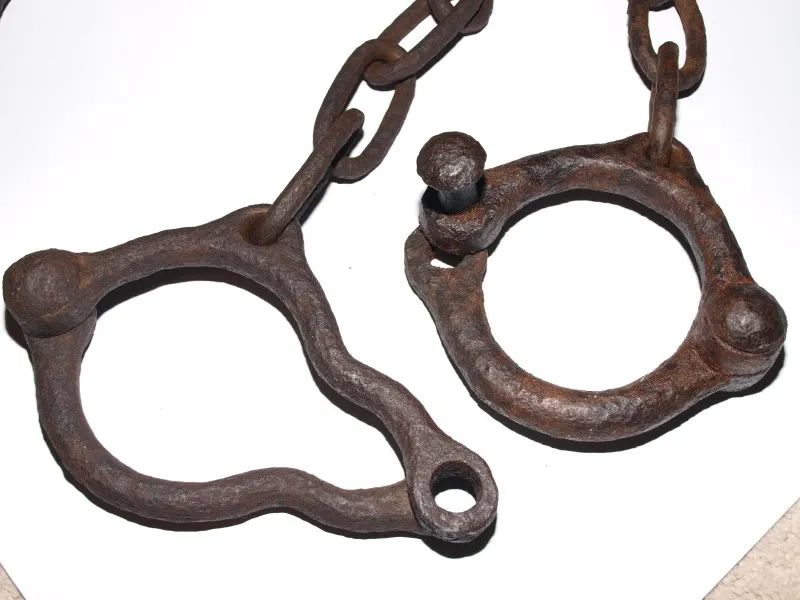
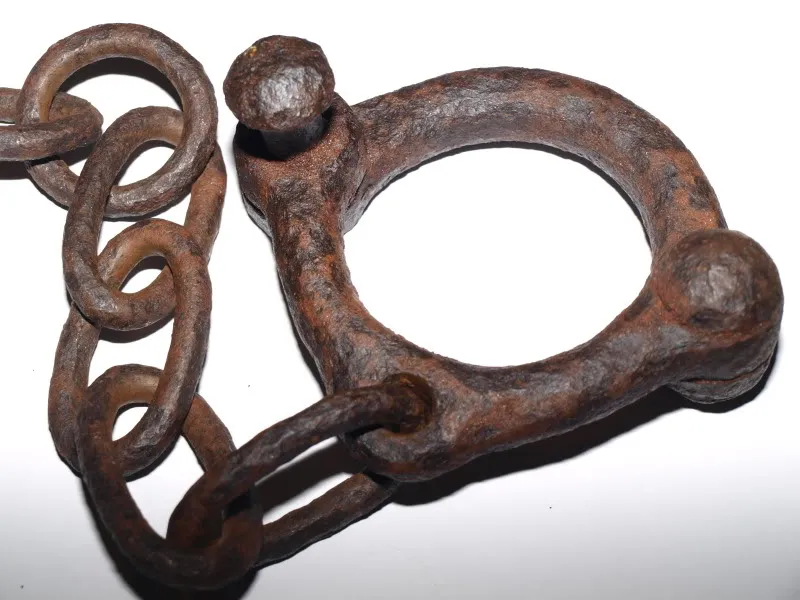
Here's a few pictures of a set of convict leg irons I have just purchased.
The round irons are a bit heavier than usual, but I don't think they would be classified as punishment irons, they weigh just over 6.5 pounds. The oval set only weigh 6 pounds.
As you can see in the photos, they are a bit rusty, and all of the cuffs are seized in their positions.
I'm looking for advise as to what, if anything, should be done to preserve these irons ?
Perhaps just keeping them in a warm, dry apartment is enough ? since they have managed to survive 200 years of unfavourable conditions already.
Thanks in advance,
Justin
Hi Paul:
Yes, there is a sparking test for wrought iron, but the sparks produced by a grinder are mainly indicating the carbon content of the metal. Pure iron is brittle, but with around a 0.5% carbon content, it becomes quite malleable. As the carbon content increases (and thus the number of sparks produced by the grinding wheel) the iron becomes harder but less malleable; by the time the carbon reached around 1%, they called it steel (even though it was originally produced by the wroughting process). With iron, too much of a good thing (carbon) becomes a bad thing and if the carbon content was around 2% or greater the iron goes back to being brittle. In the old days, they had no specific name for that, although it later was called pig iron.
The distinguishing thing about wrought iron is that it has both a grain and a texture, both resulting from the way it was smelted. Going back to Roman times, the hottest fires they had were ones made of charcoal, but these were not hot enough to bring the iron to a molten state. After most of the excess impurities in iron ore were smelted out, the resulting lump (called a bloom) was full of irregularly sized and shaped air pockets, much like the inside of a loaf of homemade bread.
That's were the wroughting came into play. With the bloom as hot as they could get it, they started hammering away (i.e. wroughting) on it to eliminate the air pockets to create what they called a billet. As the billet flattened out, they'd fold it in half and hammer some more, fold again, hammer some more, and so on. What was happening at the microscopic level was not that the iron was melting and fusing together, but the iron fibers (being in a hot plastic state) were intertwining with one another as well as the silicate fibers which further acted as sort of a glue to hold stuff together. By analogy, wroughting produces a form of metallic plywood. However, those original air pockets in the bloom were never completely eliminated; they were just flattened out, leaving a surface texture on the iron. Thus, the little shallow pits you see one the surface of wrought iron are not the result of surface rusting, but the wroughting process itself. Because those flattened out air pockets are dispersed throughout wrought iron making it porous, when subjected to friction, wrought iron will wear down faster than modern iron which has no such voids.
Additionally, during the wroughting process, excess carbon would burn and flake off of the surface, which was one of the ways they got the carbon content down to the desired level.
If you want to get an idea of what that the surface texture of charcoal wrought iron looks like, just get a big, thick hunk of homemade bread, and flatten it out with a rolling pin.
Since each fold of the iron doubles the previous number of layers of iron, a billet folded and wrought 5 times will have 32 layers, 10 folds results in 1,024 layers while a billet with 20 folds has over a million layers. The more layers, the higher the quality of the finished iron.
After the billet was in a rectangular shape, they did not fold it in half the same way between wroughts, but would rotate the billet 90% to break up the folded layers into longitudinal sections. This resulted in the wrought iron having a grain, much like bamboo, which gives a springy quality to wrought iron that modern steel does not have. Unlike the modern stuff, wrought iron can be worked cold (i.e. not heated up first in a forge); it can be repeatedly bent around without breaking as will modern steel.
By using crucibles and bellows (and a lot of time), it is possible to actually melt iron with charcoal as a heat source, but only in small quantities. As such, except for very small items, you cannot cast charcoal wrought iron; that is, pour it in a mold since you never get it hot enough to melt.
In 1790, the puddling process for refining iron was perfected in England. Using coke for fuel as an indirect heat source in a draft furnace, they were able to bring the iron to a thick, molten state. In the furnace, they stirred the molten iron around, causing it to puddle into a ball of refined iron. Puddled iron, like charcoal iron, still has air pockets in it due to burned off impurities as well as ones introduced by the stirring, but they are generally smaller and more regular in size. Nonetheless, the stuff still had to be wroughted to eliminate those air pockets. By this time, they were using mechanical means to do the wroughting, either a trip hammer (called drop forging) or rollers (called roll milling).
To get an idea of the surface texture of puddled iron, just flatten out another piece of bread on your kitchen counter, but use factory made bread (instead of homemade bread) which has a finer and more regular inside texture.
Of course, you can smooth off the surface texture of either charcoal iron or puddled iron with a file as did early locksmiths. However, this also removes the dark patina on the surface of the iron (the oxidation of the silicates) created in the forging process. That's why locksmiths were called whitesmiths in the old days; then they were done, the surface color of the iron was "white" rather than the "black" color left by the blacksmith.
Production of modern iron using the Bessemer process started in the United States in 1866. With it, the iron is entirely liquefied and poured into molds to form ingots or whatever. As such, all iron today starts out life by being cast. Also, it has no grain and the only surface texture it will have will be that left behind by the mold the thing is cast into.
Late 19th century modern iron salesmen did a really good job of screwing up the terminology. Iron with a 1% carbon content they still called steel, but they called the low carbon stuff wrought iron, even though it was never wroughted, while the crummier high carbon stuff they called cast iron.
You'll sometime see so-called "wrought iron" benches and chairs at home and garden centers, which is a lie since they're actually high carbon cast iron. If you want to add a little ambiance to your garden with one of these, don't drop it on the concrete parking lot while toting it to your car. The thing will probably break. While the term wrought iron originally designated a refining process, it now is sometimes used to denote a product (cast iron), which is why it's gotten a rather sorry reputation in modern times. While I've never done it, I would happily bet that if you can find a true wrought iron bench made back in the 18th century, you could drop it off the top of a multi-story building and not only would it not break, it would probably bounce.
Blacksmiths hated the modern Bessemer stuff. Not having a grain or any appreciable silicate content, they could not work the stuff as they could wrought iron, so they continued to demand the original article made the traditional way. And there were a lot of problems with that early Bessemer steel; it tended to crack when subjected to stress. While it was a lot cheaper than wrought iron, it was inferior for many applications, particularly tools of any sort that were subjected to stress.
In fact, when Gustave Eiffel constructed his famous tower in Paris, he demanded that only wrought iron being used, even though it was vastly more expensive than the modern stuff; he didn't want the thing cracking and breaking up in the wind. Before Bessemer got all the kinks worked out in his refining process, there were several catastrophic bridge failures in the U.S. due to the new stuff cracking and breaking.
So, for you British handcuff collectors out there, that's the reason you see some handcuffs (as well as iron tools) that are marked "genuine wrought" or "warranted wrought". These were made after Bessemer began producing modern steel, misleadingly calling the low carbon steel "wrought iron"(today, it's usually called mild steel). Ever wonder why manufacturers were giving a warranty of sorts on the type of iron they were using unless there was a fake variety floating around out there? Well, that's why. Accordingly, if you're got some cuffs with such a marking, you can bet they were made after 1880 or so when the modern blast furnace began appearing in England and Europe.
I apologize for the length of this post, but I've never figured out a short way to accurately describe this stuff. Hope it makes sense.
Franklin