OnlyCuffsOnlyCuffsarchive search
The Forum at Handcuffs.Org

Old Leg Shackles

64 visible archived posts · 64 preserved total · topic ID 3335
Original topic ↗Recovered images
Randall Ruby 08 Jan 2010
#1
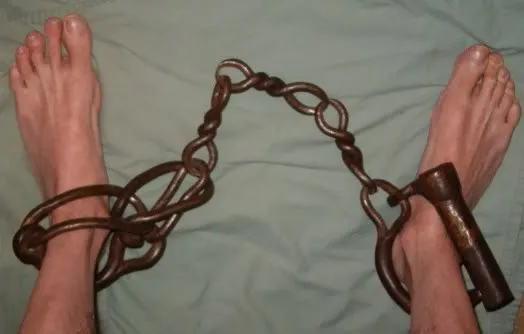
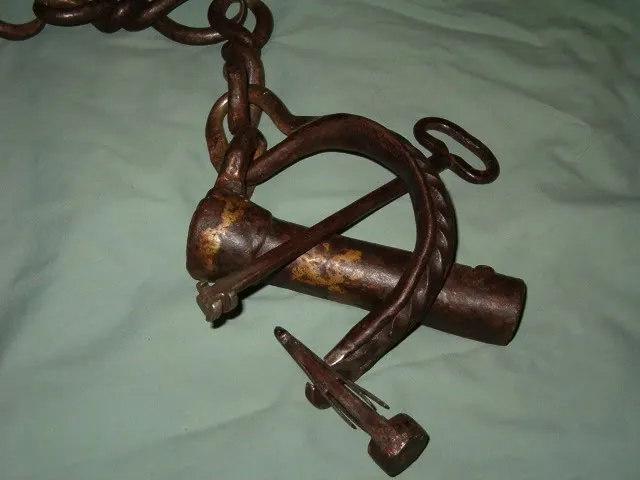
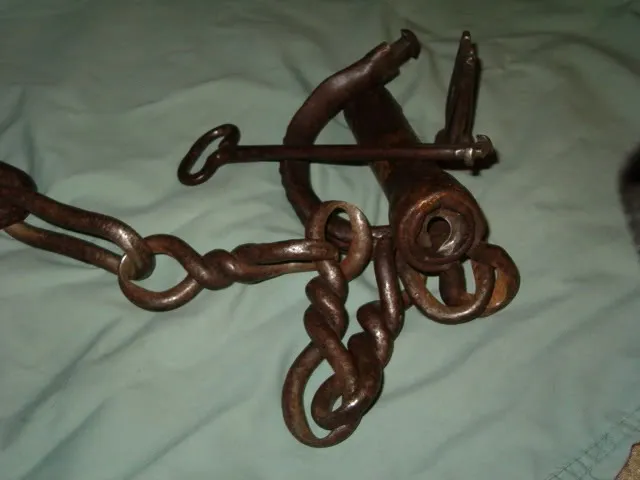
I got these for a Christmas present from my uncle. He knows I like weird stuff but he won't tell me where he got them just to tease me. All he told me is that the lock thing on the left is a puzzle lock and the one on the right is a spring wedge lock. In Googling I found this site and some blogs but the pictures were all gone. These seem to be really old. The ends of the chains are worn thin. Are they really leg shackles or something else? Does anyone know if these were used on slaves or in old prisons? To unlock them you screw the key inside the lock then slide it down to mash the springs on the wedge down and pull it out. You then have to weave everything else out through the other side to get it to come apart. If anyone knows anything about these I'd like to know. Thanks. RR

On the pictures, they're not really brown but more black and the gold stuff looks like smears of tarnished brass.


Steve Santini 09 Jan 2010
#2
Slave shackles but instead are bona fide Medieval period leg manacles.

They would have been used in European prisons and dungeons circa late 1600's to late 1700's.

The hand forged ankle shackles made for slaves in North America usually tend to be lighter weight in construction.

Steve Santini
axylon 09 Jan 2010
#3
I got these for a Christmas present from my uncle. He knows I like weird stuff but he won't tell me where he got them just to tease me. All he told me is that the lock thing on the left is a puzzle lock and the one on the right is a spring wedge lock. In Googling I found this site and some blogs but the pictures were all gone. These seem to be really old. The ends of the chains are worn thin. Are they really leg shackles or something else? Does anyone know if these were used on slaves or in old prisons? To unlock them you screw the key inside the lock then slide it down to mash the springs on the wedge down and pull it out. You then have to weave everything else out through the other side to get it to come apart. If anyone knows anything about these I'd like to know. Thanks. RR

On the pictures, they're not really brown but more black and the gold stuff looks like smears of tarnished brass.


Click to expand...
they certainly look like genuinely antique shackles to me. I wonder why some chain links appear worn thin. My first though was that it would be from rubbing on the next link, but the next link does not look to be similarly thinned.
Dorson 09 Jan 2010
#4
I got these for a Christmas present from my uncle. He knows I like weird stuff but he won't tell me where he got them just to tease me. All he told me is that the lock thing on the left is a puzzle lock and the one on the right is a spring wedge lock. In Googling I found this site and some blogs but the pictures were all gone. These seem to be really old. The ends of the chains are worn thin. Are they really leg shackles or something else? Does anyone know if these were used on slaves or in old prisons? To unlock them you screw the key inside the lock then slide it down to mash the springs on the wedge down and pull it out. You then have to weave everything else out through the other side to get it to come apart. If anyone knows anything about these I'd like to know. Thanks. RR

On the pictures, they're not really brown but more black and the gold stuff looks like smears of tarnished brass.


Click to expand...
Wilson, the reason is fairly simple really. The type of metal is wrought/forged iron, not steel. Ordinary steel will continue to rust to the core, whereas, wrought iron develops a surface rust which acts as a protective coat to prevent further corrosion. Since the parts that were constantly rubbing and hence wearing off the protective finish of protective rust off in an ongoing process over time caused the metal to become thin in those areas. One good example of bare metal that is exposed to the elements and is not painted and still standing and in operation is the Eiffel Tower in Paris, France. It is not constructed of steel but of wrought iron.
Edgeplay_Cgo 10 Jan 2010
#5
I got these for a Christmas present from my uncle. He knows I like weird stuff but he won't tell me where he got them just to tease me. All he told me is that the lock thing on the left is a puzzle lock and the one on the right is a spring wedge lock. In Googling I found this site and some blogs but the pictures were all gone. These seem to be really old. The ends of the chains are worn thin. Are they really leg shackles or something else? Does anyone know if these were used on slaves or in old prisons? To unlock them you screw the key inside the lock then slide it down to mash the springs on the wedge down and pull it out. You then have to weave everything else out through the other side to get it to come apart. If anyone knows anything about these I'd like to know. Thanks. RR

On the pictures, they're not really brown but more black and the gold stuff looks like smears of tarnished brass.


Click to expand...
I'm semi convinced there are modern, possibly Indian, smiths making hand forged shackles for the tourist trade. There are "too many" hand forged pairs floating around on eBay.

But I'm satisfied that yours are probably authentic. The ropework on the shackle bow is the sort of detail that an old-time smith might add, just for the hell of it, that marks them as his work. They are very nice puzzle lock irons. The puzzle lock was used to avoid the expense of making two locks.

The lock barrel on yours appears to have been repaired by brazing, possibly to fill rust-throughs or other casualties of time.

They're nice leg irons.
Steve Santini 10 Jan 2010
#6
I got these for a Christmas present from my uncle. He knows I like weird stuff but he won't tell me where he got them just to tease me. All he told me is that the lock thing on the left is a puzzle lock and the one on the right is a spring wedge lock. In Googling I found this site and some blogs but the pictures were all gone. These seem to be really old. The ends of the chains are worn thin. Are they really leg shackles or something else? Does anyone know if these were used on slaves or in old prisons? To unlock them you screw the key inside the lock then slide it down to mash the springs on the wedge down and pull it out. You then have to weave everything else out through the other side to get it to come apart. If anyone knows anything about these I'd like to know. Thanks. RR

On the pictures, they're not really brown but more black and the gold stuff looks like smears of tarnished brass.


Click to expand...
These have not been repaired by braizing.

The brass smears that appears on the lock tube are in fact how these types of irons were commonly put together in old times. (In fact, so were a number of older plug lock cuffs and leg irons).

As oppossed to forge welding where the smith would hammer join two pieces of iron, the use of brass shims in between iron sections to be joined was a common way of forging together parts.

An early type of soldering similiar to that used in modern times by plumbers when pipe fitting and joining.

Thin brass sheets or shims would be put between parts to be joined and these would then be clamped together. The entire thing would then be put in the forge and as brass melts at a lower tempertature than iron it would melt and form a weld bewteen the iron parts.

The brass would frequently run off over the iron body of the restraint creating the "smears" that can be seen on this set of irons.

I will be explaining this old time process of manufacturing restraints in my coming book on ancient restraints and instruments of torture.

Steve Santini
Steve Santini 10 Jan 2010
#7
I got these for a Christmas present from my uncle. He knows I like weird stuff but he won't tell me where he got them just to tease me. All he told me is that the lock thing on the left is a puzzle lock and the one on the right is a spring wedge lock. In Googling I found this site and some blogs but the pictures were all gone. These seem to be really old. The ends of the chains are worn thin. Are they really leg shackles or something else? Does anyone know if these were used on slaves or in old prisons? To unlock them you screw the key inside the lock then slide it down to mash the springs on the wedge down and pull it out. You then have to weave everything else out through the other side to get it to come apart. If anyone knows anything about these I'd like to know. Thanks. RR

On the pictures, they're not really brown but more black and the gold stuff looks like smears of tarnished brass.


Click to expand...
While it true there are East Indian makers of similiar irons around, the Indian versions can be spotted a million miles away due to their cruder manufacturing methods. They are never as well and cleanly finished as true ancient European or early American made restraints.

As for there being "too many" of these sorts of restraints showing up on Ebay and the thought that this somehow lends itself to support the theory that they must be fake, allow me to say that old, ancient, and hand forged restraints and my exclusive collecting forte these days and because of this I am always hunting for such things. I myself have not seen all that many such restraints.

And even if there were a glut of them appearing on ebay, it is only logical when one remembers that such irons were made by many makers in many countries in the same basic style for centuries.

This is like saying because there is a set or 2 of Towers cuffs on ebay every week there must be fakes being made.

Speaking of Towers D.L. cuffs, just take a look at how many pairs do appear. And this is from a firm that was not around for more than 100 years!

Now take primitive irons. Made by countless smiths in numerous countries for hundreds of years.

One should expect to see them appear with a good deal of frequency and yet, real and authentic ones are seen far less than Towers or Darbies.

Another thing about the Indian replicas is that I have yet to see an Indian replica with, 1) Both the screw keys and spring wedge mechanisms appearing in one lock body, as is often seen in authentic old restraints, and, 2) All of the Indian replicas I have seen take an internally threaded tube Darby type key. There are certainly externally threaded key Indian padlocks out there but I have yet to see any restraints of note.

Steve Santini
Randall Ruby 10 Jan 2010
#8
I got these for a Christmas present from my uncle. He knows I like weird stuff but he won't tell me where he got them just to tease me. All he told me is that the lock thing on the left is a puzzle lock and the one on the right is a spring wedge lock. In Googling I found this site and some blogs but the pictures were all gone. These seem to be really old. The ends of the chains are worn thin. Are they really leg shackles or something else? Does anyone know if these were used on slaves or in old prisons? To unlock them you screw the key inside the lock then slide it down to mash the springs on the wedge down and pull it out. You then have to weave everything else out through the other side to get it to come apart. If anyone knows anything about these I'd like to know. Thanks. RR

On the pictures, they're not really brown but more black and the gold stuff looks like smears of tarnished brass.


Click to expand...
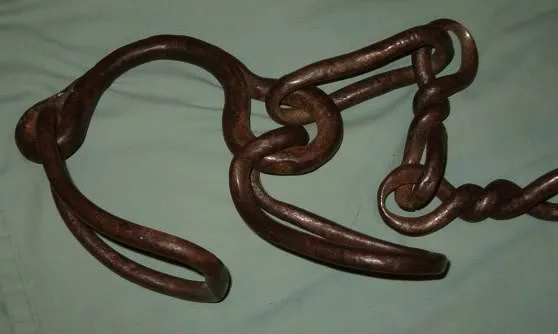
Thanks for all the information. I thought these were old but didn't think they were that old. The chain links in the middle are worn down very thin. Here's a better picture.


The brass smears are also inside the lock tube (don't know how to take a picture of that) along the seam on the bottom. It looks like they took a flat piece of metal and bent it into a tube with the ends overlapping and soldered it together. The more I mess with these things the cooler they get. I showed them to a friend of mine last night whose into Goth and she totally freaked. Did they also make smaller versions of these as handcuffs? RR
Steve Santini 10 Jan 2010
#9
I got these for a Christmas present from my uncle. He knows I like weird stuff but he won't tell me where he got them just to tease me. All he told me is that the lock thing on the left is a puzzle lock and the one on the right is a spring wedge lock. In Googling I found this site and some blogs but the pictures were all gone. These seem to be really old. The ends of the chains are worn thin. Are they really leg shackles or something else? Does anyone know if these were used on slaves or in old prisons? To unlock them you screw the key inside the lock then slide it down to mash the springs on the wedge down and pull it out. You then have to weave everything else out through the other side to get it to come apart. If anyone knows anything about these I'd like to know. Thanks. RR

On the pictures, they're not really brown but more black and the gold stuff looks like smears of tarnished brass.


Click to expand...
Hi,

Yes, they also made smaller versions for wrists and also neck collars using the same manufacturing technology.

It is only logical to see the most of the brass around the seam of the lock tube.

You are correct that this is how they forged the tube together after it had been rolled.

Of course in ancient times they could not just go out and buy ready made pipe and so they had to make it.

I have several pairs like yours and I must agree... they are very cool!

One set I have, that date to the late Roman period, have the same brass smears around the original padlock that secures them and chain links that are worn razor thin. It is amazing they still hold!

Cheers, Steve


johanahlberg 10 Jan 2010
#10
I got these for a Christmas present from my uncle. He knows I like weird stuff but he won't tell me where he got them just to tease me. All he told me is that the lock thing on the left is a puzzle lock and the one on the right is a spring wedge lock. In Googling I found this site and some blogs but the pictures were all gone. These seem to be really old. The ends of the chains are worn thin. Are they really leg shackles or something else? Does anyone know if these were used on slaves or in old prisons? To unlock them you screw the key inside the lock then slide it down to mash the springs on the wedge down and pull it out. You then have to weave everything else out through the other side to get it to come apart. If anyone knows anything about these I'd like to know. Thanks. RR

On the pictures, they're not really brown but more black and the gold stuff looks like smears of tarnished brass.


Click to expand...
Hi.

Steve is right. This metod of soldering parts is old. The soldering methods with brass is known back more than 2500 years. Old restraints and padlock are amzingly forged by master blacksmiths and if you think for a minute how crude their tools where its fantastic how they could fabricate these fine works.

I also collect old padlocks and I have some handforged made by Swedish black or gunsmiths some locks dates back to 1500-1600 and still works! You cant find anything like it made in India.

I agre these legirons they are indeed old. I have the same type of lockmechnism in an old padlock, key works in the same way pressing down two springs. To enter the lock opening the key has to pass a theraded way. This makes it hard to pick or to get another key inside the barell.

Johan Ahlberg
Sweden
Franklin 10 Jan 2010
#11
I got these for a Christmas present from my uncle. He knows I like weird stuff but he won't tell me where he got them just to tease me. All he told me is that the lock thing on the left is a puzzle lock and the one on the right is a spring wedge lock. In Googling I found this site and some blogs but the pictures were all gone. These seem to be really old. The ends of the chains are worn thin. Are they really leg shackles or something else? Does anyone know if these were used on slaves or in old prisons? To unlock them you screw the key inside the lock then slide it down to mash the springs on the wedge down and pull it out. You then have to weave everything else out through the other side to get it to come apart. If anyone knows anything about these I'd like to know. Thanks. RR

On the pictures, they're not really brown but more black and the gold stuff looks like smears of tarnished brass.


Click to expand...
Hi Randall:

If your uncle is interested in adopting another nephew who likes this sort of weird stuff, let him know I'm available (my birthday is in April).

For some examples of your type of fetters, you might want to visit:
http://www.rigidcuff.com/2virgin.com/jmrobin/index.html
As you'll see, M. Robin has prepared an illustrated work on these items. Unfortunately, it's only available in French.

Old leg irons like yours, in good condition and in working order with the original key, are very difficult to find, and it's nice to see you appreciate them. To me, one of the super neat things about them is the individually made locking mechanisms; while there are often similarities, no two are ever identical. Looking at pictures of them is one thing, but to actually have a set so that you can see all the details of their construction is something else entirely.

And, they are a lot of fun to play with.

Congratulations on getting them.

Franklin
Edgeplay_Cgo 11 Jan 2010
#12
I got these for a Christmas present from my uncle. He knows I like weird stuff but he won't tell me where he got them just to tease me. All he told me is that the lock thing on the left is a puzzle lock and the one on the right is a spring wedge lock. In Googling I found this site and some blogs but the pictures were all gone. These seem to be really old. The ends of the chains are worn thin. Are they really leg shackles or something else? Does anyone know if these were used on slaves or in old prisons? To unlock them you screw the key inside the lock then slide it down to mash the springs on the wedge down and pull it out. You then have to weave everything else out through the other side to get it to come apart. If anyone knows anything about these I'd like to know. Thanks. RR

On the pictures, they're not really brown but more black and the gold stuff looks like smears of tarnished brass.


Click to expand...
An early type of soldering similiar to that used in modern times by plumbers when pipe fitting and joining

Hmmmm! A medieval form of brazing. Thanks. I wasn't aware of that process. It makes sense. There's no reason a smith couldn't forge braze. It would make for expensive cuffs, but everything was expensive.

As for the modern copies, I have a couple of pair of hand forged irons that I'm suspicious of,. because of the locks. They aren't the "official slave irons" stuff. They're blacksmith made, one with a spring lock, one with a Darby type screw lock. At least one has wear patterns similar to the irons under discussion. I paid repro prices for them, so I'll not be upset whichever way they are.

But I'm no longer convinced that hand forged = authentic.


Unknown / guest 11 Jan 2010
#13
I got these for a Christmas present from my uncle. He knows I like weird stuff but he won't tell me where he got them just to tease me. All he told me is that the lock thing on the left is a puzzle lock and the one on the right is a spring wedge lock. In Googling I found this site and some blogs but the pictures were all gone. These seem to be really old. The ends of the chains are worn thin. Are they really leg shackles or something else? Does anyone know if these were used on slaves or in old prisons? To unlock them you screw the key inside the lock then slide it down to mash the springs on the wedge down and pull it out. You then have to weave everything else out through the other side to get it to come apart. If anyone knows anything about these I'd like to know. Thanks. RR

On the pictures, they're not really brown but more black and the gold stuff looks like smears of tarnished brass.


Click to expand...
Actually, thinking about the brazing some more, It was probably cheaper then forge welding a finicky lock tube. There's no technical reason why it could not have been welded, but it would be a major PITA.

johanahlberg 11 Jan 2010
#14
I got these for a Christmas present from my uncle. He knows I like weird stuff but he won't tell me where he got them just to tease me. All he told me is that the lock thing on the left is a puzzle lock and the one on the right is a spring wedge lock. In Googling I found this site and some blogs but the pictures were all gone. These seem to be really old. The ends of the chains are worn thin. Are they really leg shackles or something else? Does anyone know if these were used on slaves or in old prisons? To unlock them you screw the key inside the lock then slide it down to mash the springs on the wedge down and pull it out. You then have to weave everything else out through the other side to get it to come apart. If anyone knows anything about these I'd like to know. Thanks. RR

On the pictures, they're not really brown but more black and the gold stuff looks like smears of tarnished brass.


Click to expand...
Hi Dennis,

the reason they didnt weld the edges of the tube is that it requieres a lot of heath until the metal nearly evapourate and a blow with the hammer to join it. The metal is not so thick so its nearly impossible to weld it toghter. To use brass welding (soldering) is far more easy and it could be reopend. Today with modern gas welding euipment these kind of work is so easy compared to the old blacksmiths that had to put the metall in the fire.

yours

Johan Ahlberg
Franklin 11 Jan 2010
#15
I got these for a Christmas present from my uncle. He knows I like weird stuff but he won't tell me where he got them just to tease me. All he told me is that the lock thing on the left is a puzzle lock and the one on the right is a spring wedge lock. In Googling I found this site and some blogs but the pictures were all gone. These seem to be really old. The ends of the chains are worn thin. Are they really leg shackles or something else? Does anyone know if these were used on slaves or in old prisons? To unlock them you screw the key inside the lock then slide it down to mash the springs on the wedge down and pull it out. You then have to weave everything else out through the other side to get it to come apart. If anyone knows anything about these I'd like to know. Thanks. RR

On the pictures, they're not really brown but more black and the gold stuff looks like smears of tarnished brass.


Click to expand...
Brazing was a very common blacksmithing technique. Just about any time two thin pieces of iron had to be joined, or a thin piece to a thick piece, they were brazed. The only alternative was to rivet the pieces together, which would not have been nearly as strong.

Because of its porosity, wrought iron easily lends itself to brazing, either with brass or copper. Then as now, the process was easy. First clean the faces of the pieces to be joined, flux the joint, then bring the iron up to the melting point of the brazing material; as the flux burns off and the brazing material (either in the form of a thin rod or sheet) is melting while in contact with the hot iron, the flux literally sucks the molten brass into the joint. After the joint cools and the brazing material hardens, you're done. In essence, it could be described as a glued joint.

Even today, plumbers still routinely use this technique to "sweat" (solder) copper pipe together. My Dad taught me how to do it as a kid, and it still amazes me even today how the flux sucks the solder into the joint, even if the joint is upside down. The only trick to the technique is to use the heat of the copper pipe (not the torch flame) to melt the solder. In watching modern day welders braze items with a gas torch, they do the same thing: heating the iron to melt the brazing rod and not just melting the rod with the torch.

In some 19th century blacksmithing books I've read, borax was recommended as a flux for brazing.

As you can see in this picture, the threads of the left key were brazed into place using copper. On the right key, the thread tube and collar were brazed using brass.


And indeed, it's been used a long time. This is a Roman puzzle lock neck shackle and if you look carefully, you can see the traces of brass where the joint was made to create the loop on the shackle.


Even though brazing is simple and effective, with modern electro-welding equipment, it's no longer necessary. It's just another one of those old techniques that's disappearing.

Franklin
Steve Santini 11 Jan 2010
#16
I got these for a Christmas present from my uncle. He knows I like weird stuff but he won't tell me where he got them just to tease me. All he told me is that the lock thing on the left is a puzzle lock and the one on the right is a spring wedge lock. In Googling I found this site and some blogs but the pictures were all gone. These seem to be really old. The ends of the chains are worn thin. Are they really leg shackles or something else? Does anyone know if these were used on slaves or in old prisons? To unlock them you screw the key inside the lock then slide it down to mash the springs on the wedge down and pull it out. You then have to weave everything else out through the other side to get it to come apart. If anyone knows anything about these I'd like to know. Thanks. RR

On the pictures, they're not really brown but more black and the gold stuff looks like smears of tarnished brass.


Click to expand...
I thought I had said some of this already.

But Franklin has provided more details and this is appreciated.

By and large, the most common form of "flux" used for handforging or braze joining in ancient times was a mixture of sand and powdered micca (a mineral).

Steve Santini

rdc 12 Jan 2010
#17
I got these for a Christmas present from my uncle. He knows I like weird stuff but he won't tell me where he got them just to tease me. All he told me is that the lock thing on the left is a puzzle lock and the one on the right is a spring wedge lock. In Googling I found this site and some blogs but the pictures were all gone. These seem to be really old. The ends of the chains are worn thin. Are they really leg shackles or something else? Does anyone know if these were used on slaves or in old prisons? To unlock them you screw the key inside the lock then slide it down to mash the springs on the wedge down and pull it out. You then have to weave everything else out through the other side to get it to come apart. If anyone knows anything about these I'd like to know. Thanks. RR

On the pictures, they're not really brown but more black and the gold stuff looks like smears of tarnished brass.


Click to expand...
Franklin

Thanks for the additional info

What does that monster key on the right go to?
atlanta*casting 13 Jan 2010
#18
I got these for a Christmas present from my uncle. He knows I like weird stuff but he won't tell me where he got them just to tease me. All he told me is that the lock thing on the left is a puzzle lock and the one on the right is a spring wedge lock. In Googling I found this site and some blogs but the pictures were all gone. These seem to be really old. The ends of the chains are worn thin. Are they really leg shackles or something else? Does anyone know if these were used on slaves or in old prisons? To unlock them you screw the key inside the lock then slide it down to mash the springs on the wedge down and pull it out. You then have to weave everything else out through the other side to get it to come apart. If anyone knows anything about these I'd like to know. Thanks. RR

On the pictures, they're not really brown but more black and the gold stuff looks like smears of tarnished brass.


Click to expand...
"By and large, the most common form of "flux" used for handforging or braze joining in ancient times was a mixture of sand and powdered micca (a mineral)."

Steve Santini

Steve.
The key pictured in this post looks to have a seam or line running down one side. Is this what you
are talking about being where the key was formed then "brazed" ?


atlanta*casting 13 Jan 2010
#19
I got these for a Christmas present from my uncle. He knows I like weird stuff but he won't tell me where he got them just to tease me. All he told me is that the lock thing on the left is a puzzle lock and the one on the right is a spring wedge lock. In Googling I found this site and some blogs but the pictures were all gone. These seem to be really old. The ends of the chains are worn thin. Are they really leg shackles or something else? Does anyone know if these were used on slaves or in old prisons? To unlock them you screw the key inside the lock then slide it down to mash the springs on the wedge down and pull it out. You then have to weave everything else out through the other side to get it to come apart. If anyone knows anything about these I'd like to know. Thanks. RR

On the pictures, they're not really brown but more black and the gold stuff looks like smears of tarnished brass.


Click to expand...
Thanks for your information Franklin. I know how to sweat copper pipes together but have never
had any experience with iron.
Steve Santini 13 Jan 2010
#20
I got these for a Christmas present from my uncle. He knows I like weird stuff but he won't tell me where he got them just to tease me. All he told me is that the lock thing on the left is a puzzle lock and the one on the right is a spring wedge lock. In Googling I found this site and some blogs but the pictures were all gone. These seem to be really old. The ends of the chains are worn thin. Are they really leg shackles or something else? Does anyone know if these were used on slaves or in old prisons? To unlock them you screw the key inside the lock then slide it down to mash the springs on the wedge down and pull it out. You then have to weave everything else out through the other side to get it to come apart. If anyone knows anything about these I'd like to know. Thanks. RR

On the pictures, they're not really brown but more black and the gold stuff looks like smears of tarnished brass.


Click to expand...
The tube of the key was rolled and brazed.

What you are seeing is the seam.

Steve
Steve Santini 13 Jan 2010
#21
I got these for a Christmas present from my uncle. He knows I like weird stuff but he won't tell me where he got them just to tease me. All he told me is that the lock thing on the left is a puzzle lock and the one on the right is a spring wedge lock. In Googling I found this site and some blogs but the pictures were all gone. These seem to be really old. The ends of the chains are worn thin. Are they really leg shackles or something else? Does anyone know if these were used on slaves or in old prisons? To unlock them you screw the key inside the lock then slide it down to mash the springs on the wedge down and pull it out. You then have to weave everything else out through the other side to get it to come apart. If anyone knows anything about these I'd like to know. Thanks. RR

On the pictures, they're not really brown but more black and the gold stuff looks like smears of tarnished brass.


Click to expand...
This same type of seam and traces of brass on some very old Darby keys.

Mind you, the seam is often much better made.

Steve
johanahlberg 13 Jan 2010
#22
I got these for a Christmas present from my uncle. He knows I like weird stuff but he won't tell me where he got them just to tease me. All he told me is that the lock thing on the left is a puzzle lock and the one on the right is a spring wedge lock. In Googling I found this site and some blogs but the pictures were all gone. These seem to be really old. The ends of the chains are worn thin. Are they really leg shackles or something else? Does anyone know if these were used on slaves or in old prisons? To unlock them you screw the key inside the lock then slide it down to mash the springs on the wedge down and pull it out. You then have to weave everything else out through the other side to get it to come apart. If anyone knows anything about these I'd like to know. Thanks. RR

On the pictures, they're not really brown but more black and the gold stuff looks like smears of tarnished brass.


Click to expand...
Regarding these legirons there have been a lot of talk however it was intended for humans or for animals.

I know of one resacher in Stockholm that have specialised for years in the history of the wikings. He found, at a escavation in Birka, a similar legiron and he have a teori it was used on slaves that the wikings brought with them in their ships.

Nothing is new under the sun...


yours

Johan Ahlberg
Steve Santini 13 Jan 2010
#23
I got these for a Christmas present from my uncle. He knows I like weird stuff but he won't tell me where he got them just to tease me. All he told me is that the lock thing on the left is a puzzle lock and the one on the right is a spring wedge lock. In Googling I found this site and some blogs but the pictures were all gone. These seem to be really old. The ends of the chains are worn thin. Are they really leg shackles or something else? Does anyone know if these were used on slaves or in old prisons? To unlock them you screw the key inside the lock then slide it down to mash the springs on the wedge down and pull it out. You then have to weave everything else out through the other side to get it to come apart. If anyone knows anything about these I'd like to know. Thanks. RR

On the pictures, they're not really brown but more black and the gold stuff looks like smears of tarnished brass.


Click to expand...
The Romans also used similiar leg irons on slaves and prisoners and they have been found at numerous archaeological digs of Roman Ruins or settlements.

The basic form is very, very old and I have always had my doubts that most of these shackles were made for use on animals.

Certainly versions were made for animals but these tend to have a larger size and more singular design like the "camel shackles" coming out of the Middle East that are often attributed to being "slave shackles."

I have in my collection as assortment of shackle parts which were excavated from the ruins of the dungeons at a 14th century Lithunainian castle.

I have posted a pic of some of these broken shackle parts below.

What is interesting is that in this assortment there is one bow of a shackle with part of the spring wedge lock still attached and a number of these shackle components are very, very small in radius.

Far too small to be used on a large farm animal like a horse or cow.

Sadly, but likely very accurately, the smaller shackles were meant for use on the wrists of women or even children.

They are in fact that small.


rdc 14 Jan 2010
#24
I got these for a Christmas present from my uncle. He knows I like weird stuff but he won't tell me where he got them just to tease me. All he told me is that the lock thing on the left is a puzzle lock and the one on the right is a spring wedge lock. In Googling I found this site and some blogs but the pictures were all gone. These seem to be really old. The ends of the chains are worn thin. Are they really leg shackles or something else? Does anyone know if these were used on slaves or in old prisons? To unlock them you screw the key inside the lock then slide it down to mash the springs on the wedge down and pull it out. You then have to weave everything else out through the other side to get it to come apart. If anyone knows anything about these I'd like to know. Thanks. RR

On the pictures, they're not really brown but more black and the gold stuff looks like smears of tarnished brass.


Click to expand...
Steve Santini

I have heard of camel shackles. As the expert how do you tell them from slave shackles.
Steve Santini 14 Jan 2010
#25
I got these for a Christmas present from my uncle. He knows I like weird stuff but he won't tell me where he got them just to tease me. All he told me is that the lock thing on the left is a puzzle lock and the one on the right is a spring wedge lock. In Googling I found this site and some blogs but the pictures were all gone. These seem to be really old. The ends of the chains are worn thin. Are they really leg shackles or something else? Does anyone know if these were used on slaves or in old prisons? To unlock them you screw the key inside the lock then slide it down to mash the springs on the wedge down and pull it out. You then have to weave everything else out through the other side to get it to come apart. If anyone knows anything about these I'd like to know. Thanks. RR

On the pictures, they're not really brown but more black and the gold stuff looks like smears of tarnished brass.


Click to expand...
There are a few ways.

1) Camel shackles tend to be much larger round than human shackles.

2) Camel shackles tend to have the most ornate decorations engraved into them to identify an owner of a particular animal.

3) The actual camel shackles I have seen, identical to the one illustrated in "Manacles of the World" by Tom Gross, have an extra link or unusual way of linking on the "puzzle lock" side of the irons.

4) They also tend to have less of a sophisticated locking mechanism often incorporating a spring wedge lock but not a complex threaded key that is needed to compress the wedges. On one of the sets I once personally owned, there was no actual keyhole per say but instead two little holes on either side of the lock case. All one had to do was insert 2 small bits of wire and push and the thing was open.

Steve Santini
Steve Santini 14 Jan 2010
#26
I got these for a Christmas present from my uncle. He knows I like weird stuff but he won't tell me where he got them just to tease me. All he told me is that the lock thing on the left is a puzzle lock and the one on the right is a spring wedge lock. In Googling I found this site and some blogs but the pictures were all gone. These seem to be really old. The ends of the chains are worn thin. Are they really leg shackles or something else? Does anyone know if these were used on slaves or in old prisons? To unlock them you screw the key inside the lock then slide it down to mash the springs on the wedge down and pull it out. You then have to weave everything else out through the other side to get it to come apart. If anyone knows anything about these I'd like to know. Thanks. RR

On the pictures, they're not really brown but more black and the gold stuff looks like smears of tarnished brass.


Click to expand...
I do not claim to be an "expert."

I will leave that up to others to decide.

Rather, I have just made the collecting and study of hand forged early restraints and ancient instruments of torture my particular speciality for many years now.

There may very well be others who know more on the subject and perhaps even in this group.

Steve Santini
Dorson 14 Jan 2010
#27
I got these for a Christmas present from my uncle. He knows I like weird stuff but he won't tell me where he got them just to tease me. All he told me is that the lock thing on the left is a puzzle lock and the one on the right is a spring wedge lock. In Googling I found this site and some blogs but the pictures were all gone. These seem to be really old. The ends of the chains are worn thin. Are they really leg shackles or something else? Does anyone know if these were used on slaves or in old prisons? To unlock them you screw the key inside the lock then slide it down to mash the springs on the wedge down and pull it out. You then have to weave everything else out through the other side to get it to come apart. If anyone knows anything about these I'd like to know. Thanks. RR

On the pictures, they're not really brown but more black and the gold stuff looks like smears of tarnished brass.


Click to expand...
I would say it would be hard for any one person to be a total expert. There are way to many variables in collecting. Everyone here basically brings something a little bit different to the table and makes some sort of contribution. Collectively, you have the best resources I think anywhere on the internet right here. It is just a matter of asking the right question and hope the right person is listening as not everyone is constantly checking this site. I have noticed over the years that just when you think we know of every single type of restraint that exists, another one we knew nothing about pops up. The inventiveness of restraints continues to be ongoing.
Randall Ruby 14 Jan 2010
#28
I got these for a Christmas present from my uncle. He knows I like weird stuff but he won't tell me where he got them just to tease me. All he told me is that the lock thing on the left is a puzzle lock and the one on the right is a spring wedge lock. In Googling I found this site and some blogs but the pictures were all gone. These seem to be really old. The ends of the chains are worn thin. Are they really leg shackles or something else? Does anyone know if these were used on slaves or in old prisons? To unlock them you screw the key inside the lock then slide it down to mash the springs on the wedge down and pull it out. You then have to weave everything else out through the other side to get it to come apart. If anyone knows anything about these I'd like to know. Thanks. RR

On the pictures, they're not really brown but more black and the gold stuff looks like smears of tarnished brass.


Click to expand...
I told my uncle all the stuff Í'd learned about the shackles. He wants them back (just kidding) but told me where he got them. I went by yesterday to the antiques dealer and he told me he got them from a supplier in Belgium. Most of the stuff he sells is old military stuff from Europe. He told me that a big use of these were to punish petty criminals. They'd lock them up to a post with a sign telling the crime, like being drunk, so people could make fun of them and throw garbage at them and stuff. The puzzle shackle went on the post and the lock on the guys leg. Thats where the word pillory comes from, the post being called a pillar. That seems to explain why the links are worn so thin. There's still enough there to hold a guy for a few hours, but not a long time. It also made the punishment more fun for the public since the guy could kinda dodge around a little bit when people were throwing things at him. Thats maybe another reason the links are so worn down. The dealer told me that in early America, iron was really expensive so they used wooden stocks instead. He has two more sets with different type locks I'm thinking about buying. RR
Steve Santini 14 Jan 2010
#29
I got these for a Christmas present from my uncle. He knows I like weird stuff but he won't tell me where he got them just to tease me. All he told me is that the lock thing on the left is a puzzle lock and the one on the right is a spring wedge lock. In Googling I found this site and some blogs but the pictures were all gone. These seem to be really old. The ends of the chains are worn thin. Are they really leg shackles or something else? Does anyone know if these were used on slaves or in old prisons? To unlock them you screw the key inside the lock then slide it down to mash the springs on the wedge down and pull it out. You then have to weave everything else out through the other side to get it to come apart. If anyone knows anything about these I'd like to know. Thanks. RR

On the pictures, they're not really brown but more black and the gold stuff looks like smears of tarnished brass.


Click to expand...
That they are from Europe originally. Just as I had thought.

American irons like this made for use on slaves were lighter weight in construction.

While the irons you have may have been used into the slightly distant past, I believe they are in fact much older.

Like I said in an earlier post, from the late Medieval period.

Steve Santini

atlanta*casting 15 Jan 2010
#30
I got these for a Christmas present from my uncle. He knows I like weird stuff but he won't tell me where he got them just to tease me. All he told me is that the lock thing on the left is a puzzle lock and the one on the right is a spring wedge lock. In Googling I found this site and some blogs but the pictures were all gone. These seem to be really old. The ends of the chains are worn thin. Are they really leg shackles or something else? Does anyone know if these were used on slaves or in old prisons? To unlock them you screw the key inside the lock then slide it down to mash the springs on the wedge down and pull it out. You then have to weave everything else out through the other side to get it to come apart. If anyone knows anything about these I'd like to know. Thanks. RR

On the pictures, they're not really brown but more black and the gold stuff looks like smears of tarnished brass.


Click to expand...
Thanks Franklin and Steve for the info on key brazing.

I have had this old key in my collection for awhile and suspected it was somehow brazed at
the top but this helps to confirm it.


I have seen one similar to it listed with matching antique padlock online which fetched approx $400. - $600.
Franklin 15 Jan 2010
#31
I got these for a Christmas present from my uncle. He knows I like weird stuff but he won't tell me where he got them just to tease me. All he told me is that the lock thing on the left is a puzzle lock and the one on the right is a spring wedge lock. In Googling I found this site and some blogs but the pictures were all gone. These seem to be really old. The ends of the chains are worn thin. Are they really leg shackles or something else? Does anyone know if these were used on slaves or in old prisons? To unlock them you screw the key inside the lock then slide it down to mash the springs on the wedge down and pull it out. You then have to weave everything else out through the other side to get it to come apart. If anyone knows anything about these I'd like to know. Thanks. RR

On the pictures, they're not really brown but more black and the gold stuff looks like smears of tarnished brass.


Click to expand...
Hi Randall:

Glad to hear you're still having fun with your shackles. While they're neat, their history is nifty as well. It's also good to know you've found a knowledgeable dealer. If you pick up the other sets, be sure and post some pictures for us.

While today there is never any way to know exactly for sure how those old fetters were or were not used, I'm of the opinion that the post (pillar) to ankle means of shackling was perhaps more common than ankle to ankle. In olden times, jails were few and far between, so shackling of a prisoner to a post provided a cost effective means of detention and punishment. While many of these fetters are roughly of the same dimensions as modern day leg shackles, others have extraordinarily long chains.


In the bottom two sets, the chains are so long that enough can be threaded back through the puzzle shackle to partially open it so you can slip your foot out. While functionally useless for securing an ankle, it would be perfectly secure if fastened to a post. Similarly, in another set I've got, the puzzle shackle is huge, large enough to be a neck shackle. While you can easily slip your foot in and out of it, it can be fastened securely to a small tree trunk.

Iron fetters were used briefly in colonial America, but as your dealer observed, were supplanted by wooden stocks. The Massachusetts Bay Colony magistrates brought bilboes from England as a means of punishing refractory or sinning colonists, and they were soon in constant use. In the oldest court records of the colony appear the frequent sentences of offenders to be placed in the bilboes. The earliest entry was on the 7th of August, 1632: "Jams Woodward shall be sett in the bilbowes for being drunk at the Newe-towne." Newe-towne was the original name of Cambridge. Soon another colonist felt the bilboes for "selling peeces and powder and shott to the Indians." In Virginia, the provost-marshal had a fee of ten shillings for "laying by the heels."

In Boston the magistrates recognized that iron was expensive and in short supply while wood was plentiful. So, in 1639 a set of wooden stocks was ordered and as soon as the job was done, the magistrates selected as their first customer Edward Palmer, who was "fyned £5 & censured to bee sett an houre in the stocks." Mr. Palmer, the carpenter who had built the stocks, was accused of extortion for charging his superiors £1 13s. 7d. for his labor and materials. Thereafter, though perhaps a hazard to an avaricious carpenter who constructed them, wooden stocks replaced bilboes as a means of punishment throughout colonial America. For example, in 1662, the Virginia Colony burgesses declared, "The court in every county shall cause to be set up near a Court House a Pillory, a pair of Stocks, a Whipping Post and a Ducking-Stool in such place as they think convenient, which not being set up within six month after the date of this act the said Court shall be fined 5,000 lbs. of tobacco."

While some today might conclude these old punishments were perhaps a bit on the strict side of harsh, I rather think the possibility of being publicly pelted with rotten vegetables by your neighbors whilst shackled to a post in the town square perhaps was a tad more effective in deterring crime than modern day community service.

Franklin

BTW:
rdc: the "monster key" you asked about goes to the second fetter in the picture. The shackle is a spring loaded darby with a threaded key and lock. And it is somewhat of a Godzilla shackle weighing just under three pounds by itself.


randall 16 Jan 2010
#32
I got these for a Christmas present from my uncle. He knows I like weird stuff but he won't tell me where he got them just to tease me. All he told me is that the lock thing on the left is a puzzle lock and the one on the right is a spring wedge lock. In Googling I found this site and some blogs but the pictures were all gone. These seem to be really old. The ends of the chains are worn thin. Are they really leg shackles or something else? Does anyone know if these were used on slaves or in old prisons? To unlock them you screw the key inside the lock then slide it down to mash the springs on the wedge down and pull it out. You then have to weave everything else out through the other side to get it to come apart. If anyone knows anything about these I'd like to know. Thanks. RR

On the pictures, they're not really brown but more black and the gold stuff looks like smears of tarnished brass.


Click to expand...
u ruel
Steve Santini 16 Jan 2010
#33
I got these for a Christmas present from my uncle. He knows I like weird stuff but he won't tell me where he got them just to tease me. All he told me is that the lock thing on the left is a puzzle lock and the one on the right is a spring wedge lock. In Googling I found this site and some blogs but the pictures were all gone. These seem to be really old. The ends of the chains are worn thin. Are they really leg shackles or something else? Does anyone know if these were used on slaves or in old prisons? To unlock them you screw the key inside the lock then slide it down to mash the springs on the wedge down and pull it out. You then have to weave everything else out through the other side to get it to come apart. If anyone knows anything about these I'd like to know. Thanks. RR

On the pictures, they're not really brown but more black and the gold stuff looks like smears of tarnished brass.


Click to expand...
To me at least it appears the the long small linked chain on the bottom set of leg irons you show is not the original chain.

Perhaps it is a replacement.

It does not at all fit with the large and massive twisted links on the shackle sides.

To me this long chain in between with smaller links seems far too out of place and the links all so look very uniform.

I have the feeling it is much more modern than the rest of the irons.

It is no suprise you are able to feed these small links back through the puzzle side enough to get it to open part way.

Steve Santini

Franklin 16 Jan 2010
#34
I got these for a Christmas present from my uncle. He knows I like weird stuff but he won't tell me where he got them just to tease me. All he told me is that the lock thing on the left is a puzzle lock and the one on the right is a spring wedge lock. In Googling I found this site and some blogs but the pictures were all gone. These seem to be really old. The ends of the chains are worn thin. Are they really leg shackles or something else? Does anyone know if these were used on slaves or in old prisons? To unlock them you screw the key inside the lock then slide it down to mash the springs on the wedge down and pull it out. You then have to weave everything else out through the other side to get it to come apart. If anyone knows anything about these I'd like to know. Thanks. RR

On the pictures, they're not really brown but more black and the gold stuff looks like smears of tarnished brass.


Click to expand...
Hi Steve:

That bottom set came out of Sweden. Overall, it's the nicest, well made old shackle I have.


My understanding is that the flattened link style was popular with Scandinavian blacksmiths. The patina over the entire piece is quite regular, and the iron itself when you rattle it around has a sharp, bell like ring to it that suggests a high quality iron such as was produced in that area.

My understanding is that by the 17th century, certain smiths in urban or more industrialized areas specialized in making certain items for resale to other smiths, such as chain. Chain is tedious to make, but once everything is set up, not all that difficult. As you're probably aware, the iron billets from the bloomery were heated and then pulled through a series of swaging dies to produce iron rods of even diameter. The rods were then wound round a mandrel to produce a coil of iron from which the individual links were then cut and forged together, resulting in very uniform links. To produce a flattened chain, as here, they then ran the oval link chain through a double roller contraption resembling a clothes wringer, mashing the links together against one another; I think that tool was called a mangle. Here, the chain is very well made, and the scarf welds on the end of each of the individual links are barely visible, indicating the guy who did it had a lot of experience. After all, if all you do is make chain all day long, you're bound to eventually get very good at it, provided you don't die of boredom.

The same basic process was also used to produce chain mail, except that those very tiny links were overlapped and riveted together rather than forge welded.

So, while I'm reasonably of the opinion that while various parts were probably made by different smiths, especially indicated by the use of large oval links to attach the chain to the shackles, it is all original.

This division of work does not seem to be uncommon. On other sets I have with attached locking shackles, the workmanship on the locking shackle is sometimes of a higher quality than that seen in the remainder of the item, indicating that a highly skilled and experienced master smith made the lock while someone of lesser skill made the chain and puzzle shackle.

Franklin
Steve Santini 16 Jan 2010
#35
I got these for a Christmas present from my uncle. He knows I like weird stuff but he won't tell me where he got them just to tease me. All he told me is that the lock thing on the left is a puzzle lock and the one on the right is a spring wedge lock. In Googling I found this site and some blogs but the pictures were all gone. These seem to be really old. The ends of the chains are worn thin. Are they really leg shackles or something else? Does anyone know if these were used on slaves or in old prisons? To unlock them you screw the key inside the lock then slide it down to mash the springs on the wedge down and pull it out. You then have to weave everything else out through the other side to get it to come apart. If anyone knows anything about these I'd like to know. Thanks. RR

On the pictures, they're not really brown but more black and the gold stuff looks like smears of tarnished brass.


Click to expand...
Thank you for your detailed description and clearer close up pics of the irons.

While it is true that various chains were made in ancient times in a variety of shapes and sizes, and I am familiar with how these things were accomplished having had the good fortune to work one summer in my youth for a rather artistic and highly skilled manufacturing blacksmith, I am not certain about your "division of labour" theory.

On many of the irons I have seen, owned, or examined in person it was obvious that the work was done by one singular individual and this shows in numerous areas on the restraint as a whole.

Over the past 14 years I have had many early irons pass into and through my hands including sets very similiar to the ones you have kindly provided pics of.

In almost all instances where the connecting chain is very much unlike the end links that fix it to the puzzle shackle or locking side very close examination reveals an old repair. Forge welded and worn smooth by time but still a different chain being added on that was not original to the irons.

In any event, congratulations on owning a very nice set of Medieval hand forged warded lock spring wedge shackles such as these.

Fortunatly, for guys like you and I, this seems to be one area of restraint collecting that has not "caught on" with too many serious collectors and so these treasures are still to be had if one searches for them.

Personally, I have always considered such primitive shackles to be far more valuable and unique than many of the vintage mass produced ,(no matter in how small numbers), handcuffs and leg irons.

The ancient shackles show true age, they are unique and singular in construction, have passed through centuries of history, and are often connected to important periods of human evolution.

For these reasons I consider them to be incredible instruments truly worthy of the title "museum pieces."

Cheers, Steve


Dorson 16 Jan 2010
#36
I got these for a Christmas present from my uncle. He knows I like weird stuff but he won't tell me where he got them just to tease me. All he told me is that the lock thing on the left is a puzzle lock and the one on the right is a spring wedge lock. In Googling I found this site and some blogs but the pictures were all gone. These seem to be really old. The ends of the chains are worn thin. Are they really leg shackles or something else? Does anyone know if these were used on slaves or in old prisons? To unlock them you screw the key inside the lock then slide it down to mash the springs on the wedge down and pull it out. You then have to weave everything else out through the other side to get it to come apart. If anyone knows anything about these I'd like to know. Thanks. RR

On the pictures, they're not really brown but more black and the gold stuff looks like smears of tarnished brass.


Click to expand...
What I would like to see is a comparison of the old shackles of North Africa area that were used in the slave trade, etc. as compared to the rest of the world. I know the stuff was being used some 30 years ago as I saw footage of the so called non existent slave trade along the old trade routes. I remember seeing puzzle shackles, bilboe's, and clever but torturous restraints. I don't know the title of the video but I think it was done in the 70's.
Franklin 17 Jan 2010
#37
I got these for a Christmas present from my uncle. He knows I like weird stuff but he won't tell me where he got them just to tease me. All he told me is that the lock thing on the left is a puzzle lock and the one on the right is a spring wedge lock. In Googling I found this site and some blogs but the pictures were all gone. These seem to be really old. The ends of the chains are worn thin. Are they really leg shackles or something else? Does anyone know if these were used on slaves or in old prisons? To unlock them you screw the key inside the lock then slide it down to mash the springs on the wedge down and pull it out. You then have to weave everything else out through the other side to get it to come apart. If anyone knows anything about these I'd like to know. Thanks. RR

On the pictures, they're not really brown but more black and the gold stuff looks like smears of tarnished brass.


Click to expand...
Steve:

Well, like you, I collect them because I like them. Collectors of anything, be it coins, stamps, firearms or whatever, always like to have as much information they can get about their stuff. I suppose a major reason these items have been rather ignored is that being individually handmade and without any identifying marks or stamps (and certainly no patent information) they absolutely defy precise categorization as do factory made restraints. Additionally, they're the dickens to find, but do pop up from time to time in the strangest of places. It's somewhat frustrating not knowing more about them other than generalities, but for me, the mystery surrounding them only makes them all the more interesting. As for the minute details of their craftsmanship, pictures just don't do them credit. Also, I suppose all the junk out there being touted as "authentic" rather detracts from their allure. When I see that garbage, I don't know whether to laugh or vomit.

BTW Like me, I suspect you've had people laugh when you try to explain camel shackles to them. Here's a picture you might like. It's a scan of an early 20th century hand-tinted photograph of an dromedary sporting a set of the things. As you can see, he doesn't seem very happy about his situation and was perhaps attempting to avoid having his picture taken.


Dorson:

Shoot me an email and I'll send you some stuff I have on African slave shackles. It's way more than would be appropriate to post here.

Franklin
Mark Lyons 17 Jan 2010
#38
I got these for a Christmas present from my uncle. He knows I like weird stuff but he won't tell me where he got them just to tease me. All he told me is that the lock thing on the left is a puzzle lock and the one on the right is a spring wedge lock. In Googling I found this site and some blogs but the pictures were all gone. These seem to be really old. The ends of the chains are worn thin. Are they really leg shackles or something else? Does anyone know if these were used on slaves or in old prisons? To unlock them you screw the key inside the lock then slide it down to mash the springs on the wedge down and pull it out. You then have to weave everything else out through the other side to get it to come apart. If anyone knows anything about these I'd like to know. Thanks. RR

On the pictures, they're not really brown but more black and the gold stuff looks like smears of tarnished brass.


Click to expand...
Good work guys!

I am enjoying this discussion as I admit, I am not very well versed in identifying these items. I do have a few examples and am reluctant to acquire any more unless I am certain that they are not animal hobbles.
Collecting these has been interesting and they always seem to be able to be gotten for very little money. I don't think I ever paid much more than $100 for any particular piece. Some have been purchased on eBay and others were found at antique stores or swap-meets. A long time ago, I bought one at a scrap yard.
I believe this blog describing these shackles has been the longest and most informative to date on this forum. I hope pictures of some other examples will be posted and more information comes to light.


I also also grateful to learn this tid-bit of information...that Paris Hilton and dromedarys have so much in common....both dislike and try to avoid the paparazzi!

mark
O--O
Franklin 18 Jan 2010
#39
I got these for a Christmas present from my uncle. He knows I like weird stuff but he won't tell me where he got them just to tease me. All he told me is that the lock thing on the left is a puzzle lock and the one on the right is a spring wedge lock. In Googling I found this site and some blogs but the pictures were all gone. These seem to be really old. The ends of the chains are worn thin. Are they really leg shackles or something else? Does anyone know if these were used on slaves or in old prisons? To unlock them you screw the key inside the lock then slide it down to mash the springs on the wedge down and pull it out. You then have to weave everything else out through the other side to get it to come apart. If anyone knows anything about these I'd like to know. Thanks. RR

On the pictures, they're not really brown but more black and the gold stuff looks like smears of tarnished brass.


Click to expand...
Hi Mark:

Awwwwwwww; c'mon. Take some chances. So what if you get taken every now and then? As my Dad taught me, if you ain't making mistakes, you ain't trying.

To me, the main thing in separating genuine fetters from fakes or mistakes (i.e. animal hobbles) is in the details. The one consistent thing I've seen about genuine old fetters is that the smiths who made them had a practical reason for everything they did. These were utilitarian devices and they never wasted an ounce of effort or materials just for the hell or it or for artistic purposes.

As Dennis observed, there is some "ropework" on the locking shackle of Randall's irons. However, I don't believe this was merely decorative. By putting a spiral twist in a square iron bar, the smith created a sufficient cylindrical form to in turn wrap with a thin plate to form a smooth interior surface of the shackle to decrease chafing. This smith did the same thing on both the locking and puzzle shackles:


Randall's shackles have another nuance to them that I've yet to see on the fakes and that you'll never see on an animal hobble. Look at the configuration of the twists on the chain links on his first picture. Going from right to left, the 1st link has a right hand twist, the 2nd a right twist, but the 3rd link has a left hand twist.

Now look at these:


On the first set of irons on the left, going from bottom to top, the twist is left, right, right, right.
On the second, right, left, right, right.
On the third, left, left, right, left.

This mixing of twists is not always seen, as in the fourth set with three right hand twists.

So, were the makers of the first three sets just being sloppy? After pondering upon this peculiarity for a long time, I think I figured out why it was done.

Basic human nature dictates that if you're twisting out a set of chain links, you're going to twist them all in the same direction, unless you have a good reason to throw in an oddball twist.

If you've ever tried to break a chain, about the only way to do it is to twist it into submission. You may need a crowbar to do it, but it can be done. The twists these blacksmiths put into their chain links add additional strength and prevent someone from inserting a couple of levers into a single link to twist it around. With the puzzle shackle on one ankle and the lock shackle on the other, you can't twist the chain in an attempt to break it, unless you cut a foot off first.

However, if the puzzle shackle is attached to a post, and the prisoner flopping around like a mackerel, and some help with a crowbar, with the far right set of shackles, it is possible to twist all the links in a right handed fashion until something breaks. However, if you try this with the other three sets, that one link with the oddball twist will counteract your efforts, whether twisting to the right or left.

Okay, cows, horses, sheep, goats, even dromedaries, ain't smart enough to twist a chain to the point of breaking. So, it perfectly fine to use very long oval links in a hobble.

So, while not all old fetters have these twisted links, if you come across a set with twisted links, particularly if it has a link with an oddball twist, your chances are very good you've got the real deal.

Franklin

Mark Lyons 18 Jan 2010
#40
I got these for a Christmas present from my uncle. He knows I like weird stuff but he won't tell me where he got them just to tease me. All he told me is that the lock thing on the left is a puzzle lock and the one on the right is a spring wedge lock. In Googling I found this site and some blogs but the pictures were all gone. These seem to be really old. The ends of the chains are worn thin. Are they really leg shackles or something else? Does anyone know if these were used on slaves or in old prisons? To unlock them you screw the key inside the lock then slide it down to mash the springs on the wedge down and pull it out. You then have to weave everything else out through the other side to get it to come apart. If anyone knows anything about these I'd like to know. Thanks. RR

On the pictures, they're not really brown but more black and the gold stuff looks like smears of tarnished brass.


Click to expand...
Franklin,
I am making an assumption that the moniker above is your last name and that Benjamin was an ancestor of yours. My assumption is supported by the fact that just like your namesake, you too are a genious!
I have never heard this theory before and as simplistic as it is, it makes perfect sense. I never paid any attention to the direction of windings of the links and probably would never have given any thought as to why the individual links were spun in opposing directions, even if I had noticed.
Animal hobbles probably would have basic round or oval links as I would imagine that twisting these links would take considerable time and effort.
Thank you for bringing this idea to my attention.

mark

O--O
Franklin 19 Jan 2010
#41
I got these for a Christmas present from my uncle. He knows I like weird stuff but he won't tell me where he got them just to tease me. All he told me is that the lock thing on the left is a puzzle lock and the one on the right is a spring wedge lock. In Googling I found this site and some blogs but the pictures were all gone. These seem to be really old. The ends of the chains are worn thin. Are they really leg shackles or something else? Does anyone know if these were used on slaves or in old prisons? To unlock them you screw the key inside the lock then slide it down to mash the springs on the wedge down and pull it out. You then have to weave everything else out through the other side to get it to come apart. If anyone knows anything about these I'd like to know. Thanks. RR

On the pictures, they're not really brown but more black and the gold stuff looks like smears of tarnished brass.


Click to expand...
Hi Mark:

Thanks for your kind compliments.

Yes, my "twisted" theory is simplistic. But I've never believed that simplicity should be deemed a crime, particularly when based upon simple logic and reason derived from hard, tangible facts.

But, for all I know, they might have done the different sort of oddball twisting to ward off witches and devils.

Or maybe blacksmiths back then were mostly ambidextrous.

Who knows?

Franklin
rdc 19 Jan 2010
#42
I got these for a Christmas present from my uncle. He knows I like weird stuff but he won't tell me where he got them just to tease me. All he told me is that the lock thing on the left is a puzzle lock and the one on the right is a spring wedge lock. In Googling I found this site and some blogs but the pictures were all gone. These seem to be really old. The ends of the chains are worn thin. Are they really leg shackles or something else? Does anyone know if these were used on slaves or in old prisons? To unlock them you screw the key inside the lock then slide it down to mash the springs on the wedge down and pull it out. You then have to weave everything else out through the other side to get it to come apart. If anyone knows anything about these I'd like to know. Thanks. RR

On the pictures, they're not really brown but more black and the gold stuff looks like smears of tarnished brass.


Click to expand...
If you have them, could you post additional photos of the lock mechanisms on the different shackles?

I rather feel like Oliver Twist: May I have more? Please!
Franklin 19 Jan 2010
#43
I got these for a Christmas present from my uncle. He knows I like weird stuff but he won't tell me where he got them just to tease me. All he told me is that the lock thing on the left is a puzzle lock and the one on the right is a spring wedge lock. In Googling I found this site and some blogs but the pictures were all gone. These seem to be really old. The ends of the chains are worn thin. Are they really leg shackles or something else? Does anyone know if these were used on slaves or in old prisons? To unlock them you screw the key inside the lock then slide it down to mash the springs on the wedge down and pull it out. You then have to weave everything else out through the other side to get it to come apart. If anyone knows anything about these I'd like to know. Thanks. RR

On the pictures, they're not really brown but more black and the gold stuff looks like smears of tarnished brass.


Click to expand...
rdc:
Give me a few days and I'll see what I can do.

Mark:
In pondering upon the validity of my unproven theories, there's something else I'd like you to take into consideration.

By 1600 or so, there was a wood shortage in Europe, which in turn created what today we would call a fuel crisis. Vast tracts of old growth forests were gone, chopped down for fuel as well as building purposes. Additionally, expanding navies and merchant fleets increased the demand for timber hence driving up the prices. Coal began to be used as an alternative fuel, but it had to be mined and transported, thereby increasing its cost. Furthermore, local authorities often taxed imports of coal, thereby adding to the price.

For blacksmiths, charcoal was the fuel of choice since it burned hotter than anything else available. Charcoal is essentially roasted wood, but the amount of fuel (wood) it takes to reduce a given quantity of wood into charcoal is at least as much or more as the quantity of charcoal produced. Plain wood is totally unsuitable for a smith, but coal will suffice for most tasks. However, since coal does not burn as hot as does charcoal, you have to use more of it than charcoal.

So, to keep their costs to a minimum, the smiths had to get as much mileage out of each heat they could. Reheating the same piece of iron over and over again just wasted fuel, so they worked as fast as they could and only performed the minimum amount of labor to accomplish any given task. Introducing any sort of cute or purely artistic elements into their work that required hot forging was truly a waste of time and money. If things came out a little uneven or a bit lopsided, that was okay as long as the imperfection did not impair the functional utility of the item.

That's another reason why brazing was used in lieu of forge welding: less heat required = lower cost. Similarly, cold forging techniques, such as riveting, were used whenever possible. No fuel was required, other than food for the apprentice who like any kid is going to eat as much whether he's sitting on his butt or swinging a sledgehammer, so you might as well have him do the latter.

So, in looking at these old items, my position has long been that each and every detail has a positive reason for being there; otherwise, it would not be there due to a fundamental human desire: making a profit. Similarly, what is NOT present can often be just as instructive.

And that's what makes collecting these old items all the more fun: trying to figure how and why those old smiths did what they did.

Franklin
Steve Santini 19 Jan 2010
#44
I got these for a Christmas present from my uncle. He knows I like weird stuff but he won't tell me where he got them just to tease me. All he told me is that the lock thing on the left is a puzzle lock and the one on the right is a spring wedge lock. In Googling I found this site and some blogs but the pictures were all gone. These seem to be really old. The ends of the chains are worn thin. Are they really leg shackles or something else? Does anyone know if these were used on slaves or in old prisons? To unlock them you screw the key inside the lock then slide it down to mash the springs on the wedge down and pull it out. You then have to weave everything else out through the other side to get it to come apart. If anyone knows anything about these I'd like to know. Thanks. RR

On the pictures, they're not really brown but more black and the gold stuff looks like smears of tarnished brass.


Click to expand...
I have to disagree with you on this one Franklin.

The apprentice to the master smith was little more than a slave and was allowed to eat when the master said so and only what was offered.

He had no food of his own nor did he have the wage or time to go out and get/harvest his own.

In ancient times, it was recognized that learning a useful trade meant life or death for the student and if a smith was found to take on an apprentice said apprentice worked for no pay at all.

In fact, and it was considered a great priveldge, the apprentice lived in the home of the master.

No pay was offered because it was considered enough of an honour to live with and learn from the master.

Accounts exist where the families of the apprentice actually paid the master for allowing the apprentice to live with him and learn the trade.

What is really interesting with this arrangement is the term we use nowadays refer to as, "Masterpiece."

This term originated in the Medieval times and it was derived from the practice of the apprentice working away at a "master project" which he would offer at the end of his tenure to the master to prove he was worthy of a journeyman's title.

Thus resulted in many fantasic and intricately worked and engraved locks which were made throught the centuries as a testament to all of the skills the apprentice has learned over the years of his study with the master smith.

Steve Santini


Anonymous 20 Jan 2010
#45
I got these for a Christmas present from my uncle. He knows I like weird stuff but he won't tell me where he got them just to tease me. All he told me is that the lock thing on the left is a puzzle lock and the one on the right is a spring wedge lock. In Googling I found this site and some blogs but the pictures were all gone. These seem to be really old. The ends of the chains are worn thin. Are they really leg shackles or something else? Does anyone know if these were used on slaves or in old prisons? To unlock them you screw the key inside the lock then slide it down to mash the springs on the wedge down and pull it out. You then have to weave everything else out through the other side to get it to come apart. If anyone knows anything about these I'd like to know. Thanks. RR

On the pictures, they're not really brown but more black and the gold stuff looks like smears of tarnished brass.


Click to expand...
Santini

you are just a sick pervert

this was a nice blog but you have ruined it
randall 20 Jan 2010
#46
I got these for a Christmas present from my uncle. He knows I like weird stuff but he won't tell me where he got them just to tease me. All he told me is that the lock thing on the left is a puzzle lock and the one on the right is a spring wedge lock. In Googling I found this site and some blogs but the pictures were all gone. These seem to be really old. The ends of the chains are worn thin. Are they really leg shackles or something else? Does anyone know if these were used on slaves or in old prisons? To unlock them you screw the key inside the lock then slide it down to mash the springs on the wedge down and pull it out. You then have to weave everything else out through the other side to get it to come apart. If anyone knows anything about these I'd like to know. Thanks. RR

On the pictures, they're not really brown but more black and the gold stuff looks like smears of tarnished brass.


Click to expand...
whoppin hell
Franklin 20 Jan 2010
#47
I got these for a Christmas present from my uncle. He knows I like weird stuff but he won't tell me where he got them just to tease me. All he told me is that the lock thing on the left is a puzzle lock and the one on the right is a spring wedge lock. In Googling I found this site and some blogs but the pictures were all gone. These seem to be really old. The ends of the chains are worn thin. Are they really leg shackles or something else? Does anyone know if these were used on slaves or in old prisons? To unlock them you screw the key inside the lock then slide it down to mash the springs on the wedge down and pull it out. You then have to weave everything else out through the other side to get it to come apart. If anyone knows anything about these I'd like to know. Thanks. RR

On the pictures, they're not really brown but more black and the gold stuff looks like smears of tarnished brass.


Click to expand...
Uhhhh


Just calm down boys

Okay??

Franklin
Franklin 20 Jan 2010
#48
I got these for a Christmas present from my uncle. He knows I like weird stuff but he won't tell me where he got them just to tease me. All he told me is that the lock thing on the left is a puzzle lock and the one on the right is a spring wedge lock. In Googling I found this site and some blogs but the pictures were all gone. These seem to be really old. The ends of the chains are worn thin. Are they really leg shackles or something else? Does anyone know if these were used on slaves or in old prisons? To unlock them you screw the key inside the lock then slide it down to mash the springs on the wedge down and pull it out. You then have to weave everything else out through the other side to get it to come apart. If anyone knows anything about these I'd like to know. Thanks. RR

On the pictures, they're not really brown but more black and the gold stuff looks like smears of tarnished brass.


Click to expand...
Steve:

Well, I am going to disagree with you on this one.

According to you, the master apprentice relationship was a hate/hate relationship.

Well, if that was the case, the apprentices would have never learned a goddamned thing.

Good pupils inspire a teacher to learn more to in turn inspire their students. The truly great masters in turn benefit from the wonderful sharing from their students.

I rather pity you.

You are so damned smart, there is just nothing you can possibly learn from anyone else. And there of course in no fashion in which you might be wrong.


Congratulations, Mr. Santini. Your life seems to be more perfect than most of us will ever experience.
mustangbully 20 Jan 2010
#49
I got these for a Christmas present from my uncle. He knows I like weird stuff but he won't tell me where he got them just to tease me. All he told me is that the lock thing on the left is a puzzle lock and the one on the right is a spring wedge lock. In Googling I found this site and some blogs but the pictures were all gone. These seem to be really old. The ends of the chains are worn thin. Are they really leg shackles or something else? Does anyone know if these were used on slaves or in old prisons? To unlock them you screw the key inside the lock then slide it down to mash the springs on the wedge down and pull it out. You then have to weave everything else out through the other side to get it to come apart. If anyone knows anything about these I'd like to know. Thanks. RR

On the pictures, they're not really brown but more black and the gold stuff looks like smears of tarnished brass.


Click to expand...
I must agree with Franklin , that Santini can't let things go , he has to ruin what was a great post with volumes of information.......You sir (Santini)are the biggest Ass , get something else to do besides get into others space.....
Edgeplay_Cgo 20 Jan 2010
#50
I got these for a Christmas present from my uncle. He knows I like weird stuff but he won't tell me where he got them just to tease me. All he told me is that the lock thing on the left is a puzzle lock and the one on the right is a spring wedge lock. In Googling I found this site and some blogs but the pictures were all gone. These seem to be really old. The ends of the chains are worn thin. Are they really leg shackles or something else? Does anyone know if these were used on slaves or in old prisons? To unlock them you screw the key inside the lock then slide it down to mash the springs on the wedge down and pull it out. You then have to weave everything else out through the other side to get it to come apart. If anyone knows anything about these I'd like to know. Thanks. RR

On the pictures, they're not really brown but more black and the gold stuff looks like smears of tarnished brass.


Click to expand...
According to you, the master apprentice relationship was a hate/hate relationship.


I don't think that is necessarily implied by "The apprentice to the master smith was little more than a slave," although that exaggerates the lowliness of the apprentice. The apprentice was indentured to the master, and had little freedom, and was not paid. He could be released by the master for bad behaviour, which would more or less ruin the apprentice. He did usually live with the master's family and generally ate at their table. That placed him somewhere between adopted son and choreboy.

This was an honourable institution with a long history, which didn't fully die out until the 19th Century, or perhaps the early 20th. The apprentice was learning a trade, and taking up the master's time. In return, his labor belonged to the master. He started out doing all the crap jobs in the smithy; cleaning the place, hauling ashes, filling the slack tub, etc. As he gained in skill and maturity, he could be trusted with more demanding jobs, like running the bellows and eventually doing smith work. One of the standard jobs for an apprentice, or a journeyman working for a master, would be hammer man. He would stand on the other side of the anvil from the Smith and provide a lot of the brute force hammering (under direction of course).

In one sense, the apprentice was little more than a slave. Life was tough, and everyone worked their butt off or starved. Child labor was common. From that point of view, it could equally be said that the tradesman's children were "little more than slaves." And their status was above that of a new apprentice.

Accounts exist where the families of the apprentice actually paid the master for allowing the apprentice to live with him and learn the trade.

This wouldn't surprise me a bit, particularly if one was apprenticed to a particularly notable master. I'm sure some masters figured out how to turn this into a profit center. And I'm sure some masters could be right pricks and take unfair advantage of their apprentices.

The apprentice was freed of his indenture when he achieved journeyman status and was free to journey around and find work - if he could. Or he might attach himself to a master smith as an employee.

I have one minor quibble with the Masterpiece. IIRC, that was the work submitted by a journeyman aspiring to Master status. It would be submitted to the guild masters for judgment of his skill. There were other requirements as well, such as time in service and honourable character, but the Masterpiece was the final exam, so to speak. The journeyman needed to impress, so yes, some of them were true works of art. As Steve pointed out, we still use the word today.

Steve Santini 20 Jan 2010
#51
I got these for a Christmas present from my uncle. He knows I like weird stuff but he won't tell me where he got them just to tease me. All he told me is that the lock thing on the left is a puzzle lock and the one on the right is a spring wedge lock. In Googling I found this site and some blogs but the pictures were all gone. These seem to be really old. The ends of the chains are worn thin. Are they really leg shackles or something else? Does anyone know if these were used on slaves or in old prisons? To unlock them you screw the key inside the lock then slide it down to mash the springs on the wedge down and pull it out. You then have to weave everything else out through the other side to get it to come apart. If anyone knows anything about these I'd like to know. Thanks. RR

On the pictures, they're not really brown but more black and the gold stuff looks like smears of tarnished brass.


Click to expand...
You have happliy reafirmed that there are some here who can also do research before declaring that the posts of others are without merit.

It is nice to see.

Cheers, Steve

Anonymous 23 Jan 2010
#52
I got these for a Christmas present from my uncle. He knows I like weird stuff but he won't tell me where he got them just to tease me. All he told me is that the lock thing on the left is a puzzle lock and the one on the right is a spring wedge lock. In Googling I found this site and some blogs but the pictures were all gone. These seem to be really old. The ends of the chains are worn thin. Are they really leg shackles or something else? Does anyone know if these were used on slaves or in old prisons? To unlock them you screw the key inside the lock then slide it down to mash the springs on the wedge down and pull it out. You then have to weave everything else out through the other side to get it to come apart. If anyone knows anything about these I'd like to know. Thanks. RR

On the pictures, they're not really brown but more black and the gold stuff looks like smears of tarnished brass.


Click to expand...
homosexuals rather like the same
Anonymous 24 Jan 2010
#53
I got these for a Christmas present from my uncle. He knows I like weird stuff but he won't tell me where he got them just to tease me. All he told me is that the lock thing on the left is a puzzle lock and the one on the right is a spring wedge lock. In Googling I found this site and some blogs but the pictures were all gone. These seem to be really old. The ends of the chains are worn thin. Are they really leg shackles or something else? Does anyone know if these were used on slaves or in old prisons? To unlock them you screw the key inside the lock then slide it down to mash the springs on the wedge down and pull it out. You then have to weave everything else out through the other side to get it to come apart. If anyone knows anything about these I'd like to know. Thanks. RR

On the pictures, they're not really brown but more black and the gold stuff looks like smears of tarnished brass.


Click to expand...
dennis

Then go have santini as your master

You will probably like it
Dean L. McLeod 18 May 2010
#54
I got these for a Christmas present from my uncle. He knows I like weird stuff but he won't tell me where he got them just to tease me. All he told me is that the lock thing on the left is a puzzle lock and the one on the right is a spring wedge lock. In Googling I found this site and some blogs but the pictures were all gone. These seem to be really old. The ends of the chains are worn thin. Are they really leg shackles or something else? Does anyone know if these were used on slaves or in old prisons? To unlock them you screw the key inside the lock then slide it down to mash the springs on the wedge down and pull it out. You then have to weave everything else out through the other side to get it to come apart. If anyone knows anything about these I'd like to know. Thanks. RR

On the pictures, they're not really brown but more black and the gold stuff looks like smears of tarnished brass.


Click to expand...
Although the conversation seems to have petered out 4 months ago, I'm newly interested in the subject. I just acquired a set of shackles and am curious as to their provenance. Anyone willing to talk about them if I provide details and photos? I'm pretty sure they're not reproductions.
Dorson 18 May 2010
#55
I got these for a Christmas present from my uncle. He knows I like weird stuff but he won't tell me where he got them just to tease me. All he told me is that the lock thing on the left is a puzzle lock and the one on the right is a spring wedge lock. In Googling I found this site and some blogs but the pictures were all gone. These seem to be really old. The ends of the chains are worn thin. Are they really leg shackles or something else? Does anyone know if these were used on slaves or in old prisons? To unlock them you screw the key inside the lock then slide it down to mash the springs on the wedge down and pull it out. You then have to weave everything else out through the other side to get it to come apart. If anyone knows anything about these I'd like to know. Thanks. RR

On the pictures, they're not really brown but more black and the gold stuff looks like smears of tarnished brass.


Click to expand...
Start a different thread and pictures are always a big help...
beccabovine2 08 May 2011
#56
I got these for a Christmas present from my uncle. He knows I like weird stuff but he won't tell me where he got them just to tease me. All he told me is that the lock thing on the left is a puzzle lock and the one on the right is a spring wedge lock. In Googling I found this site and some blogs but the pictures were all gone. These seem to be really old. The ends of the chains are worn thin. Are they really leg shackles or something else? Does anyone know if these were used on slaves or in old prisons? To unlock them you screw the key inside the lock then slide it down to mash the springs on the wedge down and pull it out. You then have to weave everything else out through the other side to get it to come apart. If anyone knows anything about these I'd like to know. Thanks. RR

On the pictures, they're not really brown but more black and the gold stuff looks like smears of tarnished brass.


Click to expand...
We purchase these old leg shackles and were told they are possible slave shackles. I was also told after purchase that they maybe oxen hobbles or animal shackles because of their weight. They are 18 inches at the chain and are 5 lbs approx. Could you help us identify them? Do they have any significant value? If need more photos please contact us.

Thanks,

Allan and Rebecca
Unknown / guest 08 May 2011
#57
I got these for a Christmas present from my uncle. He knows I like weird stuff but he won't tell me where he got them just to tease me. All he told me is that the lock thing on the left is a puzzle lock and the one on the right is a spring wedge lock. In Googling I found this site and some blogs but the pictures were all gone. These seem to be really old. The ends of the chains are worn thin. Are they really leg shackles or something else? Does anyone know if these were used on slaves or in old prisons? To unlock them you screw the key inside the lock then slide it down to mash the springs on the wedge down and pull it out. You then have to weave everything else out through the other side to get it to come apart. If anyone knows anything about these I'd like to know. Thanks. RR

On the pictures, they're not really brown but more black and the gold stuff looks like smears of tarnished brass.


Click to expand...
We purchased set of old leg shackles and were told they are old slave shackles. We were also told a few days later that they were old oxen hobbles or animal shackles. They measure 18in with the chain and weight of 5lbs. Could you help us identify them and give a monetary value if possible? The shackles appear to be blacksmith made and look very old. They do have some wear in the chain links.

Thanks,
Allan and Rebecca
Joshua 08 May 2011
#58
I got these for a Christmas present from my uncle. He knows I like weird stuff but he won't tell me where he got them just to tease me. All he told me is that the lock thing on the left is a puzzle lock and the one on the right is a spring wedge lock. In Googling I found this site and some blogs but the pictures were all gone. These seem to be really old. The ends of the chains are worn thin. Are they really leg shackles or something else? Does anyone know if these were used on slaves or in old prisons? To unlock them you screw the key inside the lock then slide it down to mash the springs on the wedge down and pull it out. You then have to weave everything else out through the other side to get it to come apart. If anyone knows anything about these I'd like to know. Thanks. RR

On the pictures, they're not really brown but more black and the gold stuff looks like smears of tarnished brass.


Click to expand...
Ummm as you can imagine, a photo is necessary.
andre82 11 Aug 2013
#59
I got these for a Christmas present from my uncle. He knows I like weird stuff but he won't tell me where he got them just to tease me. All he told me is that the lock thing on the left is a puzzle lock and the one on the right is a spring wedge lock. In Googling I found this site and some blogs but the pictures were all gone. These seem to be really old. The ends of the chains are worn thin. Are they really leg shackles or something else? Does anyone know if these were used on slaves or in old prisons? To unlock them you screw the key inside the lock then slide it down to mash the springs on the wedge down and pull it out. You then have to weave everything else out through the other side to get it to come apart. If anyone knows anything about these I'd like to know. Thanks. RR

On the pictures, they're not really brown but more black and the gold stuff looks like smears of tarnished brass.


Click to expand...
hi every one! I search a link of jmrobin operas.this link www.rigidcuff.com/2virgin.com/
jmrobin/index.htm is not funtionally. i also search the other discussions of Steve Santini about this type of leg irons ( the finds from Lithuanian castle etc.) .Thanks
Steve Mollett 12 Aug 2013
#60
I got these for a Christmas present from my uncle. He knows I like weird stuff but he won't tell me where he got them just to tease me. All he told me is that the lock thing on the left is a puzzle lock and the one on the right is a spring wedge lock. In Googling I found this site and some blogs but the pictures were all gone. These seem to be really old. The ends of the chains are worn thin. Are they really leg shackles or something else? Does anyone know if these were used on slaves or in old prisons? To unlock them you screw the key inside the lock then slide it down to mash the springs on the wedge down and pull it out. You then have to weave everything else out through the other side to get it to come apart. If anyone knows anything about these I'd like to know. Thanks. RR

On the pictures, they're not really brown but more black and the gold stuff looks like smears of tarnished brass.


Click to expand...
I have a heavy set with semi-circular scroll-work on the shackles, and the boxlike lock case has a 'spring' wedge inside that presses against the locking pin; the pin ending in an external "horseshoe-nail" stud that could be manipulated with a lever-type tool (or a set of pliers).
I'm guessing these would be Camel Shackles like the ones Steve described.
Jackie 04 Mar 2015
#61
I got these for a Christmas present from my uncle. He knows I like weird stuff but he won't tell me where he got them just to tease me. All he told me is that the lock thing on the left is a puzzle lock and the one on the right is a spring wedge lock. In Googling I found this site and some blogs but the pictures were all gone. These seem to be really old. The ends of the chains are worn thin. Are they really leg shackles or something else? Does anyone know if these were used on slaves or in old prisons? To unlock them you screw the key inside the lock then slide it down to mash the springs on the wedge down and pull it out. You then have to weave everything else out through the other side to get it to come apart. If anyone knows anything about these I'd like to know. Thanks. RR

On the pictures, they're not really brown but more black and the gold stuff looks like smears of tarnished brass.


Click to expand...
Steve commented, "Now take primitive irons. Made by countless smiths in numerous countries for hundreds of years. One should expect to see them appear with a good deal of frequency and yet, real and authentic ones are seen far less than Towers or Darbies."

Could this be because the wrought iron ones could be recycled? Does anyone have evidence that blacksmiths, in the 19th century, say, used old shackles as a supply source?
LK 04 Mar 2015
#62
I got these for a Christmas present from my uncle. He knows I like weird stuff but he won't tell me where he got them just to tease me. All he told me is that the lock thing on the left is a puzzle lock and the one on the right is a spring wedge lock. In Googling I found this site and some blogs but the pictures were all gone. These seem to be really old. The ends of the chains are worn thin. Are they really leg shackles or something else? Does anyone know if these were used on slaves or in old prisons? To unlock them you screw the key inside the lock then slide it down to mash the springs on the wedge down and pull it out. You then have to weave everything else out through the other side to get it to come apart. If anyone knows anything about these I'd like to know. Thanks. RR

On the pictures, they're not really brown but more black and the gold stuff looks like smears of tarnished brass.


Click to expand...
sorry Jackie, I don't know the info your requesting, hopefully someone else might, the reason I'm interrupting ur thread tho is I just found the following info relating to the posts on the previous pages

http://en.wikipedia.org/wiki/Pillory

interesting info along with another reason for neck collars

LK D~D

P.S. Please anyone with info for Jackie on her question reply


Jackie 09 Mar 2015
#63
I got these for a Christmas present from my uncle. He knows I like weird stuff but he won't tell me where he got them just to tease me. All he told me is that the lock thing on the left is a puzzle lock and the one on the right is a spring wedge lock. In Googling I found this site and some blogs but the pictures were all gone. These seem to be really old. The ends of the chains are worn thin. Are they really leg shackles or something else? Does anyone know if these were used on slaves or in old prisons? To unlock them you screw the key inside the lock then slide it down to mash the springs on the wedge down and pull it out. You then have to weave everything else out through the other side to get it to come apart. If anyone knows anything about these I'd like to know. Thanks. RR

On the pictures, they're not really brown but more black and the gold stuff looks like smears of tarnished brass.


Click to expand...
Thanks for replying about pillory restraints, LK.

Actually, I found the thread interesting because of the blacksmithing insights. In my own research, I haven't been able to find evidence that old wrought-iron slave shackles were recycled into something else and wondered if anyone else had ideas about it.
Anonymous 09 Mar 2015
#64
I got these for a Christmas present from my uncle. He knows I like weird stuff but he won't tell me where he got them just to tease me. All he told me is that the lock thing on the left is a puzzle lock and the one on the right is a spring wedge lock. In Googling I found this site and some blogs but the pictures were all gone. These seem to be really old. The ends of the chains are worn thin. Are they really leg shackles or something else? Does anyone know if these were used on slaves or in old prisons? To unlock them you screw the key inside the lock then slide it down to mash the springs on the wedge down and pull it out. You then have to weave everything else out through the other side to get it to come apart. If anyone knows anything about these I'd like to know. Thanks. RR

On the pictures, they're not really brown but more black and the gold stuff looks like smears of tarnished brass.


Click to expand...
Why recycle something that was still perfectly useful 200 years down the track unless it was broken? Even then you'd probably just fix it - it is cheaper.

I have records (somewhere) from UK archives in the 1700s which are invoices to local blacksmiths to make shackles for the local Jail. These blacksmiths would also have made horse chains, hobbles &c. Whether the same principles and designs were used for humans is the question. I think so.

Paul