Steve Santini 04 Jun 2010
#13Hi,
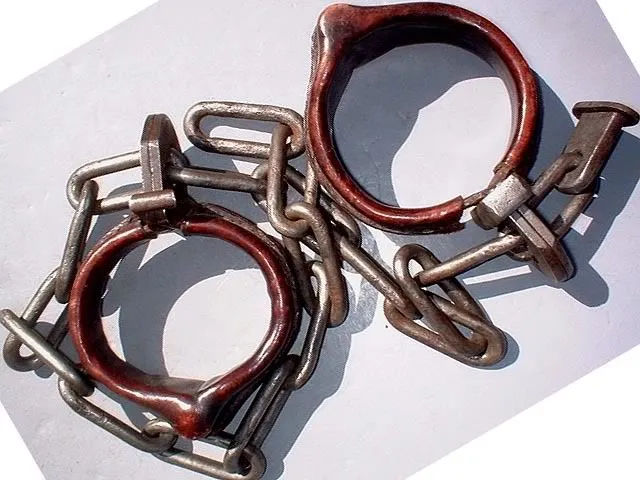
Joe Tanner is offering a nice leg iron that he states is from Finland.
I have seen a few of these in different variations, but all of them have the same very thick glossy leather wrapped around the metal shackles.
I am wondering how all these very old leg irons have such pristine leather and if anyone can identify the hallmarks.
http://cgi.ebay.com/ROYAL-CROWN-marked- ... 53e194dfc0
Does anyone know more about these interesting items?
mark
O--O
Hello,
I have seen some speculation here as to the origins of various markings on early shackles like these.
In my personal collection I have a wide variety of early European restraint and torture instruments and some of them, yes, even some of the torture instruments, have insignia stampings.
So does a Medieval German executioner's sword I have.
My research into such markings or stampings and consultations I have had with noted European collectors of similiar artifacts has shown me that such stampings are not crowns or royal emblems to designate the item came from this country or that but instead are regional markings to designate which part of a particular country an item was made and used in.
In Medieval and post Medieval times many items dealing with the adminstration of justice, i.e. restraints, torture instruments, and execution devices were sometimes marked with the offical crest for the region of thier manufacture and use.
This stamp was not the stamp of the particular maker or blacksmith that forged the item but was instead a sort of "justice seal" to indicate that the item was owned by the armory that also retained offical ownership of the arms and armor and anything else used for the defense of law and lands.
So, to properly name these marks, they should be titled as "Armory markings" or "Regional seals or crests."
While many may tend to think of Medieval and early post Medieval justice as a sort of hap hazzard, "I needed this and the local blacksmith hammered me one out", in many cases this was not so and there was a rigid form of structure involved that designated which items were to me made, for what exact purpose, and how they were to me marked to designate ownership and chain of custody.
For instance, I have a period 1700's German wrist screw that also has a crushing plate for thumb or finger torture. This instrument bears the offical crest for the Baden region of Germany which is the district in which it was made and used under the law and oversight of the courts.
Further, I also have a more primitive Medieval torture screw marked with the symbol of a spoked wheel.
In Medieval times the spoked wheel was the symbol of the post of offical town or village executioner as many victims during this time were sentenced to have their limbs broken via a cart wheel.
Unlike the regional and armory stamps that denoted a district or manufacture and use the wheel denoted the instrument was the personal property of the executioner.
But still, even here, we see that the stampings or symbols pounded into the metal offered a line to the ownership and the legal office or officals that used such a device.
Early justice may have been brutal and primitive by today's standards but there was in fact an organized system of what, where, who, and how, solidly in place in most cases.
Cheers, Steve Santini