
OnlyCuffsOnlyCuffsarchive search
The Forum at Handcuffs.Org

Rare 17th century Medieval "Double Bilboes."

27 visible archived posts · 27 preserved total · topic ID 3637
Original topic ↗Recovered images
Steve Santini 04 Aug 2010
#1
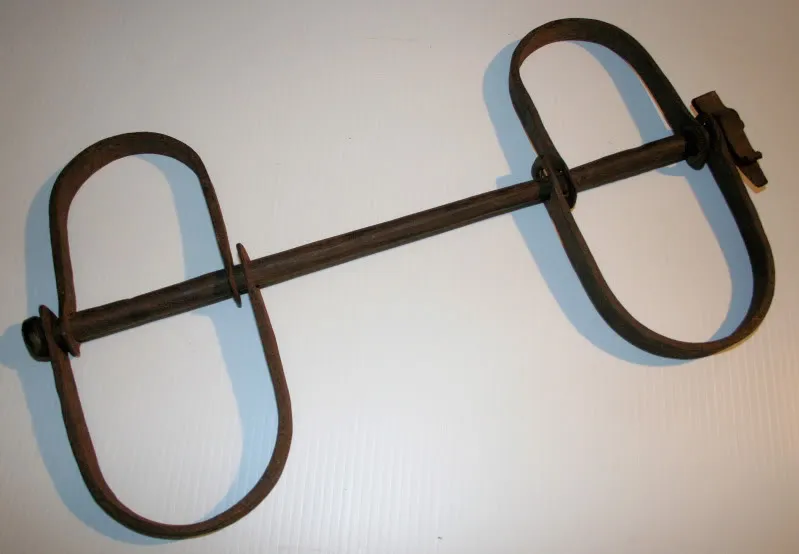
Pictured here is a very unusual set of Medieval "double bilboe" leg shackles I just recieved from Austria. They date to the early 17th century.

There are a few unique features that make these rather unique and rare.

Firstly, they are purposely designed for two prisoners to wear them at the same time in a manacled, "back to back" configuration.

The bar is not long enough for the leg manacles to be threaded all one beside the other down the bar. The pictures show what I believe to be the actual configuration these fetters were originaly used in.

The likely use for these manacles was so that an adulterous couple could be fettered back to back in these while thier arms were tied or chained above their heads in preparation for a public flogging, (which was the penalty used in some regions on couples who had committed adultery). In some sterner regions and states adulterous couples were not only flogged but they were also beheaded.

Additionally, one set of ankle fetters is of a decidedly female size while the larger ones were no doubt intended for a male.

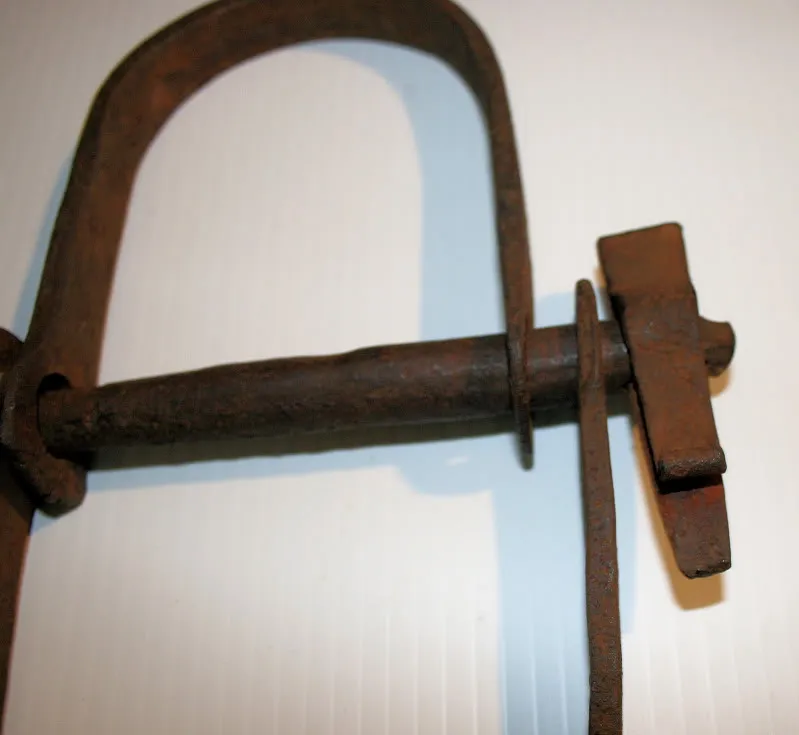
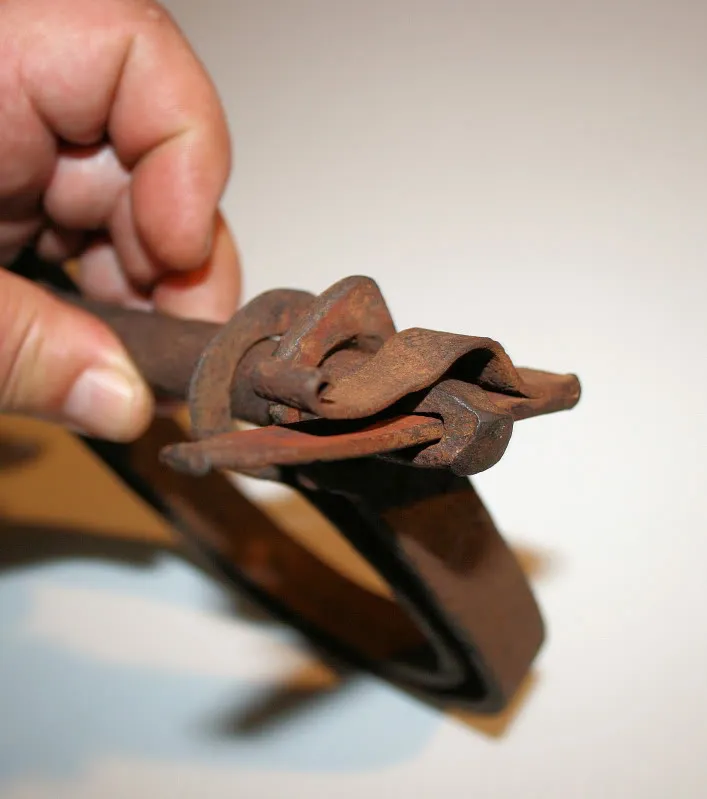
Further supporting the likely use of this restraint is the unique spring clamp locking device that secures the shackles on the bar. This does not really lock per say but it is instead a very strong spring clamp and two hands must be use to pry it open so it can be freed from the bar to allow the leg fetters to slide off of the bar.

With the prisoner's hands tied or chained above their heads it would be impossible for them to reach down and undo the spring clamp lock. Obviously, these restraints were crafted for use in a short term low security restraint situation where the prisoners wearing them were under visual supervision.

A very interesting "temporary" early restraint whose construction lends itself to a particular use it was made for.

Cheers, Steve Santini


Roger 04 Aug 2010
#2
You just made these, didn't you? That red rust is all wrong.
Steve Santini 04 Aug 2010
#3
Pictured here is a very unusual set of Medieval "double bilboe" leg shackles I just recieved from Austria. They date to the early 17th century.

There are a few unique features that make these rather unique and rare.

Firstly, they are purposely designed for two prisoners to wear them at the same time in a manacled, "back to back" configuration.

The bar is not long enough for the leg manacles to be threaded all one beside the other down the bar. The pictures show what I believe to be the actual configuration these fetters were originaly used in.

The likely use for these manacles was so that an adulterous couple could be fettered back to back in these while thier arms were tied or chained above their heads in preparation for a public flogging, (which was the penalty used in some regions on couples who had committed adultery). In some sterner regions and states adulterous couples were not only flogged but they were also beheaded.

Additionally, one set of ankle fetters is of a decidedly female size while the larger ones were no doubt intended for a male.

Further supporting the likely use of this restraint is the unique spring clamp locking device that secures the shackles on the bar. This does not really lock per say but it is instead a very strong spring clamp and two hands must be use to pry it open so it can be freed from the bar to allow the leg fetters to slide off of the bar.

With the prisoner's hands tied or chained above their heads it would be impossible for them to reach down and undo the spring clamp lock. Obviously, these restraints were crafted for use in a short term low security restraint situation where the prisoners wearing them were under visual supervision.

A very interesting "temporary" early restraint whose construction lends itself to a particular use it was made for.

Cheers, Steve Santini


Click to expand...
Well "Roger",

if you bother to take a close look, you will see the deep dark brown, almost black, patina that the iron parts have.

Any surface rust you see is a result of the humid conditions they were stored in over the past several months.

Nice one.

Anon456 04 Aug 2010
#4
Pictured here is a very unusual set of Medieval "double bilboe" leg shackles I just recieved from Austria. They date to the early 17th century.

There are a few unique features that make these rather unique and rare.

Firstly, they are purposely designed for two prisoners to wear them at the same time in a manacled, "back to back" configuration.

The bar is not long enough for the leg manacles to be threaded all one beside the other down the bar. The pictures show what I believe to be the actual configuration these fetters were originaly used in.

The likely use for these manacles was so that an adulterous couple could be fettered back to back in these while thier arms were tied or chained above their heads in preparation for a public flogging, (which was the penalty used in some regions on couples who had committed adultery). In some sterner regions and states adulterous couples were not only flogged but they were also beheaded.

Additionally, one set of ankle fetters is of a decidedly female size while the larger ones were no doubt intended for a male.

Further supporting the likely use of this restraint is the unique spring clamp locking device that secures the shackles on the bar. This does not really lock per say but it is instead a very strong spring clamp and two hands must be use to pry it open so it can be freed from the bar to allow the leg fetters to slide off of the bar.

With the prisoner's hands tied or chained above their heads it would be impossible for them to reach down and undo the spring clamp lock. Obviously, these restraints were crafted for use in a short term low security restraint situation where the prisoners wearing them were under visual supervision.

A very interesting "temporary" early restraint whose construction lends itself to a particular use it was made for.

Cheers, Steve Santini


Click to expand...
So you are saying that wrought iron turns this color while rusting away or is it steel that does it? They did not have steel back then....
Steve Santini 04 Aug 2010
#5
Pictured here is a very unusual set of Medieval "double bilboe" leg shackles I just recieved from Austria. They date to the early 17th century.

There are a few unique features that make these rather unique and rare.

Firstly, they are purposely designed for two prisoners to wear them at the same time in a manacled, "back to back" configuration.

The bar is not long enough for the leg manacles to be threaded all one beside the other down the bar. The pictures show what I believe to be the actual configuration these fetters were originaly used in.

The likely use for these manacles was so that an adulterous couple could be fettered back to back in these while thier arms were tied or chained above their heads in preparation for a public flogging, (which was the penalty used in some regions on couples who had committed adultery). In some sterner regions and states adulterous couples were not only flogged but they were also beheaded.

Additionally, one set of ankle fetters is of a decidedly female size while the larger ones were no doubt intended for a male.

Further supporting the likely use of this restraint is the unique spring clamp locking device that secures the shackles on the bar. This does not really lock per say but it is instead a very strong spring clamp and two hands must be use to pry it open so it can be freed from the bar to allow the leg fetters to slide off of the bar.

With the prisoner's hands tied or chained above their heads it would be impossible for them to reach down and undo the spring clamp lock. Obviously, these restraints were crafted for use in a short term low security restraint situation where the prisoners wearing them were under visual supervision.

A very interesting "temporary" early restraint whose construction lends itself to a particular use it was made for.

Cheers, Steve Santini


Click to expand...
These are exactly what I said they are.

I am also saying that people like myself post photos of unusual restraints here for the education of serious collectors.

Note the words, "serious collectors."

Steve Santini 04 Aug 2010
#6
Pictured here is a very unusual set of Medieval "double bilboe" leg shackles I just recieved from Austria. They date to the early 17th century.

There are a few unique features that make these rather unique and rare.

Firstly, they are purposely designed for two prisoners to wear them at the same time in a manacled, "back to back" configuration.

The bar is not long enough for the leg manacles to be threaded all one beside the other down the bar. The pictures show what I believe to be the actual configuration these fetters were originaly used in.

The likely use for these manacles was so that an adulterous couple could be fettered back to back in these while thier arms were tied or chained above their heads in preparation for a public flogging, (which was the penalty used in some regions on couples who had committed adultery). In some sterner regions and states adulterous couples were not only flogged but they were also beheaded.

Additionally, one set of ankle fetters is of a decidedly female size while the larger ones were no doubt intended for a male.

Further supporting the likely use of this restraint is the unique spring clamp locking device that secures the shackles on the bar. This does not really lock per say but it is instead a very strong spring clamp and two hands must be use to pry it open so it can be freed from the bar to allow the leg fetters to slide off of the bar.

With the prisoner's hands tied or chained above their heads it would be impossible for them to reach down and undo the spring clamp lock. Obviously, these restraints were crafted for use in a short term low security restraint situation where the prisoners wearing them were under visual supervision.

A very interesting "temporary" early restraint whose construction lends itself to a particular use it was made for.

Cheers, Steve Santini


Click to expand...
Hand forged ancient iron CAN develop reddish surface rust.

Especially on areas where the metal has been rubbing against itself.

Photo examples: (17th century leg irons and 16th century single leg shackle)On the hinge, surfaces which come to together, and other regions where the forged iron rubs up against other forged iron.

Imagine that!


Edgeplay_Cgo 05 Aug 2010
#7
Pictured here is a very unusual set of Medieval "double bilboe" leg shackles I just recieved from Austria. They date to the early 17th century.

There are a few unique features that make these rather unique and rare.

Firstly, they are purposely designed for two prisoners to wear them at the same time in a manacled, "back to back" configuration.

The bar is not long enough for the leg manacles to be threaded all one beside the other down the bar. The pictures show what I believe to be the actual configuration these fetters were originaly used in.

The likely use for these manacles was so that an adulterous couple could be fettered back to back in these while thier arms were tied or chained above their heads in preparation for a public flogging, (which was the penalty used in some regions on couples who had committed adultery). In some sterner regions and states adulterous couples were not only flogged but they were also beheaded.

Additionally, one set of ankle fetters is of a decidedly female size while the larger ones were no doubt intended for a male.

Further supporting the likely use of this restraint is the unique spring clamp locking device that secures the shackles on the bar. This does not really lock per say but it is instead a very strong spring clamp and two hands must be use to pry it open so it can be freed from the bar to allow the leg fetters to slide off of the bar.

With the prisoner's hands tied or chained above their heads it would be impossible for them to reach down and undo the spring clamp lock. Obviously, these restraints were crafted for use in a short term low security restraint situation where the prisoners wearing them were under visual supervision.

A very interesting "temporary" early restraint whose construction lends itself to a particular use it was made for.

Cheers, Steve Santini


Click to expand...
The underlying patina looks right.

It looks like the spring clip wasn't often pried off with both hands. The tip is mushroomed. It was driven off with a hammer. And that indicates that this set got considerable use over its life.

Nice piece. Thanks for posting it.

Steve Santini 05 Aug 2010
#8
Pictured here is a very unusual set of Medieval "double bilboe" leg shackles I just recieved from Austria. They date to the early 17th century.

There are a few unique features that make these rather unique and rare.

Firstly, they are purposely designed for two prisoners to wear them at the same time in a manacled, "back to back" configuration.

The bar is not long enough for the leg manacles to be threaded all one beside the other down the bar. The pictures show what I believe to be the actual configuration these fetters were originaly used in.

The likely use for these manacles was so that an adulterous couple could be fettered back to back in these while thier arms were tied or chained above their heads in preparation for a public flogging, (which was the penalty used in some regions on couples who had committed adultery). In some sterner regions and states adulterous couples were not only flogged but they were also beheaded.

Additionally, one set of ankle fetters is of a decidedly female size while the larger ones were no doubt intended for a male.

Further supporting the likely use of this restraint is the unique spring clamp locking device that secures the shackles on the bar. This does not really lock per say but it is instead a very strong spring clamp and two hands must be use to pry it open so it can be freed from the bar to allow the leg fetters to slide off of the bar.

With the prisoner's hands tied or chained above their heads it would be impossible for them to reach down and undo the spring clamp lock. Obviously, these restraints were crafted for use in a short term low security restraint situation where the prisoners wearing them were under visual supervision.

A very interesting "temporary" early restraint whose construction lends itself to a particular use it was made for.

Cheers, Steve Santini


Click to expand...
It is nice to see some collectors appreciating the posting.

The irons are most unusual and of true age and I was very lucky/happy to be able to acquire them.

S.S.
Anonymous 05 Aug 2010
#9
Pictured here is a very unusual set of Medieval "double bilboe" leg shackles I just recieved from Austria. They date to the early 17th century.

There are a few unique features that make these rather unique and rare.

Firstly, they are purposely designed for two prisoners to wear them at the same time in a manacled, "back to back" configuration.

The bar is not long enough for the leg manacles to be threaded all one beside the other down the bar. The pictures show what I believe to be the actual configuration these fetters were originaly used in.

The likely use for these manacles was so that an adulterous couple could be fettered back to back in these while thier arms were tied or chained above their heads in preparation for a public flogging, (which was the penalty used in some regions on couples who had committed adultery). In some sterner regions and states adulterous couples were not only flogged but they were also beheaded.

Additionally, one set of ankle fetters is of a decidedly female size while the larger ones were no doubt intended for a male.

Further supporting the likely use of this restraint is the unique spring clamp locking device that secures the shackles on the bar. This does not really lock per say but it is instead a very strong spring clamp and two hands must be use to pry it open so it can be freed from the bar to allow the leg fetters to slide off of the bar.

With the prisoner's hands tied or chained above their heads it would be impossible for them to reach down and undo the spring clamp lock. Obviously, these restraints were crafted for use in a short term low security restraint situation where the prisoners wearing them were under visual supervision.

A very interesting "temporary" early restraint whose construction lends itself to a particular use it was made for.

Cheers, Steve Santini


Click to expand...
Are there many other medieval shackles which fasten using a spring clip? Is the clip iron? If so, when it was bent up to release the cuffs, wouldn't it stay bent up? Or is it spring steel? Does anybody know when spring steel was invented?
Springing back. 05 Aug 2010
#10
Pictured here is a very unusual set of Medieval "double bilboe" leg shackles I just recieved from Austria. They date to the early 17th century.

There are a few unique features that make these rather unique and rare.

Firstly, they are purposely designed for two prisoners to wear them at the same time in a manacled, "back to back" configuration.

The bar is not long enough for the leg manacles to be threaded all one beside the other down the bar. The pictures show what I believe to be the actual configuration these fetters were originaly used in.

The likely use for these manacles was so that an adulterous couple could be fettered back to back in these while thier arms were tied or chained above their heads in preparation for a public flogging, (which was the penalty used in some regions on couples who had committed adultery). In some sterner regions and states adulterous couples were not only flogged but they were also beheaded.

Additionally, one set of ankle fetters is of a decidedly female size while the larger ones were no doubt intended for a male.

Further supporting the likely use of this restraint is the unique spring clamp locking device that secures the shackles on the bar. This does not really lock per say but it is instead a very strong spring clamp and two hands must be use to pry it open so it can be freed from the bar to allow the leg fetters to slide off of the bar.

With the prisoner's hands tied or chained above their heads it would be impossible for them to reach down and undo the spring clamp lock. Obviously, these restraints were crafted for use in a short term low security restraint situation where the prisoners wearing them were under visual supervision.

A very interesting "temporary" early restraint whose construction lends itself to a particular use it was made for.

Cheers, Steve Santini


Click to expand...
There were forged leaf springs in ancient spring wedge locks and shackles that go as far back as the Romans.

So, obviously folks way back knew how to harden metal in the forge to make a good spring.
Edgeplay_Cgo 06 Aug 2010
#11
Pictured here is a very unusual set of Medieval "double bilboe" leg shackles I just recieved from Austria. They date to the early 17th century.

There are a few unique features that make these rather unique and rare.

Firstly, they are purposely designed for two prisoners to wear them at the same time in a manacled, "back to back" configuration.

The bar is not long enough for the leg manacles to be threaded all one beside the other down the bar. The pictures show what I believe to be the actual configuration these fetters were originaly used in.

The likely use for these manacles was so that an adulterous couple could be fettered back to back in these while thier arms were tied or chained above their heads in preparation for a public flogging, (which was the penalty used in some regions on couples who had committed adultery). In some sterner regions and states adulterous couples were not only flogged but they were also beheaded.

Additionally, one set of ankle fetters is of a decidedly female size while the larger ones were no doubt intended for a male.

Further supporting the likely use of this restraint is the unique spring clamp locking device that secures the shackles on the bar. This does not really lock per say but it is instead a very strong spring clamp and two hands must be use to pry it open so it can be freed from the bar to allow the leg fetters to slide off of the bar.

With the prisoner's hands tied or chained above their heads it would be impossible for them to reach down and undo the spring clamp lock. Obviously, these restraints were crafted for use in a short term low security restraint situation where the prisoners wearing them were under visual supervision.

A very interesting "temporary" early restraint whose construction lends itself to a particular use it was made for.

Cheers, Steve Santini


Click to expand...
The ability to make crude springs dates back to the beginning of the iron age. The making of crucible steel is an ancient technique. But you could make that particular "spring clip" from wrought iron. The spring leaf doesn't deflect much. Wrought iron, mild steel, or any other elasto-plastic material will not permanently deform until it is loaded past its elastic limit. The deflections required to make the spring clip work are quite small.

The metal is not very hard, as evidenced by the mushrooming on the tip of the spring, where it had been bashed with a hammer. Even if it is soft metal, a tap with that hammer would fix a deformed "spring."
Paul D 06 Aug 2010
#12
Pictured here is a very unusual set of Medieval "double bilboe" leg shackles I just recieved from Austria. They date to the early 17th century.

There are a few unique features that make these rather unique and rare.

Firstly, they are purposely designed for two prisoners to wear them at the same time in a manacled, "back to back" configuration.

The bar is not long enough for the leg manacles to be threaded all one beside the other down the bar. The pictures show what I believe to be the actual configuration these fetters were originaly used in.

The likely use for these manacles was so that an adulterous couple could be fettered back to back in these while thier arms were tied or chained above their heads in preparation for a public flogging, (which was the penalty used in some regions on couples who had committed adultery). In some sterner regions and states adulterous couples were not only flogged but they were also beheaded.

Additionally, one set of ankle fetters is of a decidedly female size while the larger ones were no doubt intended for a male.

Further supporting the likely use of this restraint is the unique spring clamp locking device that secures the shackles on the bar. This does not really lock per say but it is instead a very strong spring clamp and two hands must be use to pry it open so it can be freed from the bar to allow the leg fetters to slide off of the bar.

With the prisoner's hands tied or chained above their heads it would be impossible for them to reach down and undo the spring clamp lock. Obviously, these restraints were crafted for use in a short term low security restraint situation where the prisoners wearing them were under visual supervision.

A very interesting "temporary" early restraint whose construction lends itself to a particular use it was made for.

Cheers, Steve Santini


Click to expand...
How would they go if rather than the small shackle inside the large one and not side by side but interlocking. Looks like you'd get them almost side by side but with some movement as well. That way they could be facing each other in a sitting position. ???
Steve Santini 06 Aug 2010
#13
Pictured here is a very unusual set of Medieval "double bilboe" leg shackles I just recieved from Austria. They date to the early 17th century.

There are a few unique features that make these rather unique and rare.

Firstly, they are purposely designed for two prisoners to wear them at the same time in a manacled, "back to back" configuration.

The bar is not long enough for the leg manacles to be threaded all one beside the other down the bar. The pictures show what I believe to be the actual configuration these fetters were originaly used in.

The likely use for these manacles was so that an adulterous couple could be fettered back to back in these while thier arms were tied or chained above their heads in preparation for a public flogging, (which was the penalty used in some regions on couples who had committed adultery). In some sterner regions and states adulterous couples were not only flogged but they were also beheaded.

Additionally, one set of ankle fetters is of a decidedly female size while the larger ones were no doubt intended for a male.

Further supporting the likely use of this restraint is the unique spring clamp locking device that secures the shackles on the bar. This does not really lock per say but it is instead a very strong spring clamp and two hands must be use to pry it open so it can be freed from the bar to allow the leg fetters to slide off of the bar.

With the prisoner's hands tied or chained above their heads it would be impossible for them to reach down and undo the spring clamp lock. Obviously, these restraints were crafted for use in a short term low security restraint situation where the prisoners wearing them were under visual supervision.

A very interesting "temporary" early restraint whose construction lends itself to a particular use it was made for.

Cheers, Steve Santini


Click to expand...
Yes, it could perhaps work this way but one of the prisoners would have to remain in a position where they were basically pointing thier toes because the calves of the other prisoner would be pressing down on thier feet. Or, they would have to turn their feet so the toes were pointing out to the sides.
Steve Santini 06 Aug 2010
#14
Pictured here is a very unusual set of Medieval "double bilboe" leg shackles I just recieved from Austria. They date to the early 17th century.

There are a few unique features that make these rather unique and rare.

Firstly, they are purposely designed for two prisoners to wear them at the same time in a manacled, "back to back" configuration.

The bar is not long enough for the leg manacles to be threaded all one beside the other down the bar. The pictures show what I believe to be the actual configuration these fetters were originaly used in.

The likely use for these manacles was so that an adulterous couple could be fettered back to back in these while thier arms were tied or chained above their heads in preparation for a public flogging, (which was the penalty used in some regions on couples who had committed adultery). In some sterner regions and states adulterous couples were not only flogged but they were also beheaded.

Additionally, one set of ankle fetters is of a decidedly female size while the larger ones were no doubt intended for a male.

Further supporting the likely use of this restraint is the unique spring clamp locking device that secures the shackles on the bar. This does not really lock per say but it is instead a very strong spring clamp and two hands must be use to pry it open so it can be freed from the bar to allow the leg fetters to slide off of the bar.

With the prisoner's hands tied or chained above their heads it would be impossible for them to reach down and undo the spring clamp lock. Obviously, these restraints were crafted for use in a short term low security restraint situation where the prisoners wearing them were under visual supervision.

A very interesting "temporary" early restraint whose construction lends itself to a particular use it was made for.

Cheers, Steve Santini


Click to expand...
Paul,

I misunderstood what you meant but now I get it.

I will have to try what you suggested. It just may work.

Steve
Dorson 06 Aug 2010
#15
Pictured here is a very unusual set of Medieval "double bilboe" leg shackles I just recieved from Austria. They date to the early 17th century.

There are a few unique features that make these rather unique and rare.

Firstly, they are purposely designed for two prisoners to wear them at the same time in a manacled, "back to back" configuration.

The bar is not long enough for the leg manacles to be threaded all one beside the other down the bar. The pictures show what I believe to be the actual configuration these fetters were originaly used in.

The likely use for these manacles was so that an adulterous couple could be fettered back to back in these while thier arms were tied or chained above their heads in preparation for a public flogging, (which was the penalty used in some regions on couples who had committed adultery). In some sterner regions and states adulterous couples were not only flogged but they were also beheaded.

Additionally, one set of ankle fetters is of a decidedly female size while the larger ones were no doubt intended for a male.

Further supporting the likely use of this restraint is the unique spring clamp locking device that secures the shackles on the bar. This does not really lock per say but it is instead a very strong spring clamp and two hands must be use to pry it open so it can be freed from the bar to allow the leg fetters to slide off of the bar.

With the prisoner's hands tied or chained above their heads it would be impossible for them to reach down and undo the spring clamp lock. Obviously, these restraints were crafted for use in a short term low security restraint situation where the prisoners wearing them were under visual supervision.

A very interesting "temporary" early restraint whose construction lends itself to a particular use it was made for.

Cheers, Steve Santini


Click to expand...
Not knowing any of the dimensions of the bilboes, could it have conceivably have been used for wrist and ankle?
Steve Santini 06 Aug 2010
#16
Pictured here is a very unusual set of Medieval "double bilboe" leg shackles I just recieved from Austria. They date to the early 17th century.

There are a few unique features that make these rather unique and rare.

Firstly, they are purposely designed for two prisoners to wear them at the same time in a manacled, "back to back" configuration.

The bar is not long enough for the leg manacles to be threaded all one beside the other down the bar. The pictures show what I believe to be the actual configuration these fetters were originaly used in.

The likely use for these manacles was so that an adulterous couple could be fettered back to back in these while thier arms were tied or chained above their heads in preparation for a public flogging, (which was the penalty used in some regions on couples who had committed adultery). In some sterner regions and states adulterous couples were not only flogged but they were also beheaded.

Additionally, one set of ankle fetters is of a decidedly female size while the larger ones were no doubt intended for a male.

Further supporting the likely use of this restraint is the unique spring clamp locking device that secures the shackles on the bar. This does not really lock per say but it is instead a very strong spring clamp and two hands must be use to pry it open so it can be freed from the bar to allow the leg fetters to slide off of the bar.

With the prisoner's hands tied or chained above their heads it would be impossible for them to reach down and undo the spring clamp lock. Obviously, these restraints were crafted for use in a short term low security restraint situation where the prisoners wearing them were under visual supervision.

A very interesting "temporary" early restraint whose construction lends itself to a particular use it was made for.

Cheers, Steve Santini


Click to expand...
There is no way these could be used for the hands even on the biggest man's wrist.

They are certainly for only legs.

Cheers. Steve
Anonymous 07 Aug 2010
#17
Pictured here is a very unusual set of Medieval "double bilboe" leg shackles I just recieved from Austria. They date to the early 17th century.

There are a few unique features that make these rather unique and rare.

Firstly, they are purposely designed for two prisoners to wear them at the same time in a manacled, "back to back" configuration.

The bar is not long enough for the leg manacles to be threaded all one beside the other down the bar. The pictures show what I believe to be the actual configuration these fetters were originaly used in.

The likely use for these manacles was so that an adulterous couple could be fettered back to back in these while thier arms were tied or chained above their heads in preparation for a public flogging, (which was the penalty used in some regions on couples who had committed adultery). In some sterner regions and states adulterous couples were not only flogged but they were also beheaded.

Additionally, one set of ankle fetters is of a decidedly female size while the larger ones were no doubt intended for a male.

Further supporting the likely use of this restraint is the unique spring clamp locking device that secures the shackles on the bar. This does not really lock per say but it is instead a very strong spring clamp and two hands must be use to pry it open so it can be freed from the bar to allow the leg fetters to slide off of the bar.

With the prisoner's hands tied or chained above their heads it would be impossible for them to reach down and undo the spring clamp lock. Obviously, these restraints were crafted for use in a short term low security restraint situation where the prisoners wearing them were under visual supervision.

A very interesting "temporary" early restraint whose construction lends itself to a particular use it was made for.

Cheers, Steve Santini


Click to expand...
Male feet pointed up and female's down.
The best restraint ever made!
Brody 09 Aug 2010
#18
Pictured here is a very unusual set of Medieval "double bilboe" leg shackles I just recieved from Austria. They date to the early 17th century.

There are a few unique features that make these rather unique and rare.

Firstly, they are purposely designed for two prisoners to wear them at the same time in a manacled, "back to back" configuration.

The bar is not long enough for the leg manacles to be threaded all one beside the other down the bar. The pictures show what I believe to be the actual configuration these fetters were originaly used in.

The likely use for these manacles was so that an adulterous couple could be fettered back to back in these while thier arms were tied or chained above their heads in preparation for a public flogging, (which was the penalty used in some regions on couples who had committed adultery). In some sterner regions and states adulterous couples were not only flogged but they were also beheaded.

Additionally, one set of ankle fetters is of a decidedly female size while the larger ones were no doubt intended for a male.

Further supporting the likely use of this restraint is the unique spring clamp locking device that secures the shackles on the bar. This does not really lock per say but it is instead a very strong spring clamp and two hands must be use to pry it open so it can be freed from the bar to allow the leg fetters to slide off of the bar.

With the prisoner's hands tied or chained above their heads it would be impossible for them to reach down and undo the spring clamp lock. Obviously, these restraints were crafted for use in a short term low security restraint situation where the prisoners wearing them were under visual supervision.

A very interesting "temporary" early restraint whose construction lends itself to a particular use it was made for.

Cheers, Steve Santini


Click to expand...
Old things like this are always difficult to determine use, largely depending upon your mindset.

For those of a nautical persuasion, this appears to be a genuine, wrought iron pin shackle a/k/a "gyve" used on board sailing ships to secure various elements of rigging together: lines (ropes to landlubbers), sheets, halyards, chains, and such.

In this instance, the spring clip is instructive. It does a fine job of holding the clevis pin in place against the elements of nature such as wind and waves, but can easily be removed when re-rigging. As a means of confining people as a bilboe; well, it is rather inadequate. On bilboes, the wedge was hammered into place to prevent easy removal.

As for it today being impossible to line all four shackles up in line on the clevis pin, a couple of whacks with a hammer on the body of the shackles could remedy that. In fact, to properly use the item as a gyve, you want the shackles to be tight on the bolt.

Could it have been used on people? Sure. But it could have served a valuable use on a schooner or warship.

In any event, a nice artifact.

Steve Santini 10 Aug 2010
#19
Pictured here is a very unusual set of Medieval "double bilboe" leg shackles I just recieved from Austria. They date to the early 17th century.

There are a few unique features that make these rather unique and rare.

Firstly, they are purposely designed for two prisoners to wear them at the same time in a manacled, "back to back" configuration.

The bar is not long enough for the leg manacles to be threaded all one beside the other down the bar. The pictures show what I believe to be the actual configuration these fetters were originaly used in.

The likely use for these manacles was so that an adulterous couple could be fettered back to back in these while thier arms were tied or chained above their heads in preparation for a public flogging, (which was the penalty used in some regions on couples who had committed adultery). In some sterner regions and states adulterous couples were not only flogged but they were also beheaded.

Additionally, one set of ankle fetters is of a decidedly female size while the larger ones were no doubt intended for a male.

Further supporting the likely use of this restraint is the unique spring clamp locking device that secures the shackles on the bar. This does not really lock per say but it is instead a very strong spring clamp and two hands must be use to pry it open so it can be freed from the bar to allow the leg fetters to slide off of the bar.

With the prisoner's hands tied or chained above their heads it would be impossible for them to reach down and undo the spring clamp lock. Obviously, these restraints were crafted for use in a short term low security restraint situation where the prisoners wearing them were under visual supervision.

A very interesting "temporary" early restraint whose construction lends itself to a particular use it was made for.

Cheers, Steve Santini


Click to expand...
On ships were made with rounded edges to prevent friction from severing lines, etc.

These shackles are flat stock which would have abraided lines.

Rigging shackles were also made as single units and often with threaded pins that kept them in place and secure.

I defy anyone to show me an example like this with al ong bar and multiple shackles on it.

Such things simply did not exist.

Even the ankle shackles (once rigging shackles)fitted on a bar mounted to the deck of Nelson's ship "Victory" have rounded edges.

This is because they once were used as rigging shackles and were pressed into alternative use as restraints.

BTW, I have a strong knowledge of sea going vessels and the equipment used on board them.

Just Google "Steve Santini Titanic" and you will see why.


Anonymous 10 Aug 2010
#20
Pictured here is a very unusual set of Medieval "double bilboe" leg shackles I just recieved from Austria. They date to the early 17th century.

There are a few unique features that make these rather unique and rare.

Firstly, they are purposely designed for two prisoners to wear them at the same time in a manacled, "back to back" configuration.

The bar is not long enough for the leg manacles to be threaded all one beside the other down the bar. The pictures show what I believe to be the actual configuration these fetters were originaly used in.

The likely use for these manacles was so that an adulterous couple could be fettered back to back in these while thier arms were tied or chained above their heads in preparation for a public flogging, (which was the penalty used in some regions on couples who had committed adultery). In some sterner regions and states adulterous couples were not only flogged but they were also beheaded.

Additionally, one set of ankle fetters is of a decidedly female size while the larger ones were no doubt intended for a male.

Further supporting the likely use of this restraint is the unique spring clamp locking device that secures the shackles on the bar. This does not really lock per say but it is instead a very strong spring clamp and two hands must be use to pry it open so it can be freed from the bar to allow the leg fetters to slide off of the bar.

With the prisoner's hands tied or chained above their heads it would be impossible for them to reach down and undo the spring clamp lock. Obviously, these restraints were crafted for use in a short term low security restraint situation where the prisoners wearing them were under visual supervision.

A very interesting "temporary" early restraint whose construction lends itself to a particular use it was made for.

Cheers, Steve Santini


Click to expand...
Methinks the Santini doth protest too much.

They have to be real shackles. After all, Steve made them himself, so he gets to say what they are.
Anonymous 10 Aug 2010
#21
Pictured here is a very unusual set of Medieval "double bilboe" leg shackles I just recieved from Austria. They date to the early 17th century.

There are a few unique features that make these rather unique and rare.

Firstly, they are purposely designed for two prisoners to wear them at the same time in a manacled, "back to back" configuration.

The bar is not long enough for the leg manacles to be threaded all one beside the other down the bar. The pictures show what I believe to be the actual configuration these fetters were originaly used in.

The likely use for these manacles was so that an adulterous couple could be fettered back to back in these while thier arms were tied or chained above their heads in preparation for a public flogging, (which was the penalty used in some regions on couples who had committed adultery). In some sterner regions and states adulterous couples were not only flogged but they were also beheaded.

Additionally, one set of ankle fetters is of a decidedly female size while the larger ones were no doubt intended for a male.

Further supporting the likely use of this restraint is the unique spring clamp locking device that secures the shackles on the bar. This does not really lock per say but it is instead a very strong spring clamp and two hands must be use to pry it open so it can be freed from the bar to allow the leg fetters to slide off of the bar.

With the prisoner's hands tied or chained above their heads it would be impossible for them to reach down and undo the spring clamp lock. Obviously, these restraints were crafted for use in a short term low security restraint situation where the prisoners wearing them were under visual supervision.

A very interesting "temporary" early restraint whose construction lends itself to a particular use it was made for.

Cheers, Steve Santini


Click to expand...
okay

so where is your provenance on what you have

anything from a prison

who is your source in austria

adolf shicklegrueber
Edgeplay_Cgo 10 Aug 2010
#22
Pictured here is a very unusual set of Medieval "double bilboe" leg shackles I just recieved from Austria. They date to the early 17th century.

There are a few unique features that make these rather unique and rare.

Firstly, they are purposely designed for two prisoners to wear them at the same time in a manacled, "back to back" configuration.

The bar is not long enough for the leg manacles to be threaded all one beside the other down the bar. The pictures show what I believe to be the actual configuration these fetters were originaly used in.

The likely use for these manacles was so that an adulterous couple could be fettered back to back in these while thier arms were tied or chained above their heads in preparation for a public flogging, (which was the penalty used in some regions on couples who had committed adultery). In some sterner regions and states adulterous couples were not only flogged but they were also beheaded.

Additionally, one set of ankle fetters is of a decidedly female size while the larger ones were no doubt intended for a male.

Further supporting the likely use of this restraint is the unique spring clamp locking device that secures the shackles on the bar. This does not really lock per say but it is instead a very strong spring clamp and two hands must be use to pry it open so it can be freed from the bar to allow the leg fetters to slide off of the bar.

With the prisoner's hands tied or chained above their heads it would be impossible for them to reach down and undo the spring clamp lock. Obviously, these restraints were crafted for use in a short term low security restraint situation where the prisoners wearing them were under visual supervision.

A very interesting "temporary" early restraint whose construction lends itself to a particular use it was made for.

Cheers, Steve Santini


Click to expand...
I concur. They would be almost completely unserviceable as rigging shackles. Way too light, and of flat stock.

As the Houdini arguments demonstrate, provenance can be as much a matter of faith as of fact. And Houdini stuff is vastly better documented than a piece of junk (now a treasure) that resided for centuries under the boots in the Sheriff's coat closet, in the town of Lower Bumphuc, Bavaria.
Steve Santini 10 Aug 2010
#23
Pictured here is a very unusual set of Medieval "double bilboe" leg shackles I just recieved from Austria. They date to the early 17th century.

There are a few unique features that make these rather unique and rare.

Firstly, they are purposely designed for two prisoners to wear them at the same time in a manacled, "back to back" configuration.

The bar is not long enough for the leg manacles to be threaded all one beside the other down the bar. The pictures show what I believe to be the actual configuration these fetters were originaly used in.

The likely use for these manacles was so that an adulterous couple could be fettered back to back in these while thier arms were tied or chained above their heads in preparation for a public flogging, (which was the penalty used in some regions on couples who had committed adultery). In some sterner regions and states adulterous couples were not only flogged but they were also beheaded.

Additionally, one set of ankle fetters is of a decidedly female size while the larger ones were no doubt intended for a male.

Further supporting the likely use of this restraint is the unique spring clamp locking device that secures the shackles on the bar. This does not really lock per say but it is instead a very strong spring clamp and two hands must be use to pry it open so it can be freed from the bar to allow the leg fetters to slide off of the bar.

With the prisoner's hands tied or chained above their heads it would be impossible for them to reach down and undo the spring clamp lock. Obviously, these restraints were crafted for use in a short term low security restraint situation where the prisoners wearing them were under visual supervision.

A very interesting "temporary" early restraint whose construction lends itself to a particular use it was made for.

Cheers, Steve Santini


Click to expand...
That many times collectors want to share photos and info about rare or unusual restraints and when they do they are attacked and berrated by "Annon" posters spewing venom and trying to pick fights.

Does this sort of thing really make collectors feel like posting pics or sharing information about seldom seen cuffs and restraints?

No way!

I imagine there are other collectors besides myself who now think long and hard about sharing here and if people who offer to share are turned off from posting here then there could very well be information and images that are not circulated and the hobby will suffer as result.

Something to think about.

Steve Santini.


Anonymous 10 Aug 2010
#24
Pictured here is a very unusual set of Medieval "double bilboe" leg shackles I just recieved from Austria. They date to the early 17th century.

There are a few unique features that make these rather unique and rare.

Firstly, they are purposely designed for two prisoners to wear them at the same time in a manacled, "back to back" configuration.

The bar is not long enough for the leg manacles to be threaded all one beside the other down the bar. The pictures show what I believe to be the actual configuration these fetters were originaly used in.

The likely use for these manacles was so that an adulterous couple could be fettered back to back in these while thier arms were tied or chained above their heads in preparation for a public flogging, (which was the penalty used in some regions on couples who had committed adultery). In some sterner regions and states adulterous couples were not only flogged but they were also beheaded.

Additionally, one set of ankle fetters is of a decidedly female size while the larger ones were no doubt intended for a male.

Further supporting the likely use of this restraint is the unique spring clamp locking device that secures the shackles on the bar. This does not really lock per say but it is instead a very strong spring clamp and two hands must be use to pry it open so it can be freed from the bar to allow the leg fetters to slide off of the bar.

With the prisoner's hands tied or chained above their heads it would be impossible for them to reach down and undo the spring clamp lock. Obviously, these restraints were crafted for use in a short term low security restraint situation where the prisoners wearing them were under visual supervision.

A very interesting "temporary" early restraint whose construction lends itself to a particular use it was made for.

Cheers, Steve Santini


Click to expand...
Now Steve, don't get all upset. Nobody meant to hurt your feelings. We all agree that you did a great job making that thing. Whatever it is, it sure is a nice one.
Steve Santini 10 Aug 2010
#25
Pictured here is a very unusual set of Medieval "double bilboe" leg shackles I just recieved from Austria. They date to the early 17th century.

There are a few unique features that make these rather unique and rare.

Firstly, they are purposely designed for two prisoners to wear them at the same time in a manacled, "back to back" configuration.

The bar is not long enough for the leg manacles to be threaded all one beside the other down the bar. The pictures show what I believe to be the actual configuration these fetters were originaly used in.

The likely use for these manacles was so that an adulterous couple could be fettered back to back in these while thier arms were tied or chained above their heads in preparation for a public flogging, (which was the penalty used in some regions on couples who had committed adultery). In some sterner regions and states adulterous couples were not only flogged but they were also beheaded.

Additionally, one set of ankle fetters is of a decidedly female size while the larger ones were no doubt intended for a male.

Further supporting the likely use of this restraint is the unique spring clamp locking device that secures the shackles on the bar. This does not really lock per say but it is instead a very strong spring clamp and two hands must be use to pry it open so it can be freed from the bar to allow the leg fetters to slide off of the bar.

With the prisoner's hands tied or chained above their heads it would be impossible for them to reach down and undo the spring clamp lock. Obviously, these restraints were crafted for use in a short term low security restraint situation where the prisoners wearing them were under visual supervision.

A very interesting "temporary" early restraint whose construction lends itself to a particular use it was made for.

Cheers, Steve Santini


Click to expand...
Just stating fact.

Your post above this one proves my point.

Too bad for the forum.

S.S.
LK 13 Aug 2010
#26
Pictured here is a very unusual set of Medieval "double bilboe" leg shackles I just recieved from Austria. They date to the early 17th century.

There are a few unique features that make these rather unique and rare.

Firstly, they are purposely designed for two prisoners to wear them at the same time in a manacled, "back to back" configuration.

The bar is not long enough for the leg manacles to be threaded all one beside the other down the bar. The pictures show what I believe to be the actual configuration these fetters were originaly used in.

The likely use for these manacles was so that an adulterous couple could be fettered back to back in these while thier arms were tied or chained above their heads in preparation for a public flogging, (which was the penalty used in some regions on couples who had committed adultery). In some sterner regions and states adulterous couples were not only flogged but they were also beheaded.

Additionally, one set of ankle fetters is of a decidedly female size while the larger ones were no doubt intended for a male.

Further supporting the likely use of this restraint is the unique spring clamp locking device that secures the shackles on the bar. This does not really lock per say but it is instead a very strong spring clamp and two hands must be use to pry it open so it can be freed from the bar to allow the leg fetters to slide off of the bar.

With the prisoner's hands tied or chained above their heads it would be impossible for them to reach down and undo the spring clamp lock. Obviously, these restraints were crafted for use in a short term low security restraint situation where the prisoners wearing them were under visual supervision.

A very interesting "temporary" early restraint whose construction lends itself to a particular use it was made for.

Cheers, Steve Santini


Click to expand...
DON'T LET THE IDIOT ANNONS STOP U FROM SHARING, THEY EVIDENTLY HAVE NO EXPERIANCE IN THE ART OF COLLECTING !!!

LK D~D
Edgeplay_Cgo 14 Aug 2010
#27
Pictured here is a very unusual set of Medieval "double bilboe" leg shackles I just recieved from Austria. They date to the early 17th century.

There are a few unique features that make these rather unique and rare.

Firstly, they are purposely designed for two prisoners to wear them at the same time in a manacled, "back to back" configuration.

The bar is not long enough for the leg manacles to be threaded all one beside the other down the bar. The pictures show what I believe to be the actual configuration these fetters were originaly used in.

The likely use for these manacles was so that an adulterous couple could be fettered back to back in these while thier arms were tied or chained above their heads in preparation for a public flogging, (which was the penalty used in some regions on couples who had committed adultery). In some sterner regions and states adulterous couples were not only flogged but they were also beheaded.

Additionally, one set of ankle fetters is of a decidedly female size while the larger ones were no doubt intended for a male.

Further supporting the likely use of this restraint is the unique spring clamp locking device that secures the shackles on the bar. This does not really lock per say but it is instead a very strong spring clamp and two hands must be use to pry it open so it can be freed from the bar to allow the leg fetters to slide off of the bar.

With the prisoner's hands tied or chained above their heads it would be impossible for them to reach down and undo the spring clamp lock. Obviously, these restraints were crafted for use in a short term low security restraint situation where the prisoners wearing them were under visual supervision.

A very interesting "temporary" early restraint whose construction lends itself to a particular use it was made for.

Cheers, Steve Santini


Click to expand...
I'm going to second LK's message.

Steve and a couple of other people here, seem to have a cadre of subhuman gobshite trolls following them around. I don't know if they've justly earned that enmity or not. I know that, as an entertainer, some people will love you and some will hate you. It comes with the territory.

I, for one, am happy they will share some of their lore and expertise here. This board is the greater for that. If they slip in a little self promotion, well they are in show biz, aren't they?