
Nils
#1Hi everybody,
recently I was able to add these two pieces to the collection. Both are from Eastern Europe (Bulgaria).
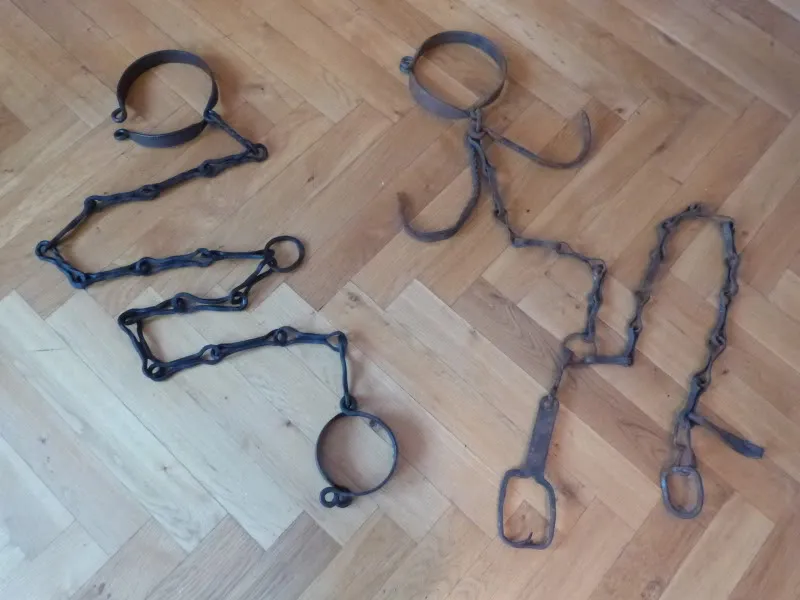
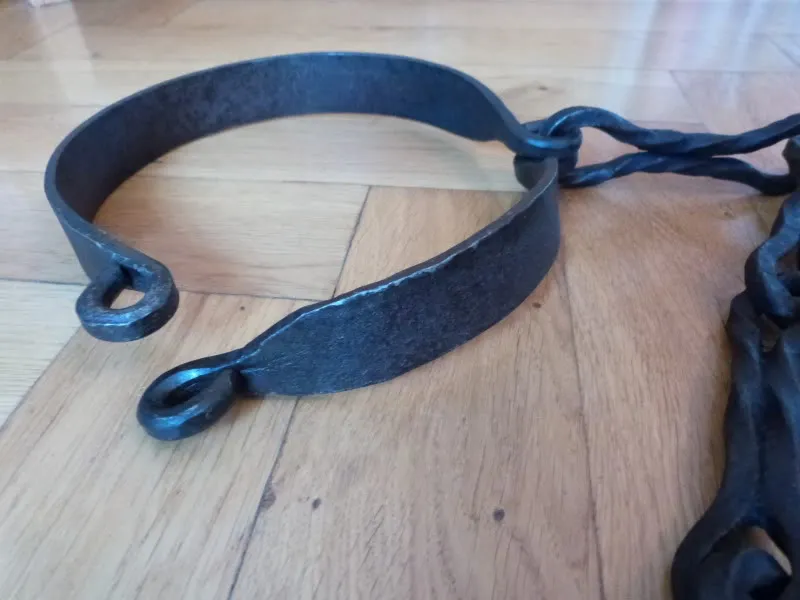
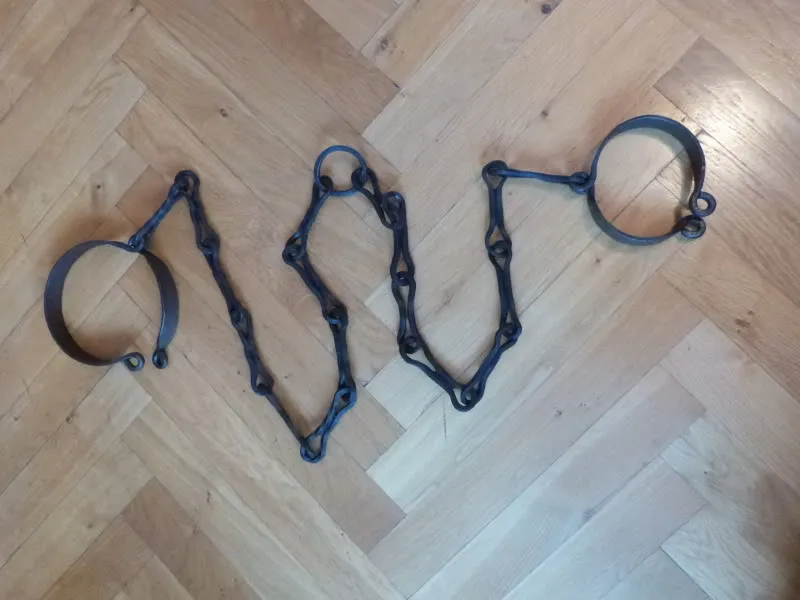
One appears to be a collar / leg iron combination, about 200cm long (7ft), with the collar being 16.5cm (7 inches) and the iron being 11cm (4.5 inches) diameter. It has a central ring to the chain. I cannot find any welding marks. The round pieces appear very even, though. This one I just cleaned up a little bit today.
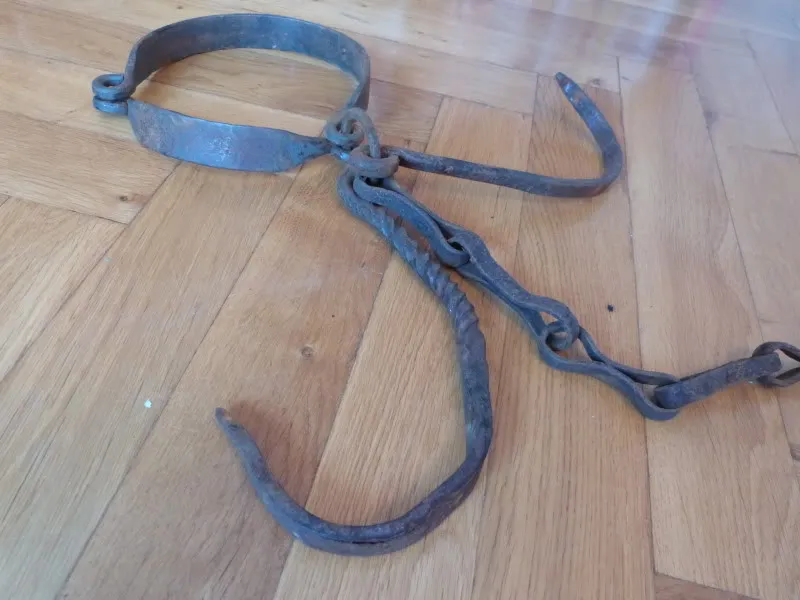
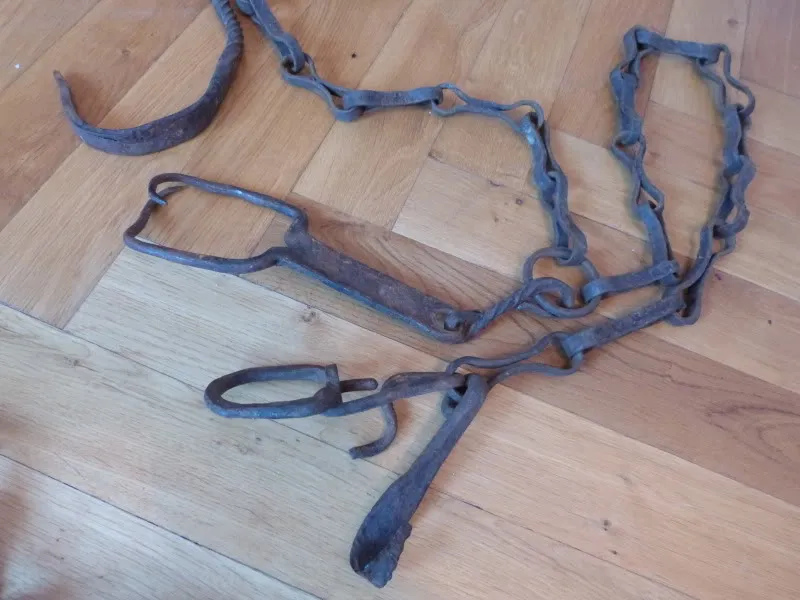
The second one is what appears to be a collar on a chain. What confuses me are are the two hooks attached to the collar, and an endpiece that looks as if it could be hooked up to something. I suppose the hooks could be to hook it up to a beam or something; not a pleasant thought, or I'm completely on the wrong track here.
I'm aware that two more like this recently sold on ebay, and I wonder if they are alike. I asked the seller about where they were from, and that is what he responded:
"These chains I bought one family house In Burgas, the place of which was during the Ottoman rule in Bulgaria, a military unit. I have a friend who has a cleaning company of old houses and help each other. Chains were in the basement of the house, like a basement, along with other old stuff, and one of them extremely rare and beautiful Turkish scimitar, with coral, silver pad granulation, white handle of walrus. Perfectly preserved scimitar, he has dated in 1810 by Christian chronology. History is such that there was no Turkish arrest more than 200 years. There were 5-6 chains, but no rings for neck or legs. [sic] Chains are definitely very old, I can only guess exactly when they are. Normally there is some continuity. I think my friend took them, there was another ring for the neck, and several feet, 2 I think."
If you refer to Thompson's article in the Archeological Journal (150), or in my case the reprint, you'll find similar designs on pp. 60-75. I wouldn't go as far as claiming these pieces are of Roman origin, but the design looks as it has been preserved from Roman times, especially the chain on the first one. Eastern Rome (Constantinople), or the Byzantine empire existed, in effect, until 1453. The Ottoman empire succeeded it (until 1923).
I would like to sugggest these pieces are probably of Ottoman origin and date them around 1820-40. Any thoughts? I'd like to see some pictures of the other sets.
Nils
Shackle No. 1.
Shackle No. 2.
recently I was able to add these two pieces to the collection. Both are from Eastern Europe (Bulgaria).
One appears to be a collar / leg iron combination, about 200cm long (7ft), with the collar being 16.5cm (7 inches) and the iron being 11cm (4.5 inches) diameter. It has a central ring to the chain. I cannot find any welding marks. The round pieces appear very even, though. This one I just cleaned up a little bit today.
The second one is what appears to be a collar on a chain. What confuses me are are the two hooks attached to the collar, and an endpiece that looks as if it could be hooked up to something. I suppose the hooks could be to hook it up to a beam or something; not a pleasant thought, or I'm completely on the wrong track here.
I'm aware that two more like this recently sold on ebay, and I wonder if they are alike. I asked the seller about where they were from, and that is what he responded:
"These chains I bought one family house In Burgas, the place of which was during the Ottoman rule in Bulgaria, a military unit. I have a friend who has a cleaning company of old houses and help each other. Chains were in the basement of the house, like a basement, along with other old stuff, and one of them extremely rare and beautiful Turkish scimitar, with coral, silver pad granulation, white handle of walrus. Perfectly preserved scimitar, he has dated in 1810 by Christian chronology. History is such that there was no Turkish arrest more than 200 years. There were 5-6 chains, but no rings for neck or legs. [sic] Chains are definitely very old, I can only guess exactly when they are. Normally there is some continuity. I think my friend took them, there was another ring for the neck, and several feet, 2 I think."
If you refer to Thompson's article in the Archeological Journal (150), or in my case the reprint, you'll find similar designs on pp. 60-75. I wouldn't go as far as claiming these pieces are of Roman origin, but the design looks as it has been preserved from Roman times, especially the chain on the first one. Eastern Rome (Constantinople), or the Byzantine empire existed, in effect, until 1453. The Ottoman empire succeeded it (until 1923).
I would like to sugggest these pieces are probably of Ottoman origin and date them around 1820-40. Any thoughts? I'd like to see some pictures of the other sets.
Nils
Shackle No. 1.
Shackle No. 2.