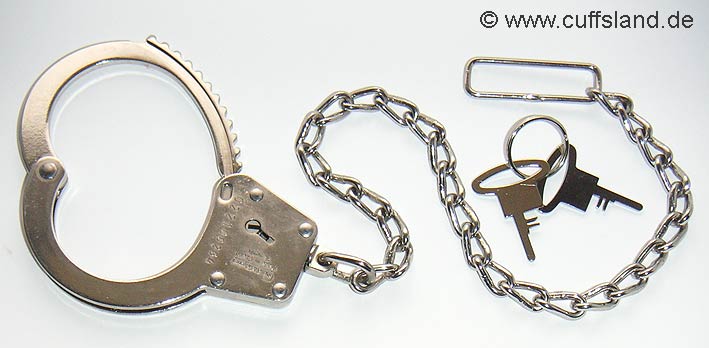
Pretty basic question, I know, but it seemed like the best place to ask. I guess they wouldn't be made if there wasn't a demand for them, but what exactly are they FOR? I presume they wouldn't be used on a violent prisoner, or anyone who might try to use the chain as a grrrote, but if someone's that trustworthy, why would you need to handcuff them at all? When would police or prison guards actually use them?
Liam asked about a device that police have used for hogtying a prisoner. Someone said that the manufacturer has discontinued that device. The Chicago Model 3400 is a similar device. Excerpt from on on-line retailer for this item:
"High security transport and control device that replaces hog-tying prisoners and prevents sudden in-custody death. Mobility is safely reduced. Kicking of people or objects (such as squad car windows) is safely eliminated by the special ergonomic design. Chicago model X55 NIJ approved Stainless steel handcuffs attached to reduced link Model 2200 leg irons via a 20" chain."
There was also a question about whether police use this gear. My source says that it was a standard item but went out of use (for hogtying if not for prisoner transport with hands in front) because of (unfounded) fears of positional asphyxia (and well-founded fears of law-suits). I quote again with my additions in parentheses:
Until the mid-1990s, use of "hogtie" restraints was common. In the hogtie position, the prisoner is placed face down on the ground, his wrists and ankles bound (or chained) behind his back and then tied together by a rope or cord (or, linked by a chain). This type of restraint began to fall in(to) disuse when it was alleged that sudden death could be produced utilizing this position and type of restraint. Numerous civil suites were filed in regard to prisoners dying while hogtied. It was alleged that securing an individual in this position caused hypoventilatory respiratory failure, i.e., positional asphyxia. (My training manual or officer said to roll the prisoner up on one shoulder when hogtied to take the pressure off the chest, especially for obese people, to avoid asphyxia.) In experiments involving high-intensity physical activity followed by hogtie restraint, Chan et al. demonstrated that, while there was impairment of respiratory activity, it "did not result in clinically relevant changes in oxygenation or ventilation." (Forensic Pathology, Second Edition, DiMaio & DiMaio)
Anyone want to volunteer to repeat the experiment?
Ted Shepherd.