RyanVaene
#1Hello fellow collectors,
Today I am bringing to the forum the sixth part of my series "Modern Vintage" as illustrated by my (almost) completed collection. This part of the series is focused on swing through style handcuffs and leg irons, from modern law enforcement cuffs to some older or more unusual varieties. As always, this information is to the best of my knowledge, and I welcome any comments, questions, corrections, etc.
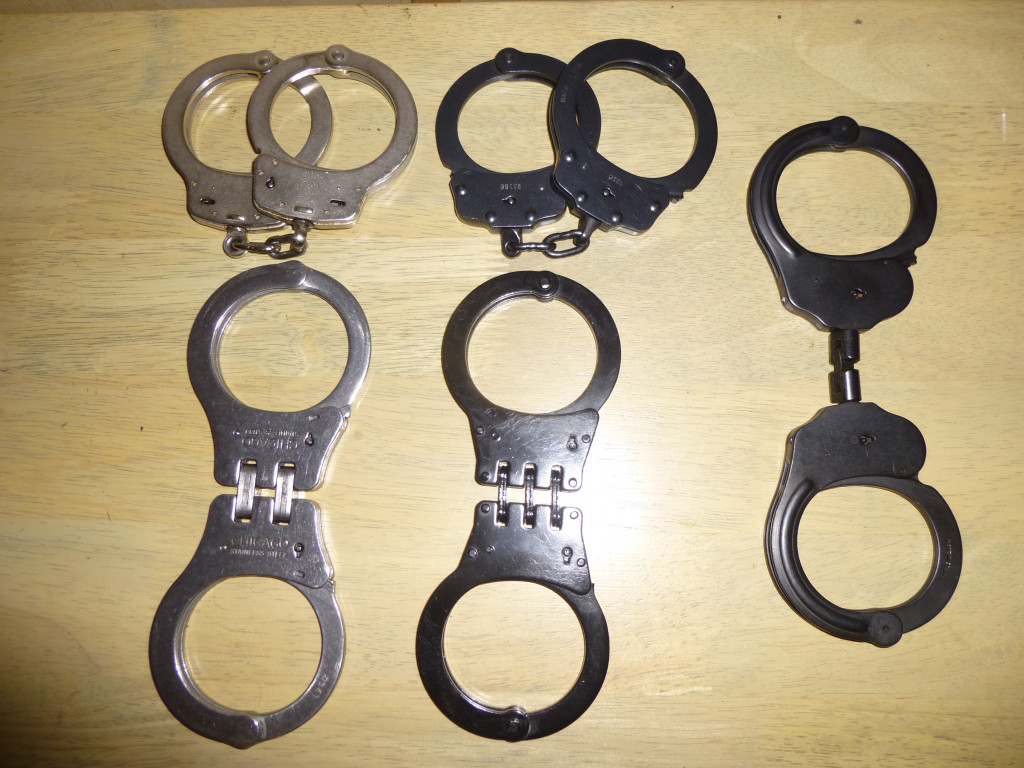
Starting at the upper left, we have the standard Smith and Wesson 100-1, which is widely used by law enforcement and corrections. These have a soft satin nickel finish which doesn't scratch easily. The double lock is activated by a slot accessible from either side of the cuff. These are well made and reliable.
To the right we have the Peerless 701C, which is comparable to the Smith and Wesson in all regards, the preference being largely a personal one. The black oxide finish looks very nice, but is easily scratched. The contrasting color makers mark and serial number look good on the black finish, and these give off a more military or industrial/mechanical look than the Smith and Wesson. The ratchet action was harsher at first, but has softened a bit over time. The edges seem a little less well rounded than the Smith and Wesson.
Lower left we have the Chicago model 1200, which is a slightly larger than usual hinged handcuff with back-loading capability. These are made of stainless steel, and use a push pin double lock on the side of the cuff body. These have a smooth ratchet action, and are very well made. The larger size makes it easy to rotate one's wrists within, slightly decreasing security, but as a hinged cuff, if applied properly, these would still be quite secure.
To the right is a pair of off-brand hinged handcuffs with a black finish, with the words "Made in China" stenciled in green paint on one cuff. These have back-loading capability, push pin double locking, and are of a standard size, all in all of an acceptable quality. Interestingly, these open with a standard handcuff key, but the keys provided have a slightly smaller bore, thus they will not open standard handcuffs. This is in stark contrast to many other off brand non law enforcement handcuffs, which require a key with a slightly shorter flag, inadvertently making them 'higher security' as they won't open with a standard key.
To the far right we have what I believe to be a pair of Alcyon handcuffs with a black finish and a universal link in place of the standard chain; however, I am unsure of the model, as I haven't found a match with this raised reinforced bow. The double lock on the side is square shaped, and must be pressed in a little further than usual, so much that it is difficult to activate with a standard key, although the standard key has no trouble opening the cuff itself. The only mark is "made in spain" on one bow.
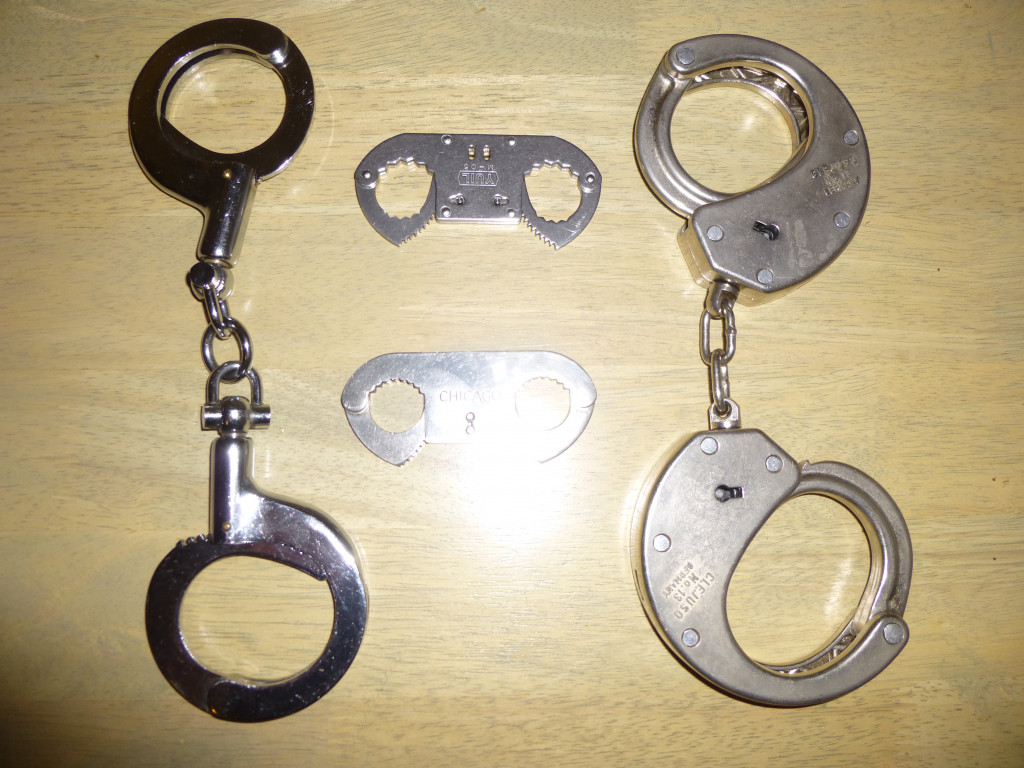
On the left, a pair of chinese made replicas of the H and R supercuff. These are not quite up to par with the craftsmanship of the original, unfortunately. The key is slightly different, although the secure hidden keyway is the same. These cuffs lock using a star wheel, and the double lock is activated by turning the key in the opposite direction. The hidden keyway is only reveled when the clevis is turned 90 degrees, making it quite difficult to escape from.
On the far right, a pair of Clejuso "medium weight" model 13, which is a very interesting German handcuff. The very heavy and well rounded cuff is well made, with a lattice design on the interior of the side plates. The double lock is finger activated, and the cuffs are identical, thus not a mirror image of the other. They are also available with a leg iron length chain, and in an even heavier version, the model 15.
In the middle, sets of thumbcuffs. The topmost is the Yuil M-05, which has separate keyholes for each cuff. The double lock is activated by a slot. These are a bit thinner than the Chicago model below, which has two keyholes, but they operate differently, in that the upper key hole unlocks the shared double lock, and the lower keyhole unlocks either cuff. The single double lock is a push pin on the top of the cuff. The Yuil has ridges on both the double and single strand, while the Chicago has ridges only on the double.
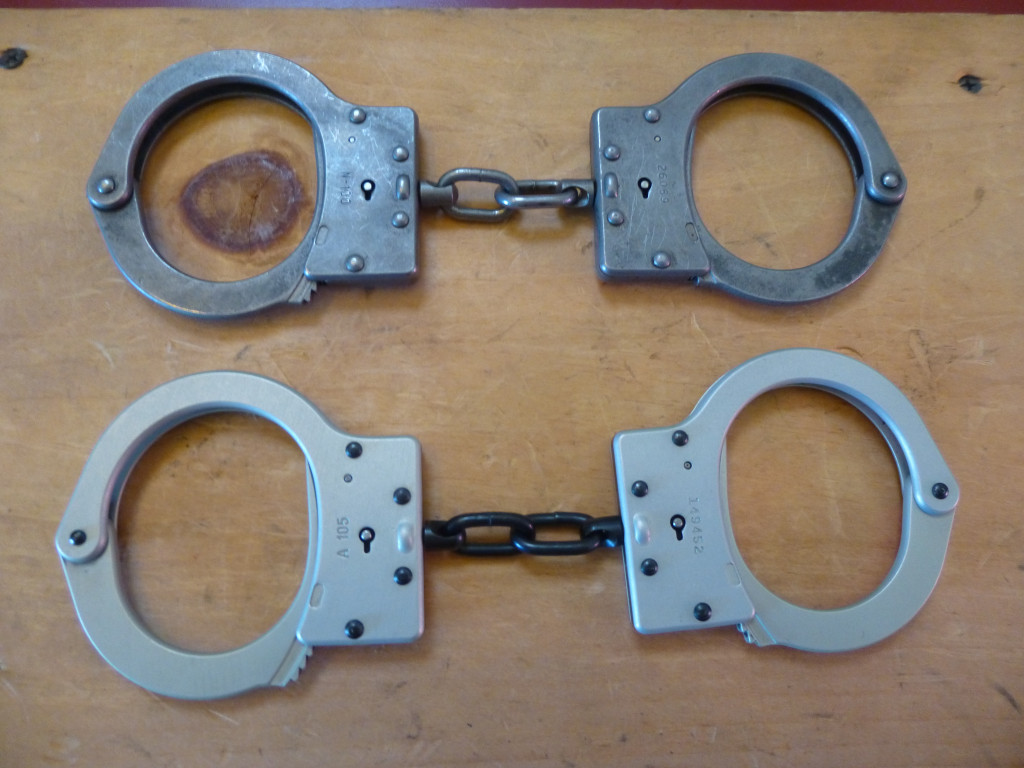
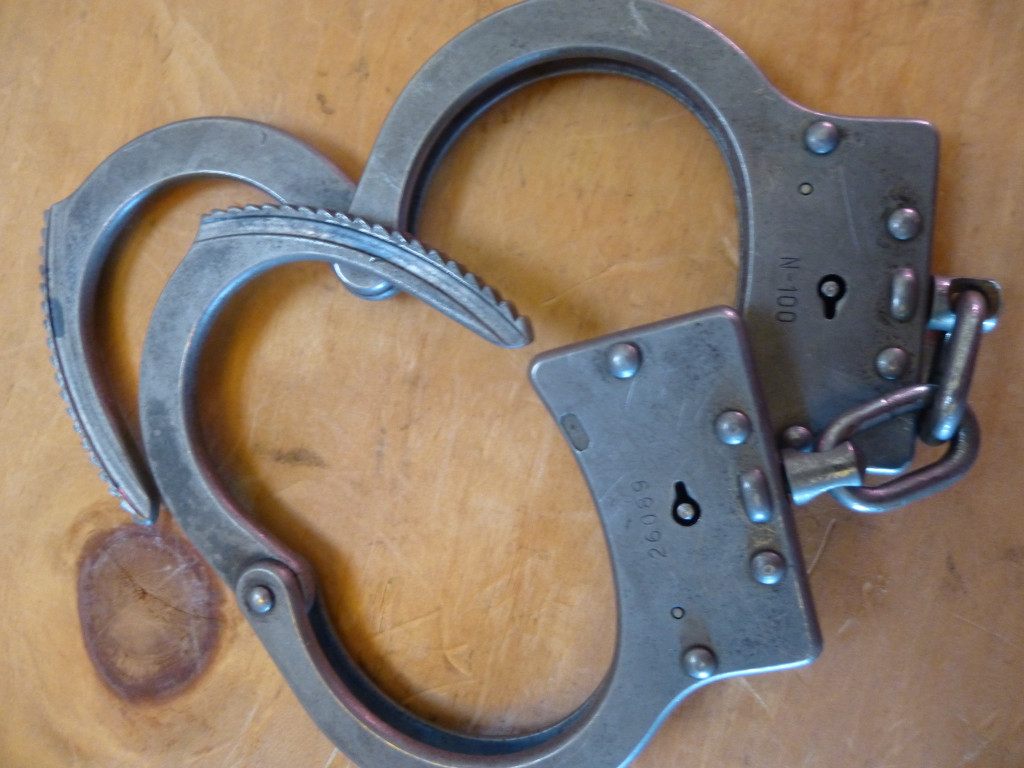
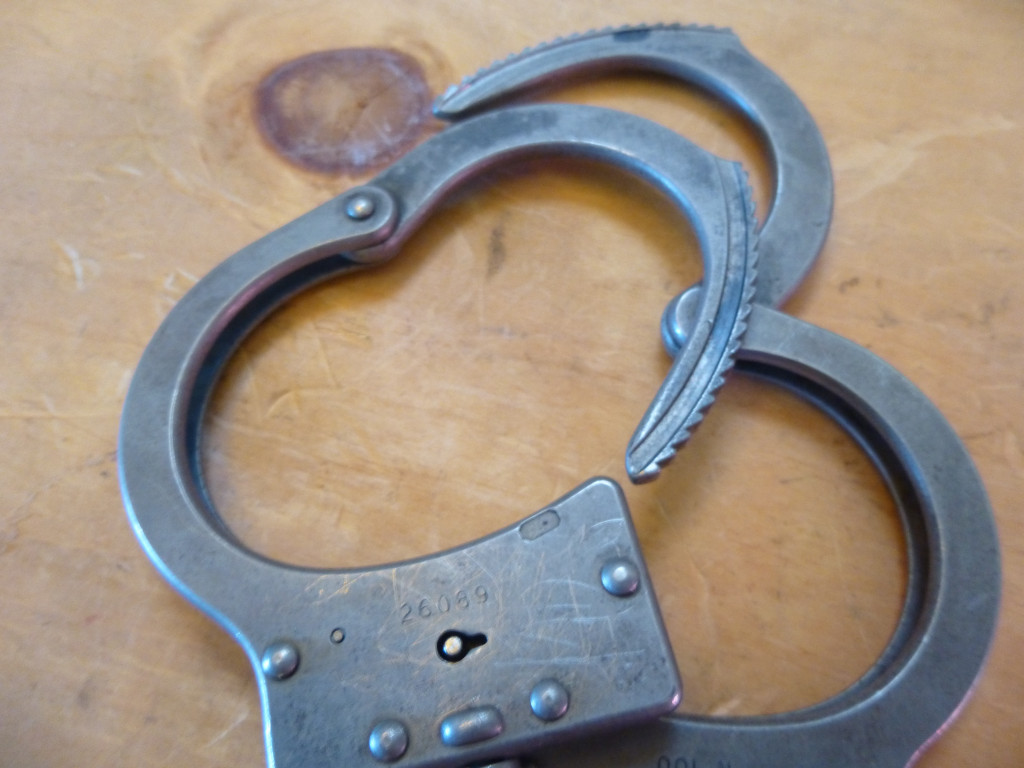
Above, two pairs of American Handcuff Company handcuffs, the model N-100 and the lightweight A-105. These are very well made cuffs, with a sort of craftsmanship and attention to detail that goes beyond modern manufacturing. The edges are more well rounded than any modern cuff, and this extends around the entire bow and lock body. The steel N-100 appears to have been black, although the finish is all but worn away, to the point that I wondered if it were a patina on a steel cuff instead of a factory finish. The N-100 has a very solid ratchet. The aluminum A-105 is extremely light, almost uncanny in its lack of heft. Only the internal parts, the chain, swivels, and rivets are steel, while the rest is aluminum. The contrasting colors give this a striking appearance.
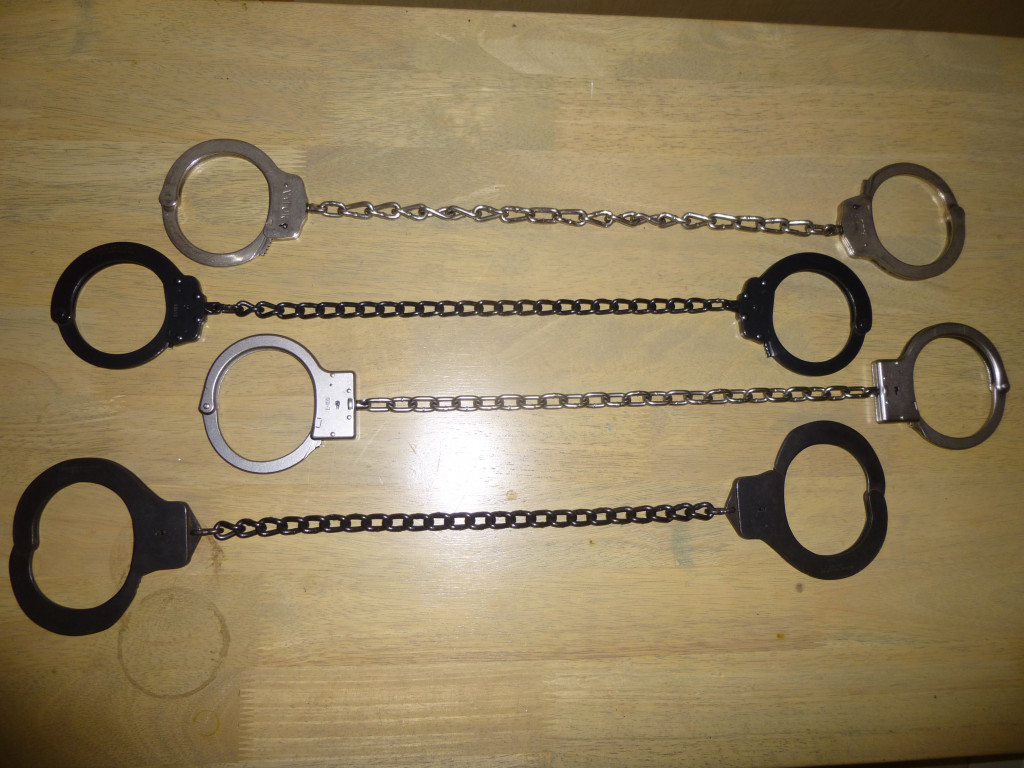
And finally above we see four sets of leg irons, with the topmost being a nickel plated set by Valor, with a ditched jaw, non mirror image cuffs, and a push button double lock. While Valor is not a professional brand, these are perfectly functional and I have had them the longest out of any cuff in my collection.
Below is the Peerless 703C, which match the Peerless 701C very nicely, with the contrasting markings again lending a certain machined look to the cuff. These are a bit stiff on the swing through and the ratchet action, but are very well made. Similar to the handcuffs, I feel these are not as well rounded on the edges as Smith and Wesson brand cuffs.
Below that is the American Handcuff Company L-100, which is a very nice set of leg irons. These are extremely well rounded on all edges, the same as the handcuffs by AHC, with a smooth ratcheting action, a push pin double lock, and a flat oval link chain.
At the bottom, a pair of Harvard Lock Company leg irons, which are of a slightly simpler design, lacking swivels, and being double locked by turning the key in the opposite direction.
That does it for the swing through style cuffs in my collection. I will be bringing one or two more parts of this series, including "Superlatives: oldest, most secure, most 'comfortable', easiest to pick, collectors favorite, etc" and a series of matched sets from my collection as well.
I'm glad to see the forum is maintaining a bit more activity recently. Please feel free to comment on any of the above. Do you think the American Handcuff N-100 was originally black finish, and has worn away, or is this a plain steel with a patina? Here are two more pictures to help decide!
Today I am bringing to the forum the sixth part of my series "Modern Vintage" as illustrated by my (almost) completed collection. This part of the series is focused on swing through style handcuffs and leg irons, from modern law enforcement cuffs to some older or more unusual varieties. As always, this information is to the best of my knowledge, and I welcome any comments, questions, corrections, etc.
Starting at the upper left, we have the standard Smith and Wesson 100-1, which is widely used by law enforcement and corrections. These have a soft satin nickel finish which doesn't scratch easily. The double lock is activated by a slot accessible from either side of the cuff. These are well made and reliable.
To the right we have the Peerless 701C, which is comparable to the Smith and Wesson in all regards, the preference being largely a personal one. The black oxide finish looks very nice, but is easily scratched. The contrasting color makers mark and serial number look good on the black finish, and these give off a more military or industrial/mechanical look than the Smith and Wesson. The ratchet action was harsher at first, but has softened a bit over time. The edges seem a little less well rounded than the Smith and Wesson.
Lower left we have the Chicago model 1200, which is a slightly larger than usual hinged handcuff with back-loading capability. These are made of stainless steel, and use a push pin double lock on the side of the cuff body. These have a smooth ratchet action, and are very well made. The larger size makes it easy to rotate one's wrists within, slightly decreasing security, but as a hinged cuff, if applied properly, these would still be quite secure.
To the right is a pair of off-brand hinged handcuffs with a black finish, with the words "Made in China" stenciled in green paint on one cuff. These have back-loading capability, push pin double locking, and are of a standard size, all in all of an acceptable quality. Interestingly, these open with a standard handcuff key, but the keys provided have a slightly smaller bore, thus they will not open standard handcuffs. This is in stark contrast to many other off brand non law enforcement handcuffs, which require a key with a slightly shorter flag, inadvertently making them 'higher security' as they won't open with a standard key.
To the far right we have what I believe to be a pair of Alcyon handcuffs with a black finish and a universal link in place of the standard chain; however, I am unsure of the model, as I haven't found a match with this raised reinforced bow. The double lock on the side is square shaped, and must be pressed in a little further than usual, so much that it is difficult to activate with a standard key, although the standard key has no trouble opening the cuff itself. The only mark is "made in spain" on one bow.
On the left, a pair of chinese made replicas of the H and R supercuff. These are not quite up to par with the craftsmanship of the original, unfortunately. The key is slightly different, although the secure hidden keyway is the same. These cuffs lock using a star wheel, and the double lock is activated by turning the key in the opposite direction. The hidden keyway is only reveled when the clevis is turned 90 degrees, making it quite difficult to escape from.
On the far right, a pair of Clejuso "medium weight" model 13, which is a very interesting German handcuff. The very heavy and well rounded cuff is well made, with a lattice design on the interior of the side plates. The double lock is finger activated, and the cuffs are identical, thus not a mirror image of the other. They are also available with a leg iron length chain, and in an even heavier version, the model 15.
In the middle, sets of thumbcuffs. The topmost is the Yuil M-05, which has separate keyholes for each cuff. The double lock is activated by a slot. These are a bit thinner than the Chicago model below, which has two keyholes, but they operate differently, in that the upper key hole unlocks the shared double lock, and the lower keyhole unlocks either cuff. The single double lock is a push pin on the top of the cuff. The Yuil has ridges on both the double and single strand, while the Chicago has ridges only on the double.
Above, two pairs of American Handcuff Company handcuffs, the model N-100 and the lightweight A-105. These are very well made cuffs, with a sort of craftsmanship and attention to detail that goes beyond modern manufacturing. The edges are more well rounded than any modern cuff, and this extends around the entire bow and lock body. The steel N-100 appears to have been black, although the finish is all but worn away, to the point that I wondered if it were a patina on a steel cuff instead of a factory finish. The N-100 has a very solid ratchet. The aluminum A-105 is extremely light, almost uncanny in its lack of heft. Only the internal parts, the chain, swivels, and rivets are steel, while the rest is aluminum. The contrasting colors give this a striking appearance.
And finally above we see four sets of leg irons, with the topmost being a nickel plated set by Valor, with a ditched jaw, non mirror image cuffs, and a push button double lock. While Valor is not a professional brand, these are perfectly functional and I have had them the longest out of any cuff in my collection.
Below is the Peerless 703C, which match the Peerless 701C very nicely, with the contrasting markings again lending a certain machined look to the cuff. These are a bit stiff on the swing through and the ratchet action, but are very well made. Similar to the handcuffs, I feel these are not as well rounded on the edges as Smith and Wesson brand cuffs.
Below that is the American Handcuff Company L-100, which is a very nice set of leg irons. These are extremely well rounded on all edges, the same as the handcuffs by AHC, with a smooth ratcheting action, a push pin double lock, and a flat oval link chain.
At the bottom, a pair of Harvard Lock Company leg irons, which are of a slightly simpler design, lacking swivels, and being double locked by turning the key in the opposite direction.
That does it for the swing through style cuffs in my collection. I will be bringing one or two more parts of this series, including "Superlatives: oldest, most secure, most 'comfortable', easiest to pick, collectors favorite, etc" and a series of matched sets from my collection as well.
I'm glad to see the forum is maintaining a bit more activity recently. Please feel free to comment on any of the above. Do you think the American Handcuff N-100 was originally black finish, and has worn away, or is this a plain steel with a patina? Here are two more pictures to help decide!