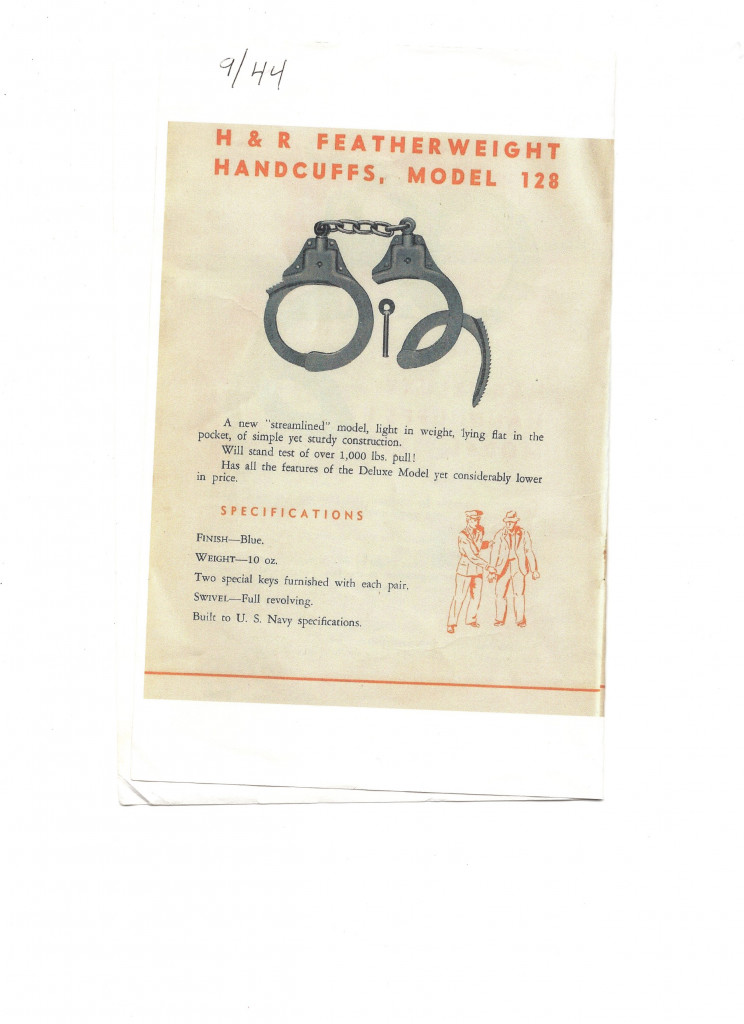
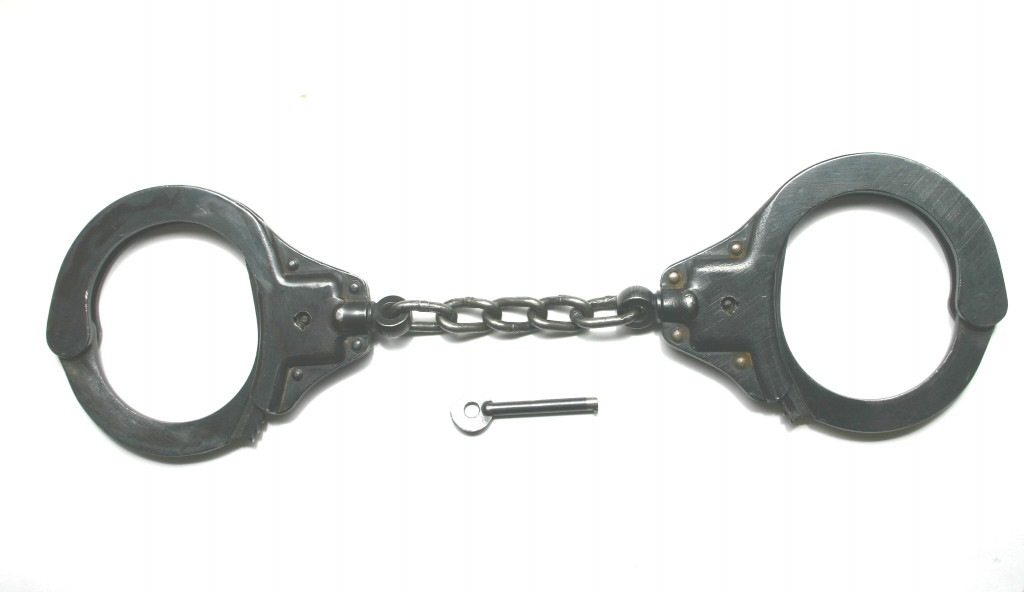
Model 128 prototype and /or patent model.
This model was supposed to be manufactured in 1945. It never happened.
Stamped construction,both sides are the same,therefore there is a keyhole
on both sides.The key has a tiny bit, must be used with caution.
Mark Lyons O--O Cuffs 20 Aug 2020
#2Utterly fantastic!
If there are keyholes on each side, is the mechanism also functional by the key on both sides?
Yes the cuff can be opened from both sides and double locked. This is not a new idea. The first ( to my knowledge)
was the Cobb, over 100 years ago.
how does the double lock work? via the keyhole?
The cuff double locks with the key. Look closely at the pic and you can see that the key
can go in 2 different ways. One key way faces down and the other inward. To double lock
key goes in the downward key way and turn key 1/4 turn ccw and remove key from inward key way.
To remove double lock just reverse.
To unlock with double lock off, key goes in downward key way and turn key 1/4 turn cw, bow drops
out, return key to downward key way and remove.
holstcollection 21 Aug 2020
#7Gordon, is this the only set known to exist?
This is for sure a very nice cuff. I'm obsessed by oddballs and raries like this one.
Thanks, Gordon.
Lars, nah, it’s nothing like anything I own.
Brad
Sent from my iPhone using Tapatalk
Hi Lars
The seller told me this was the only one. It was from the Prynce Wheeler collection.
I never heard of another one. The brochure says it was made to Navy specifications.
H&R was probably hoping for a big order from them. But in 1945, forget it.
Gordon wrote:
↑Aug 21, 2020
The cuff double locks with the key. Look closely at the pic and you can see that the key
can go in 2 different ways. One key way faces down and the other inward. To double lock
key goes in the downward key way and turn key 1/4 turn ccw and remove key from inward key way.
To remove double lock just reverse.
To unlock with double lock off, key goes in downward key way and turn key 1/4 turn cw, bow drops
out, return key to downward key way and remove.
thank you, it seems an interesting mechanism if it can be operated from both sides, Unique now and for it's time.
holstcollection 22 Aug 2020
#11Hi Gordon,
Thank you Gordon! I've never heard of another set so this one must be unique.
In addition, they are especially interesting as they came from a well known maker,
Congratulations to owning such a rare piece!
Lars
Hi, is the Hiatt 1960 mechanism based on this?
Winston
I can see why you asked that question, the operation is similar. I think it is possible,
but you would have to ask Hiatt. The difference is the M128 is a lightweight cuff,
the 1960 is much heavier and therefore have more to work with. The 1960 cuff
key I would say is probably an improvement. The thing is if you are use to M128
and have the lite touch to work the key, that's fine and you are happy.
1960 easy to operate.
For those of you who might be interested, Alfred Ruttiman was born on September 5, 1885 in Switzerland. He immigrated to the U.S. in 1913. He received his patent for handcuffs on November 13, 1945 (2,388,766). At the time, he was a resident of Worcester, Massachusetts and assigned his patent to Harrington & Richardson. City directories for Gardner, Massachusetts in 1934 and 1936 list him as an experimental and research engineer. Prior to these dates the 1930 census lists him as an engineer in an oil stove factory, but his WWII registration indicates that in 1942 he was working for H&R Arms. Between 1935 and 1945 he received numerous patents for valves, a burner bowl for stoves, a ribbon mechanism for recording apparatus, assigned to the Simplex Time Recorder Company and other patents. He died on July 1, 1976