OnlyCuffsOnlyCuffsarchive search
The Forum at Handcuffs.Org

Identify lettering

11 visible archived posts · 11 preserved total · topic ID 7718
Original topic ↗Recovered images
Coatimom 08 Dec 2023
#1
I recently purchased these as a Christmas present for my son, and I was wondering if anyone knows what the lettering signifies. I can find a lot of images of different handcuffs, but not a lot of the history. I just think it would be really cool to be able to know some of the actual background, if possible.
CuffmanBelgium 08 Dec 2023
#2
DRP stands for 'Deutsches Reich Patent'.
Coatimom 08 Dec 2023
#3
Thank you!
Bjoern70 09 Dec 2023
#4
Some more background:
 - 1910 Patent
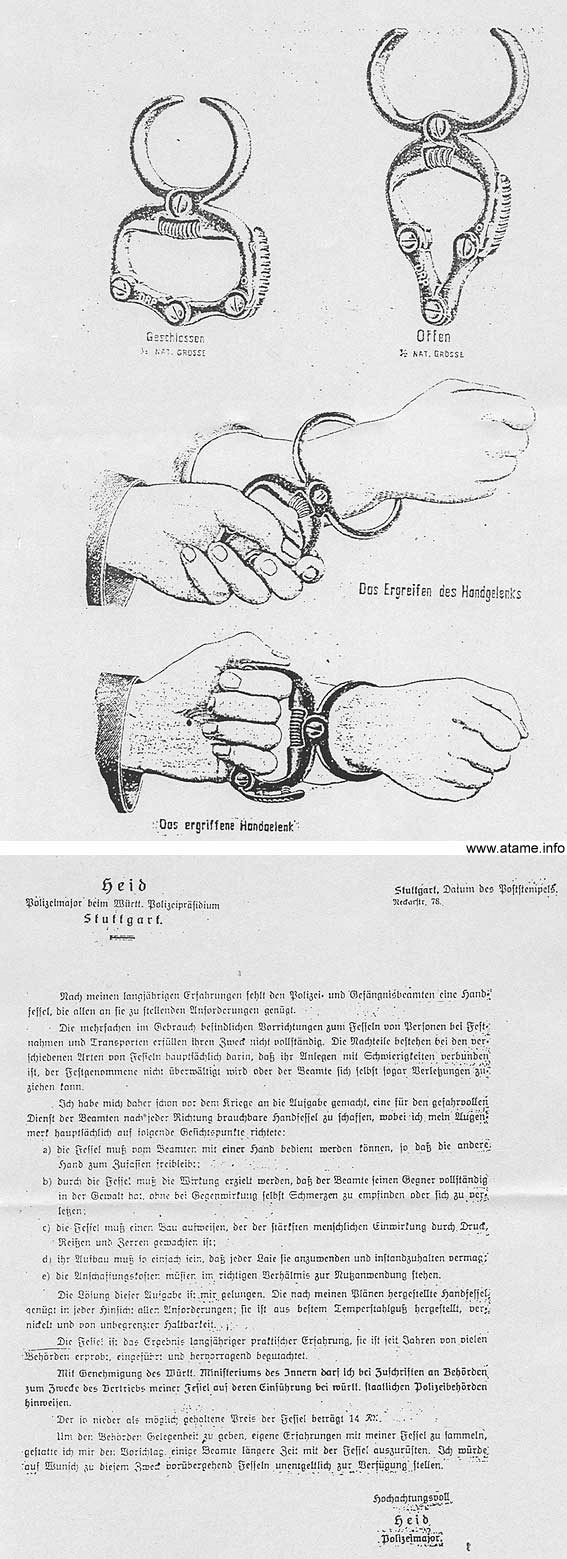
 - Advertisement letter from the inventor Reinhold Heid about the advantages of his nipper, available on Atame's splendid homepage

Best regards
Bjoern
Coatimom 09 Dec 2023
#5
Excellent! Thank you!
rejones68 09 Dec 2023
#6
Bjoern70 wrote: ↑
Dec 09, 2023
Some more background:
 - 1910 Patent
 - Advertisement letter from the inventor Reinhold Heid about the advantages of his nipper, available on Atame's splendid homepage

Best regards
Bjoern
Sir you’ve helped me with information on these Heid & Roth nippers before. Would you have any idea on how to identify the first patented version just by looking at an add like one eBay? I have 3 different versions now and I believe what I have are the second and the two different versions that were the last to be made. I’m still trying to get the first patented model but I’m not certain how to identify it by just looking at photos. Thanks in advance for any input. Best regards, Ron J
Bjoern70 09 Dec 2023
#7
Hi Ron,
I do not own such a nipper, but according to the patents from 1910, 1951 and 1964 the main difference seems to be the locking lever:
 - 3rd model has a long locking lever (58mm = 2.28"):
 - The 1951 model has a short locking lever (45mm = 1.77"):
 - The 1910 model has a long main spring, which is not visible. The locking lever is short, too. A "DRP" engraving is an indication of this model:
Best regards
Bjoern
Coatimom 09 Dec 2023
#8
Thank you so much! Most of the time when people tell everyone the parts to look at to date or identify them, I don't know what piece they are talking about, mechanical engineering is not my thing. And a lot of the markings that are supposed to be there are either unreadable or possibly worn off? I REALLY wanted to polish and shine them up, but a few people convinced me not to do it.
rejones68 09 Dec 2023
#9
Bjoern70 wrote: ↑
Dec 09, 2023
Hi Ron,
I do not own such a nipper, but according to the patents from 1910, 1951 and 1964 the main difference seems to be the locking lever:
 - 3rd model has a long locking lever (58mm = 2.28"):
1964.png
 - The 1951 model has a short locking lever (45mm = 1.77"):
1951.png
 - The 1910 model has a long main spring, which is not visible. The locking lever is short, too. A "DRP" engraving is an indication of this model:
1910.png
Best regards
Bjoern
Click to expand...
Bjoern thank you for the information. However I’m even more confused as to which versions I have. I own 3 and the levers on all of them are 1.75 inches. They all have different frame sizes and weights as well. I thought I had the two different versions patented in 1964 as they are very similar but one has a larger frame and weighs 10 grams more than the other. The levers on each are 1.75 inches. The other version I own is what I thought was the 1951 patent as it has the smallest frame of my three. However it is marked DRP and is the lighter of the three I own. Its lever is also 1.75 inches. I may never figure these nippers out, but I’m happy to have them all as part of my collection. I’m just hoping that someday I will own the 1910 version, if I don’t already. As always thank you and best regards. Ron J
Bjoern70 09 Dec 2023
#10
Hi Ron,
you could check the length of the main spring by disassambling the bows or just by testing the depth of the boreholes, e.g. by inserting a piece of wire as a probe.
The 1910 model bores should measure approximately 21mm = 0.83" in depth:
The 1951 and 1964 model bores should measure approximately 5mm = 0.2" in depth:
Best regards
Bjoern
rejones68 09 Dec 2023
#11
Bjoern70 wrote: ↑
Dec 09, 2023
Hi Ron,
you could check the length of the main spring by disassambling the bows or just by testing the depth of the boreholes, e.g. by inserting a piece of wire as a probe.
The 1910 model bores should measure approximately 21mm = 0.83" in depth:
1910_.png
The 1951 and 1964 model bores should measure approximately 5mm = 0.2" in depth:
1951_.png
Best regards
Bjoern
Thank you yet again for sharing information. I will be removing the screws in taking measurements on them. Ron J