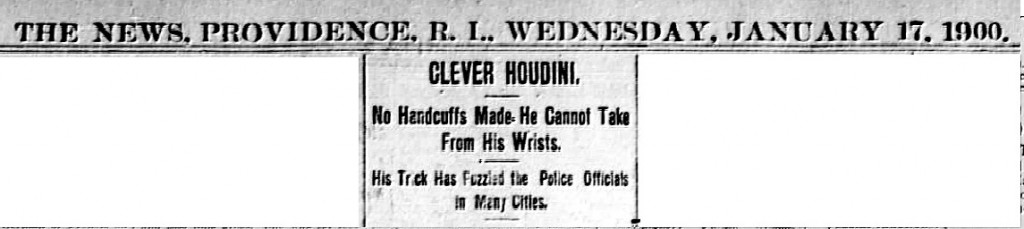
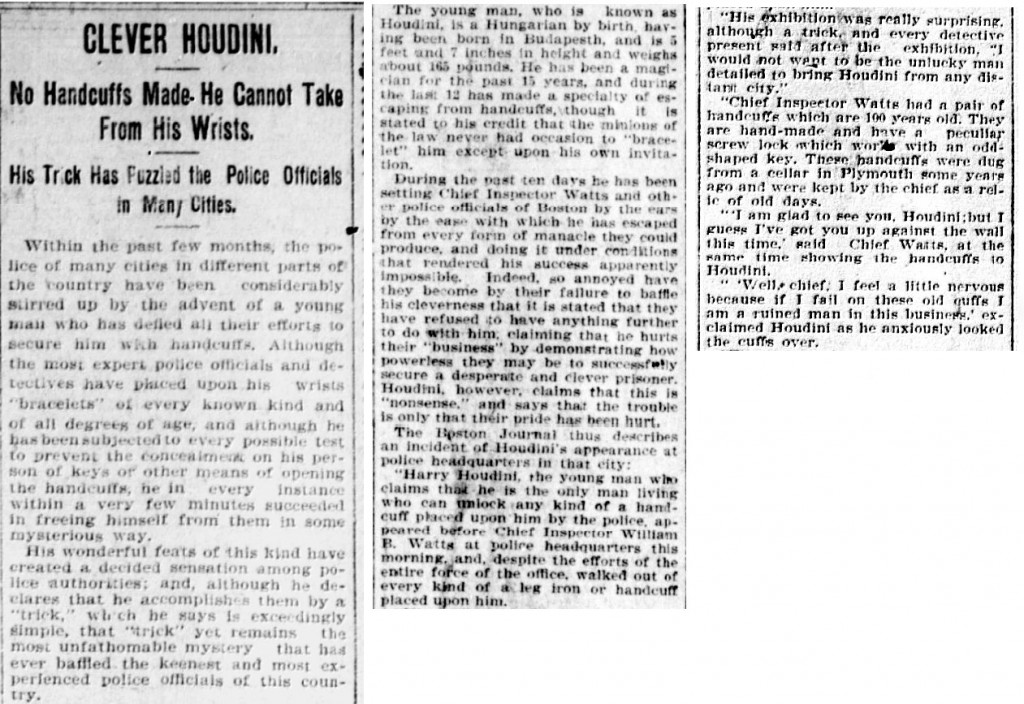
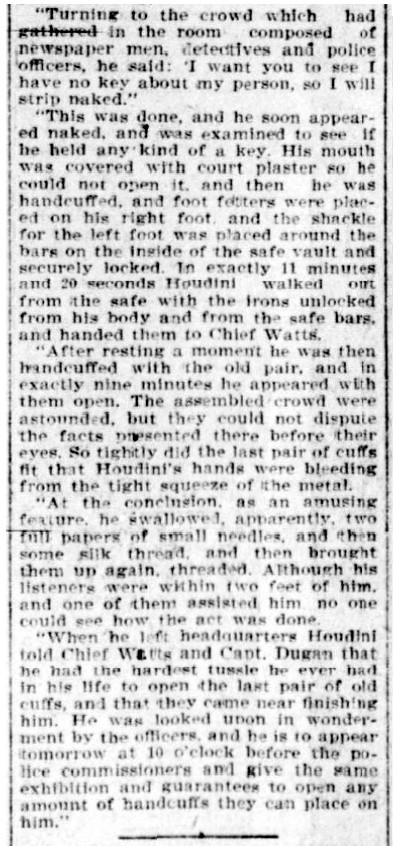
This is my favorite one of these newspaper articles. I find it incredible
!
Many authors of books tell the story of Houdini, but this one has the words come directly from Houdini.
I realize that Houdini authored many books, including his pitchbooks, but this article is more of an interview and seems to be penned by him.
Not sure if he had any help with writing his other works.
I think this is an important find and may not have had a viewership in many, many years.
Houdini talks about the German Slander Trial, tampered handcuff challenges (with some challenger's names that may not have been documented before), Siberian Transport Cell, The assassin Guiteau jail cell switch, names of some cuffs he worked with, and so many other facets in his career. He even talks about revealing his trade secrets and living in Los Angeles when he becomes retirement age. Unfortunately, we know that those plans never came to fruition, when he died way too early. Many of his secrets went with him.
I don't know if any author of a book knew about Houdini mentioning his retirement goals. I've read many books, but don't recall any of this before.
The article is laden with punctuation, spelling errors, incorrect and missing words. I Italicized a few words that may be incorrectly spelled or used.
As this discovery may be used by others in the future, I took a few simple liberties and corrected many of them, but not all, as I wanted to share this without changing too much of Houdini's words or the way he spoke.
Los Angeles Herald. September 29, 1907, Page 6
HOUDINI IS REMINISCENT
HANDCUFF KING TELLS STORY OF HIS LIFE
THRILLING INCIDENTS CROWD CAREER
Claims the Marvelous Acts He Does
Are Simple and Makes No Profession of Magic Powers
BY HARRY HOUDINI
THIS is not a biography but a story.
A biography must commence with the least interesting event of a man's life--the fact that he was born.
That must be taken for granted in m>case for my story shall commence with the events of today and take up in reverse order some of the interesting things that have happened to me since I reached that age at which every self respecting American boy begins to "shift for himself."
This is my second visit to Los Angeles. The previous one was in July, 1899 when the Orpheum was located in the present Grand Opera House on Main street. What a transformation? In eight years, Los Angeles has changed almost beyond recognition. It was like seeing an old friend gone to the bad to witness the difference in Main street today and eight years ago when it was the important street and the business center of the town.
On reaching Los Angeles my first thought was of some friends and acquaintances met here in 1899. My first visit was to the men who had chained and handcuffed me in my previous appearances. Captain Walter H. Auble and Sergeant Sam McKenzie remembered me at once. I need not say that it was a great pleasure to me that they should do so. These officers recalled to me practically everything I did at the Orpheum here eight years ago, and Captain Auble related one of the little tricks of magic I showed the men in a private exhibition given at police headquarters. Captain Auble is an excellent storyteller, and I can only approximate the interesting style in which he narrated the event.
"This man Houdini gave a little exhibition to the boys up In the assembly hall," said the captain.
"He took a package from his pocket, opened it up and showed us they were real needles. threaded In the interior? "For further proof he took one of them and stuck It through a fold in his cheek, which he held between his thumb and finger. We saw it sticking through about half an inch. He pulled it out and put it in his mouth. Then he took half the paper of needles
and placed them on his tongue. He opened his mouth and showed them there. He chewed up those needles and swallowed them, opened his mouth and showed they had disappeared. In the same way he chewed up and swallowed the other half of the package. "Next he put a few feet of thread into his mouth and ate that, too. "Finally, he opened his mouth and drew out the needles threaded, about ten inches apart.
"Now," concluded the captain, "I am not saying that Houdini really swallowed those needles and thread or that he has a self-threading stomach. But I saw him do Just what I say, though none of the boys will believe the story when I tell It." This is not told as a proof of my magic powers, but as a tribute to a good friend's excellent memory. The trick was done exactly as he states. It gave me the greatest pleasure to know that my humble efforts at entertaining the force eight years ago have been so well remembered. Sergeant Sam McKenzie was one of the men who shackled me on the Orpheum stage. "I made a good job of it. too," says Sam. "There was no faking about that. But you got out. Perhaps I will try it again before you leave Los Angeles, though I haven't much hopes of beating you."
Cuffs Must Be Regular
The one unpleasant feature of my visit here had its origin in that same visit to police headquarters. I think when Detective Tom Rico offered to bet a thousand dollars (or was It a million?) that he had a cuff from which I could not escape. He was not serious and that the challenge was made jokingly, for he made no offer to post any money, though I gave him every opportunity to do so. Probably the joshing to which he was subjected by other officers and the news paper reporters nerved him to make the unfair attempt on Monday evening last, in which he was so ignominiously defeated. As there has been a great deal of comments on this matter I shall say just a few words about it. Let me say in preface that I unlock every handcuff that is placed upon me. I do not merely slip them over my hands. l have a large hand. if a lock is plugged or broken or is not in proper working order or for any other reason cannot be unlocked, it is barred. This is only reasonable, for I do not pretend to have magic, it is all perfectly natural. Since I open the cuffs, it is a part of my challenge that i they must not be "faked" or tampered with. 'To insure this, I demand the right to inspect every manacle before it is placed upon me.
Last Monday evening, Tom Rico sent his nephew, Louis Rico, to the Orpheum with a pair of tampered cuffs. When my invitation was given, Louis Rico. and others came upon the stage. Louis Rico showed me a pair of regulation cuffs in perfect working order. When I held out my hands to him to be manacled, he substituted another pair while my back had been I turned. One of these was on my wrist and my assistant gave me a secret cue which he had been instructed to use to warn me of danger. I then took the other cuff and snapped it. Rico was nonplused. l demanded that he unlock the cuff and permit me to examine it. He replied that he had not the key. for it. (I afterward learned that he had the key in his pocket at the time.) He said, he would have to send for Tom to bring the key. He sent off a messenger to the police station and I took the opportunity to tell the audience what had taken place.
Says Cuff Is Unfair
I offered to wager $100 against Rico's $5 that the cuff had been "fixed." Why did he not accept? The answer is plain. He knew that he had done an underhanded trick and did not want to lose $5. because he knew I could prove his guilt at the time.
Then I retired to my cabinet and in forty minutes, I opened Rico's tampered cuff and handed the cuff back to the man opened and unlocked and repeated my offer to wager $100 against his $5 without a response from him. Surely, there was $5 among the bunch.
There was nothing especially difficult about the handcuffs produced by Rico. If they had been in good order. They were what is known as the
Marlin or Bottle neck cuff, patented by a Californian. A good cuff but offering no great difficulties if not tampered with. I have negotiated this class of cuff many hundred times.
Looking out of my hotel window, I see a streetcar passing which bears the announcement "Houdini will dive from the Westlake Park, Saturday at 12:30 noon." By the time this is printed that will be yesterday, and I have every hope that I shall still be alive. Should I fail to get those cuffs loose before my breath gives out you can imagine where I am while you are reading this. Among the feats of similar character that I have carried through might be mentioned the leap from the Seventh Street Bridge in Pittsburg, Pa., sixty feet into the icy waters of the Allegheny River. A crowd which is said to have numbered nearly 60,000 persons lined the bridge and the banks of the river to witness this. In December last, I leaped from the Belle Isle Bridge into the Detroit River in the presence of one of the largest crowds that ever assembled in that city.
,
Remarkable Escapes
Last Friday, which will be the last Friday week when you read this, I was nailed into a strong packing case by the employees of the J. M. Hale Co., and the case was then strongly roped by the same men. I believe that it took nearly eight minutes for me to escape without leaving any indication of my means of egress.
Among similar performances which have attracted much attention from the press was escaping from a box made, nailed and roped by the packers of the Henry Siegel store in Boston, and enclosed in another larger box which also was nailed and roped by the same parties. I have a handsome gold medal presented to me by the Siegel's in commemoration of this event, which took place on the 25th of January last.
I have been confined in packing cases, leather mall pouches, paper sacks, coffins, wicker baskets, tin-lined piano cases, roll topped desks, casks, plate glass cases with steel angle irons and a sheet steel steam boiler. All these events are detailed in the daily papers of Boston and Toledo during the months of February and March last. Can you imagine a city with the reputation for staidness and dignity which Boston boasts, going Houdini crazy? It Is hard, but it is true, and pleasant for me. Nothing that
ever visited Boston, except Tom Lawson, has attracted as much attention or received so much newspaper notoriety as I and my act last February.
But I am going backward faster than was my intention. Let us get ahead again. In San Francisco two weeks ago, a curious challenge was issued to me and accepted. Sailors often boast that what they cannot do with ropes is not worth doing. The men of the cruiser St. Louis, then in Frisco harbor, challenged me to escape from their nautical knots.
They roped and bound me much in the manner that the spider does his victims, but not with gossamer webs. Let me assure you that the cordage which Uncle Sam supplies to his navy is of the best. It will neither stretch nor slip when knotted by half a dozen stout tars. Did I escape? Yes, but it was a hard trial. When the last knot was l
oosed , I was so exhausted that I could scarcely bow my acknowledgments to the applause
that followed. I will also say that I was unable to escape until every knot was undone. They left me no chance to slip or wriggle through their meshes.
Fights on the Square
I do not relish the thought of a similar experience, but as a public performer, it is almost compulsory for me to take up any challenges of this character that are offered. I approach every new challenge with uncertainty for sometime I shall meet my Waterloo. In every career there comes a Gettysburg, and I go to mine. Well, when it comes, I shall say— "l have fought a good fight, and I have fought fair." When I am vanquished fairly, I will admit defeat like a man, but I demand fair and square opponents.
Have I ever been defeated in a challenge? No, never. I have had many narrow escapes. I have been caught napping by men who laid their brains against mine, but always some subtle instinct has warned me when a trap has been laid for me. Scarcely a week passes but someone, failing to defeat me by fair means, resorts to trickery. My experience with men of this class keeps me forever on the alert. The nearest that I ever came to defeat was in the town of Blackburn England, where I appeared at the Palace theater In October, 1902. The challenger was a man named Hodgson, who seemed to accept my public appearance in Blackburn as a sort of personal affront to him in his capacity of principal, of a school of physical culture. He challenged me in a way that left him open to do almost anything he chose to me. I saw that the challenge was altogether favorable to him, but circumstances compelled my acceptance. The cuffs which Hodgson brought had been tampered with in various ways, and this was not denied by him, but he claimed that the terms of the challenge left him the privilege. He chose to follow the letter of the challenge and cast aside every thought of good sportsmanship or professional good feeling. It was to be a battle a l'outrance.
Imposes a Cruel Test
First, he fixed a pair of irons over my upper arm, passing the chain behind my back and drawing it tight with all his great strength. To make assurance doubly sure he fixed another pair in the same way. Both were padlocked behind. Then he placed handcuffs on my wrists so that my arms, already pulled stiffly backward were now drawn forward. In vain I protested that he was almost breaking my arms. Up to that time he had the assistance of another person, also a man of great strength, and the united efforts of the two were devoted to tightening the irons to the limit. A second pair of cuffs were placed on my wrists, trussing my arms so securely that there seemed no possibility of moving them. Finally, he forced me to kneel down, and shackling my ankles passed the chain of the leg Irons through the chain that bound my elbows together behind my back. This chain was also doubled and drawn tight so that I remained kneeling with my feet drawn almost up to the middle of my back.
Will you please try this position for half a minute without irons and endeavor to imagine how I felt shackled in that way? My little ghost house was placed over me, for I could not move to get into it. I fell on my side and could not rise to my knees. After fifteen minutes Hodgson permitted as a favor that I should be lifted up to my knees. I struggled for twenty minutes without avail. It seemed that my career was ended. My arms were numb and bloodless. The circulation was almost entirely suspended. I pleaded to have the cuffs removed for a minute that the circulation might be restored. Hodgson refused unless I would admit defeat. A doctor in the audience came on the stage and examined me and stated that my arms were blue and that it was dangerous to keep me chained longer. But I would not surrender, and Hodgson would not concede an iota.
Undergoes Terrible Ordeal
Fifty minutes after the manacles were attached, I had succeeded in freeing one hand, and never did heartier cheers greet a performer than were accorded me when I thrust back the curtain and showed one handcuff opened and my hand freed. At the end of. two hours I was free, but my clothing was torn to shreds, my arms and hands were bleeding. Even the thunder of applause was no compensation for that awful two hours. Never again will I submit to a challenge that means physical torture such as that. The game is not worth the candle.
One of my experiences in Germany is worthy of record, for it was at once a vindication and a just punishment to an autocratic and unfair public official. This happened in the city of Cologne in February of the year 1902. The German police are very strict in their supervision of amusements, and no false billing or misrepresentations of exhibitions is permitted. They prosecute offenders against such regulations under the charge of obtaining money by false pretenses.
Schutzmann Werner Graff, chief of the Cologne police, endeavored to secure evidence that would convict me of misrepresentation, and failing in this he and my performance In a very bad light.
As a foreigner, it seemed a difficult matter for me to prosecute the chief of police of Cologne, yet that I did so and secured a verdict against him for slander is an eloquent tribute to the
uncorruptible Justice of the German laws and courts. Engaging the best possible legal talent, I entered suit against Graff for slander.
The case was tried through all the courts and "the costs ran into the thousands." In every court the verdict was favorable to me, and Graff was sentenced to pay all costs and a fine or spend a day in jail for each five marks of the costs and fine. As the imprisonment would have figured out into something like five years. Graff paid up like a man.
Invites Challenges
It was the method by which the judges decided this case in the higher courts that makes this case worthy of special interest. They were not governed by law, precedents, technicalities or rules of evidence but by facts. The point to be decided, said the judges in effect, Is this:
Does Houdini open locks and handcuffs in the manner he claims? After I had done my usual stunts in the court the police produced a special lock, so made that after it was locked it could not be opened with its own or any other key. This lock they challenged me to open or admit myself beaten. On the result depended the decision of the judges. I accepted, walked into a room selected by the judges, where I could work unhindered, and in four minutes reentered the court and handed the open lock to the presiding judge. In all my experience the only men I have met who will not admit defeat are those who use unfair means. In this case, the trickster was ordered by the court to make public apology, which was published in all the principal papers of the city, and lately I have heard he has resigned from the police department. The shame and stigma in Germany last long. A map of my wanderings in America and Europe would be practically a reproduction of any standard and up-to-date railway map. I have not missed many cities, and those I have missed are so far back that they have not missed me.
The record of my first appearance in England is but a fair sample of the treatment accorded me everywhere. As a professional I have every reason to be proud of it. When I sailed from New York on Decoration Day, 1900, I had not even the promise of an engagement. After several private exhibitions given before the London managers I was given a contract for two weeks, but my engagement with that manager was prolonged to the end of August, and I returned to the same theater for a second engagement in December of the same year. So, it has been everywhere. And after all these years and all this travel in every part of Europe and America there are still those who cry "Fake." It is to these that I owe my challengers, and therefore I should be thankful that there is such a thing as
unconvincible skepticism. It is these challenges that lend spice to my existence.
Visits Many Prisons
Probably no other man has visited so many of the great prisons of the world as I have. My profession has brought me into touch with the prison and police authorities everywhere and they have all been kind enough to explain how securely their prisoners are held, and to show me that it is quite impossible for their charges to escape. All of which made my escapes from these same prisons the more interesting and instructive. It has also been my good fortune to be able to point out on more than one occasion where weak spots existed in their systems, and I have received the unsolicited acknowledgements of more than one jailer and sheriff to this effect.
My reputation as "the international jailbreaker" was not won on paper. It is not merely an advertising catch-word. A few of my exploits in this line have attracted adverse attention from the governments interested, but usually the authorities have acknowledged that the escape of Houdini from their prisons did not mean that the prison could not hold the men for whom it was designed. The following list of my escapes includes only the most famous ones:
San Francisco, Cal., July 1899.
Siberian transport cell May, 1903.
Old prison Foordrecht, Holland. Sep-
Sheffield, England, January, 1904.
Liverpool, England, February, 1902.
Kansas City, Mo., April, 1900.
Berlin, Germany, September, 1900.
Huddersfield, England, November,
The Guiteau cell No. 2, murderers 'row,
Washington, D. C, Jail, January,
City Prison, Boston, Mass., March,
All Jails Fail
Do not suppose that these are by any means all the Jails that have failed to hold me. They are the ones that come readiest to my memory. Of almost every one of these I have attested certificates signed by the officers of the prison In each case and by prominent persons and officials who witnessed the performance.
The most secure prison in the world is supposed to be the cells or "carettes," in which prisoners destined for Siberia are transported. Yet from this I escaped in less than twenty minutes. Before entering the cell, I was submitted to a severe searching by the secret police. Never have I been so thorough searched as by these officers, who certainly know that part of their business. The search was conducted and escape accomplished in the presence the chief of the secret or spy police of Moscow, Russia. After accomplishing this feat, the management of the Zoo Gardens, where I was performing, did me the honor of doubling the salary previously paid me. Warden J. H. Harris of the Washington, D. C., United States Jail was sitting comfortably in his office one day in January last year, when a stranger entered and asked to be locked up.
"Why do you want to be locked up? "asked the surprised warden. "So I can break out," was the stranger's strange reply. The warden had never seen me, and as it is my custom to do this sort of stunt without previous warning, he was not expecting me. It did not take long to explain the situation, and in a few minutes the warden had collected a large crowd of the officials of the jail and their friends to see the first authorized attempt to break out of Washington Jail.
The warden was kind enough to offer me my choice of cells, but I merely requested to be shown the strongest. He took me at once to murderers' row, and Indicated No. 2, the cell in which Guiteau, the assassin of President Garfield was confined. This he said was the strongest cell In the Jail. I asked to be confined in it. "Unfortunately, it Is occupied," said Warden Harris, but at my earnest solicitation the prisoner — a convicted wife murderer — was given a cellmate —myself.
The officials stripped me to the skin, locked me into the cell and retired to await developments. It was with a feeling the nearest to terror that I have ever felt that I looked about me In that awful cell that for many years has never been without a tenant whose days were destined to end in the hangman's noose. The walls of the cell are of brick, concrete and steel, not less than three feet in thickness. The door, of heavy steel bars, is sunk into the walls fully three feet from the outer face of the wall. When this heavily constructed door is closed an arm runs out to the corridor side of the wall and slips over a steel catch which sets a spring and fastens the lock. The latter is one of the most secure of such inventions and has no less than seven tumblers, which, it will be said, is impossible to pick.
How I got out of that cell would make an interesting story that I may write some day after I get through doing my act on the stage and retire to devote my declining years to literary pursuits. I could not stay — I had to go.
The surroundings were such that no honest man would consent to remain. As I looked into the cell after my escape. I wondered that I had ever consented to be locked into a chamber with such gruesome history and associations
Plays Joke on Officials
It then occurred to me to play a joke on the officials who were awaiting my return in the warden's office.
I have a clipping from the Washington Post of Sunday, January 7, 1906, which tells the rest of the story so well that I cannot do better than offer it in full:
"In two minutes, Houdini was out of that cell, free, the lock holding him hardly longer than it took him to get into the place and get his bearings. Then, without the knowledge of the waiting officials who had retired from view, Houdini quickly ran to the cells of Chase, Whitney, Mercer, Ferguson, Donovan, Gaskins, Backus and Howlett. To each occupant the unclad cell-breaker seemed like an apparition from some other world, and the astonishment he created when he commanded each to come out and follow him can be better imagined than described.
"Chase gave a gasp of fear, and then cried: 'Have you come to let me out? What are you doing without clothes?"
He supposed then that Houdini was an escaping fellow prisoner. He followed at Houdini's heels and the cell breaker dashed with him down to the end of the corridor, where he opened the cell containing Clarence Howlett.
" What are you doing here? said Houdini to the astonished Howlett. 'What are you in for?'
" I'm a housebreaker,' said the prisoner, as though making his last confession.
" 'You're a bad one,' said Houdini, or you could get out of here. Come along.'
Howlett followed his strange captor, and Houdini then thrust Chase into the cell and rushed Howlett up to Chase's cell.
"This scene, strange and strenuous, was repeated again and again, until every desperate man was changed into another cell than his own, All were in a tumult. Twenty-one minutes after Houdini had been locked in the cell, he had done all the quick changing and stood before his free audience in the main hall, clothed as in every day manner.
"When the officials found what he had done with their prisoners their amazement passed all bounds. They took the slight change Houdini made in their plans with the utmost good nature, and soon had everything straightened out, and each of the men back in his cell."
Has Certificate of Event
The certificate of this event presented certificate of this event presented to me by "Warden Harris is one of my treasures. In a New York deposit vault, I have a box containing nearly one hundred such certificates, with which I shall paper my study when I get too old to repeat the feats they describe.
Now, what shall I add? There is so much to tell that I must stop somewhere short of a complete history.
Perhaps the most concise method is for me to let you ask a few questions. Begin then.
Where was I born? In Appleton, Wis.,
What was my first stunt? Conducting the Punch and Judy snow in a circus.
Next, I did a knot untying turn. Finally, I graduated into the handcuff act. This I was absolutely the first to attempt.
What else can I do? Well, a few of the things I am doing today may suggest what I should do if my present act should throw me down.
I am a magician. I have some tricks in what is commonly called magic that are said by the experts for whom I have done them to be unapproached by any other performer in the same line, and especially in the manipulation of cards,
These would keep the wolf from the door, as long as I have the use of my hands. I am an athlete and a contortionist, as you know " you have seen me get out of the straitjacket.
Pleasure in Magazine
But the thing in which I take i most pleasure is my magazine. This publication is the recognized organ of all magicians. Its columns are their forum. To it— which means to me--are referred almost all matters in dispute between such performers. of what appears in its columns.
There is one more question that you want answered, but it is the one that I must refuse. You want .to know how l escape from' handcuffs, shackles, Oregon boots, steel prison cells, packing cases and all the other contrivances that are prepared for my detention. That I shall not tell you, and, really, if I were to tell, the chances are that you wouldn't believe me. You would say, No, that can't be true -_e would not be such a fool as to tell the real method.
When the right man guesses the right way, he will not have to ask me whether he has it right or not. He will just do the act and the rest of the world will go on guessing as before.
Another would-be solver of my little mystery was a great scientist of Dortmund, Germany, Prof. Jansen Bartha, delved into some of my tricks and, thinking that I used some explosive, he was killed during an experiment in jarring open some locks in that way.
It is my hope to retire in a few years, and then I shall expose all my methods.
What I shall have to say will make lock manufacturers improve their creations.
In conclusion, I ask that you should not take seriously anything I do or say. I only try to entertain in a legitimate manner. I trust that when I leave here a week hence the people of Los Angeles will have as pleasant recollections of Houdini as I shall have of Los Angeles.
I came here in 1899, a struggling performer, and now I have returned prosperous and successful. Once again, before I retire, I hope to visit this city professionally. It would be pleasant to close my stage career here and settle down among the orange groves for the rest of my life.
Harry Houdini
In the article above, Houdini describes his L.A. lake escape, which I don't recall knowing about.
I used to visit my aunt up there but never knew that Houdini performed there.
Digging a bit in these old newspaper articles, I found this account from the Los Angeles Herald. [Ca], September 29, 1907, P 5