
Mark Lyons O--O Cuffs
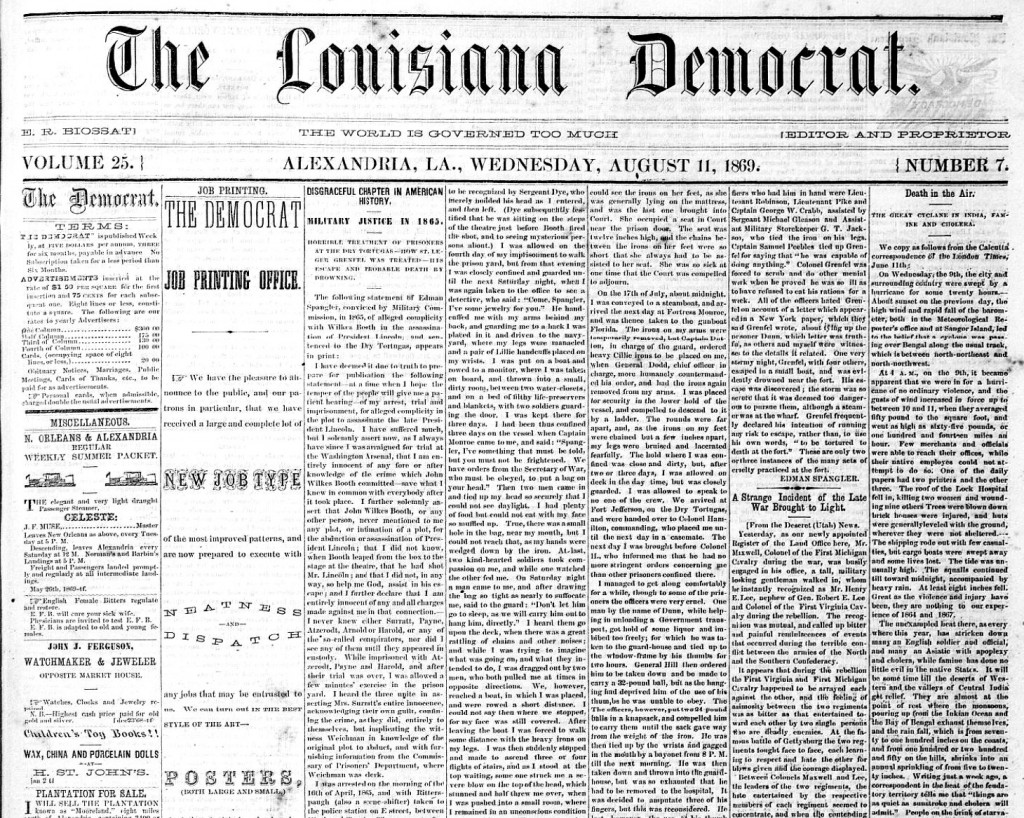
#1Here is a firsthand account written by accused Lincoln conspirator ,Edman Spangler.
He says he is innocent of the crime and tells of his capture, imprisonment and cruelty during his time in the ordeal.
Edman Spangler, who was tried and sentenced by a military commission in May, I865, on a charge of being engaged in a plot to assassinate President Lincoln, and pardoned by President Jonson, has prepared the following statement, asserting his innocence of all knowledge of the crime, and detailing the cruelties practiced on prisoners before and after conviction. Spangler was a scene-shifter and was on the stage when John Wilkes Booth shot Mr. Lincoln and jumped from the box. He also at times took care of Booth's horse. The evidence against him was of the flimsiest character, not being even circumstantial, for it did not appear in that trial, or in the subsequent civil trial of Surratt, that Spangler had any connection whatever with any of the so called conspirators. Most everybody believed him innocent then, and the Military Commission doubted his guilt by sentencing him to six years in Dry Tortugas and giving the others a life term.
The Military Commission was organized to convict, and it convicted. Abundant testimony is now at hand to show the vast amount of perjury of that trial – perjury exacted by fear and dictated by malice. Spangler's allusion to the witness Weichman being in the abduction plot is important. Weichman's testimony, it will be remembered, hung Mrs. Surratt-
I have deemed it due to truth to prepare for publication the following statement--at a time when I hope the temper of the people will give me a patient hearing---of my arrest, trial and imprisonment, for alleged complicity in the plot to assassinate the late President Lincoln. I have suffered much, but I solemnly assert now, as I always have' since I was arraigned for trial at the Washington Arsenal, that I am entirely innocent of any fore or after knowledge of the crime which John Wilkes Booth committed-save what I knew in common with everybody after it took place. I further solemnly assert that John Wilkes Booth, or any other person, never mentioned to me any plot, or intimation of a plot, for the abduction or assassination of President Lincoln; that I did not know, when Booth leaped from the box to the stage at the theatre, that he had shot Mr. Lincoln; and that I did not, in any way, so help me God, assist in his escape; and I further declare that I am entirely innocent of any and all charges made against me in that connection.
I never knew either Surratt, Payne, Atzerodt, Arnold or Harold, or any of the so-called conspirators, nor did I see any of them until they appeared in custody. While imprisoned with Atzerodt, Payne and Harold, and after their trial was over, I was allowed a few minutes' exercise in the prison yard. I heard the three unite in asserting Mrs. Surratt's entire innocence, acknowledging their own guilt, confining the crime, as they did, entirely to themselves, but implicating the witness Weichman in knowledge of the original plot to abduct, and with furnishing information front the Commissary of Prisoners Department, where Weichman was clerk.
I was arrested on the morning of the 10th of April, 1865, and with Ritterspaugh (also a scene-shifter) taken to the police station on E street, between Ninth and Tenth. The sergeant after questioning me closely, went with two policemen to search for Peanut John (the name of the boy who held Booth's horse the night before) and made to accompany us to the headquarters of the police on Tenth street, where he and I were locked up, and Ritterspaugh was released. After four hours' confinement, I was released and brought before Judges Olm and Bingham, and told them of Booth bringing his horse to the theatre on the afternoon of the 14th of April, 1865. After this investigation I said: "What is to be done with me ?" and they replied: "We know where to find you if wanted," and ordered my release. I returned to the theatre, where I remained until Saturday, when the soldiers took possession of it; but as the officer of the guard gave an attaché and myself a pass to sleep there, we retired at 10 P.M., and at 1 P. M. a guard was placed over me, who remained until 9 A.M. Sunday morning, when I was released. I did not leave the theatre until Sunday evening, and on our return the attaché (Carnal by name) and myself were arrested by Detective Larner.
Instead of taking us into the guard-house, he said he would accompany us home to sleep there, but we all went to police headquarters on Tenth Street, and when Carland asked if he were wanted, an officer sharply said, "No." I returned to the theatre that night and remained the next day till I went to dinner, corner Seventh and G streets. That over, I remained a few minutes, when Ritterspaugh (who worked at the theatre with me) came, and meeting me, said, "I have given my evidence and would like now to get some of the reward."
I walked out with Ritterspaugh for half an hour, and on returning to lie down, left word' that if any one called for me to tell them that I was lying down. Two hours after I was called down stairs to see two gentlemen who had called for me. They said that I was wanted down stairs. On reaching the sidewalk, they placed me in a hack, and drove rapidly to Carroll prison, where I was confined for a week. Three days afterward; Detective or Colonel Baker came to say room and questioned me about the sale of a horse and buggy, (which belonged to Booth) and I told him all about it freely and readily. On the day following, I was called into the office of the prison in order to be recognized by Sergeant L Dye, who merely nodded his head as I entered, and then left. (Dye subsequently testified that he was sitting on the steps of the theatre just before Booth fired the shot, and to seeing mysterious persons about.) I was allowed on the fourth day of my imprisonment to walk the prison yard, but from that evening I was closely confined and guarded until the next Saturday night, when I was again taken to the office to see a detective, who said : "Come, Spangler, I've some jewelry for you," he handcuffed me with my arms behind my back, and guarding me to a hack I was placed in it and driven to the navy yard, where my legs were manacled and a pair of Lillie handcuffs placed on my wrists. I was put on a boat and rowed to a monitor, where I was taken on board, and thrown into a small, dirty room, between two water-closets, and on a bed of filthy life-preservers and blankets, with two soldiers guarding the door. I was kept there for three days. I had been thus confined three days on the vessel when Captain Monroe came to me, and said: "Spangler, I've something that must be told, but you must not be frightened. We have orders from the Secretary of War, who must be obeyed, to put a bag on your head." Then two men came in and tied up my head so securely that I could not see daylight. I had plenty of food but could not eat with my face so muffled up. True, there was a small hole in the bag, near my mouth, but I could not reach that, as my hands were wedged down by the iron. At last, two kind-hearted soldiers took compassion on me, and while one watched the other fed me. On Saturday night, a man came to me, and after drawing the bag so tight as nearly to suffocate me, said to the guard: "Don't let him go to sleep, as we will carry him out to hang him, directly." I heard them go upon the deck, when there was a great rattling of chains and other noises and while I was trying to imagine what was going on, and what they intended to do. I was dragged out by two men, who both pulled me at times in opposite directions. We, however, reached a boat, in which I was placed, and were rowed a short distance. I could not say then where we stopped, for my face was still covered. After leaving the boat I was forced to walk some distance with the heavy irons on my legs. I was then suddenly stopped and made to ascend three or four flights of stairs, and as I stood at the top waiting, some one struck me a severe blow on the top of the head, which stunned and half threw me over, when I was pushed into a small room, where I remained in an unconscious condition for several hours. The next morning some one came with bread and coffee. I remained here for several days, suffering torture from the bag or padded hood over my face. It was on Sunday when it was removed, and I was shaven.
________________________________________________________________________________________________
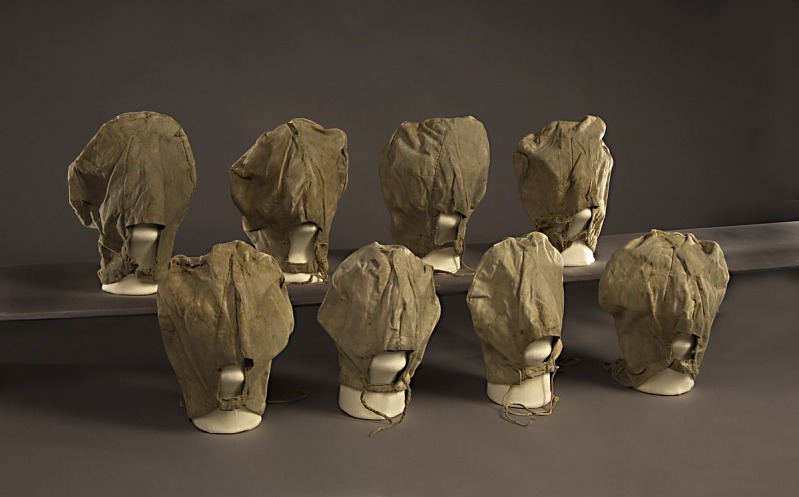
Prison Hoods
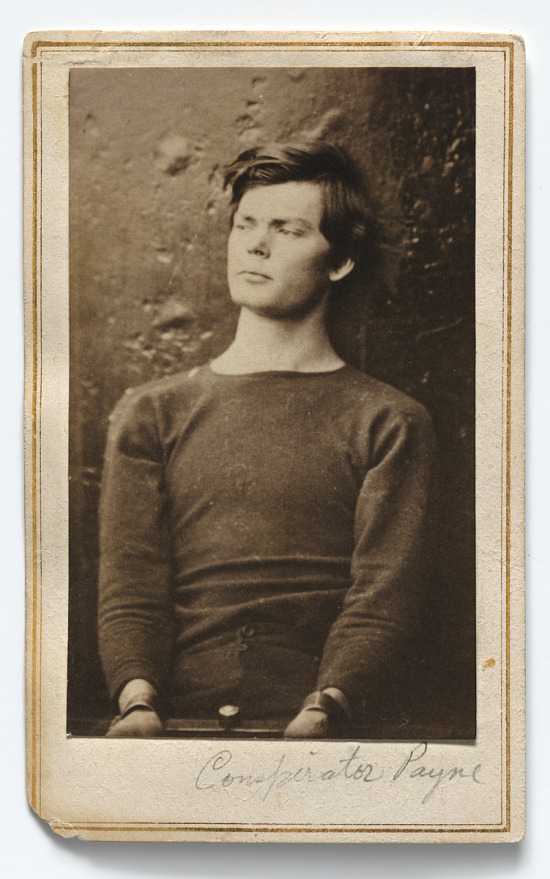
On April 14, 1865 John Wilkes Booth entered the presidential box at Ford Theatre, pointed a derringer pistol at the back of the President Abraham Lincoln’s head and fired. John Wilkes Booth’s attack on Lincoln was part of a larger plot to assassinate national leaders and throw the North into turmoil. The conspirators also planned to murder Vice President Andrew Johnson and Secretary of State William Seward. Besides Booth, eight individuals were charged. Because the plot was considered an act of war, the military assumed control of the proceedings. In a vengeful act against the accused, Secretary of War Edwin Stanton ordered that the imprisoned conspirators wear hoods at all times. These canvas hoods with rope ties were made for this purpose. The accused wore the hoods in their cells and on their way to trial. The court sentenced four suspects, Lewis Powell, David Herold, George Atzerodt, and Mary Surratt, to be hanged, and Dr. Samuel Mudd, Michael O’Laughlin, Samuel Arnold, and Edman Spangler to prison in 1904 the War Department transferred to the Smithsonian the hoods, shackles, and prison keys associated with the imprisonment of Lincoln’s assassins. They did not record which prisoners wore which hoods.
Transfer from the War Department, 1904.
____________________________________________________________________________________________________________________________________________
Some hours after General Hartrufft came and read to me several charges; that I was engaged in a plot to assassinate the President, and the day following I was carried into a Military Court, and still hooded, before all of its members. I remained here but a short time, when I was returned to my cell for another night and day, and then again presented to this Court. Mr. Bingham Assistant Judge Advocate, read the charges against me, and asked I me if I had any objection to the Court, and I replied "No," and made the plead of "Not Guilty." They then wished to know if I desired counsel, and, when I answered affirmatively, General Hunter, the President of the Court, insisted that I should not be allowed counsel.
He was, however, overruled, but it was several days before I was permitted legal aid, the Court in the meantime taking evidence with closed doors. On every adjournment of the Court, if only for an hour, I was returned to my cell and the closely fitting hood placed over my head. This continued till June 10, 1865, when I was relieved from the tortures of the bag, but my hands and limbs remained heavily manacled. On one Sunday, while I was confined at this place (the Washington Arsenal) I was visited by a gentleman of middle stature, rather stout, with full beard, and gold framed spectacles. He noticed my manacles and padded head.
I afterward learned that he was Mr. Stanton, the Secretary of War: It is proper to state that, when the hood was placed on me, Captain Monroe said it was by order of the Secretary of War. My first thought was that I was to be hung without trial, and the hood was preparatory to that act.
The first time I ever saw Mrs. Surrat was in the Carroll Prison yard on Capitol Hill. I did not see her again until we were taken into Court the first day at the Arsenal. My cell was on the same corridor with hers, and I had to pass it every time l was taken into Court. I frequently looked into her cell), a small room, about four feet wide by seven long.
_____________________________________________________________________________________________
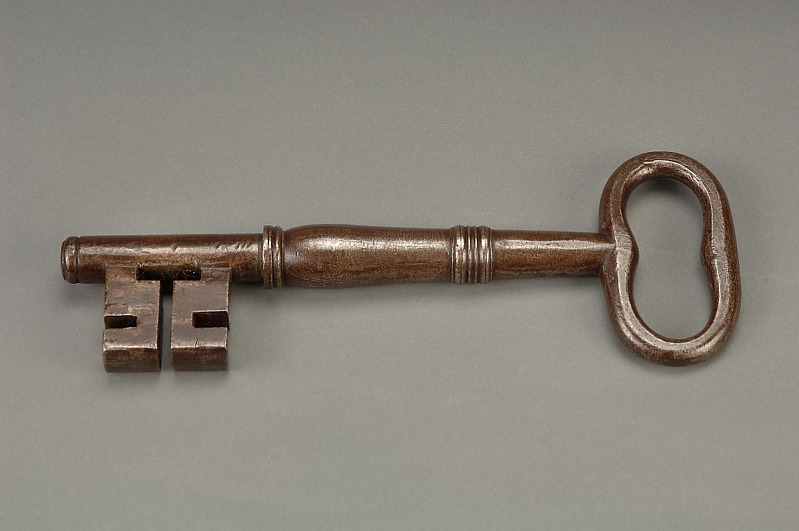
Once captured, the Lincoln conspirators were closely and constantly guarded.
During their trial, iron keys locked their prison cells.
___________________________________________________________________________________________________
The only things in her cell were an old mattress, laid on the brick, and an army blanket; I could see the irons on her feet, as she I was generally lying on the mattress, I and was the last one brought into Court. She occupied a seat in Court near the prison door. The seat was twelve inches high.
The chains between the irons on her feet were so short that she always had to be assisted to her seat.
She was so sick at one time that the Court' was compelled to adjourn.
_________________________________________________________________________________________________________________________
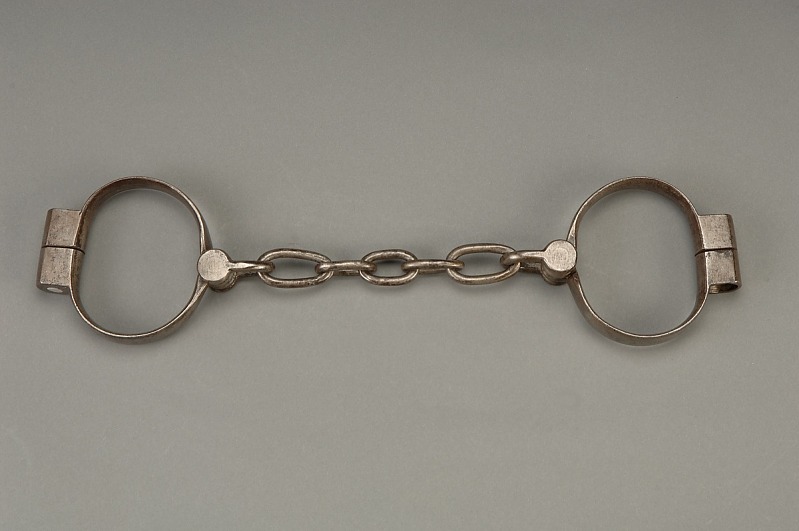
These ankle shackles (Lilly/Lily/Lillie) confined the Lincoln conspirators. (From the Smithsonian Institute)
Emotions were so strong that the defendants were bound—with the exception of Mary Surratt, the only woman—even during the trial.
(This is a contradiction, according to Spangler's account.)
___________________________________________________________________________________________________________
On the 17th of July, about midnight. I was conveyed to a steamboat, and arrived the next day at Fortress Monroe, and was thence taken to the gunboat, Florida. The irons on my arms were temporarily removed, but Captain Dutton, in charge of the guard, ordered heavy Lillie irons to be placed on me. When General Dodd, chief officer in charge, more humanely countermanded his order, and had the irons again removed from my arms. I was placed for security in the lower hold of the vessel and compelled to descend to it by a ladder. The rounds were far apart, and, as the irons on my feet were chained but a few inches apart, my legs were bruised and lacerated fearfully.
____________________________________________________________________________________________________________
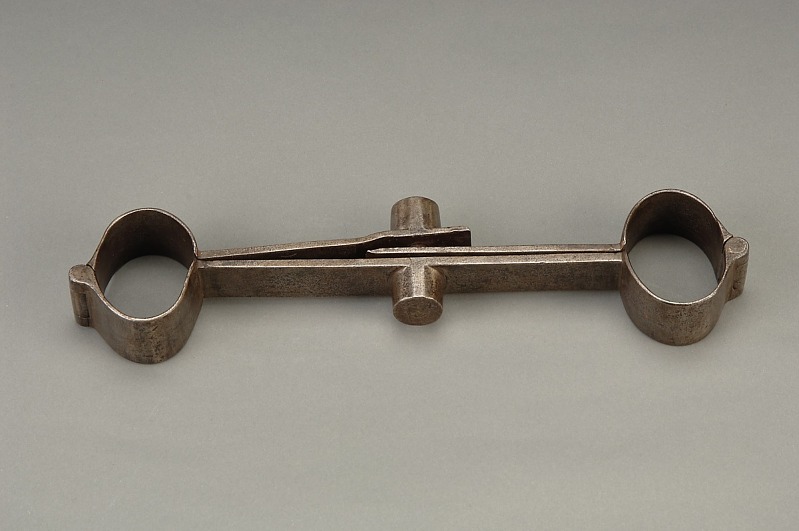
These Wrist Irons (Lilly/Lily/Lillie) confined the Lincoln conspirators. (From the Smithsonian Institute)
Emotions were so strong that the defendants were bound—with the exception of Mary Surratt, the only woman—even during the trial.
(This is a contradiction, according to Spangler's account.)
_________________________________________________________________________________________________________
The hold where I was confined was close and dirty, but, after two or three days, I was allowed on deck in the day times but was closely guarded. I was allowed to speak to no one of the crew, we arrived at Fort Jefferson, on the Dry Tortugas and were handed over to Colonel Hamilton, commanding, who placed me until the next day in a casemate. The next day, I was brought before Colonel II, who informed me that he had no more stringent orders concerning me than other prisoners confined there.
I managed to get along comfortably for a while, though to some of the prisoners, the officers were very cruel. One man by the name of Dunn, while helping in unloading a government transport, got hold of some liquor and imbibed too freely; for which he was taken to the guard-house and tied up to the window-fame by his thumbs for two hours. General Hill then ordered him to be taken down and be made to carry a 32-pound ball, but as the hanging had deprived him of the use of his thumbs, he was unable to obey. The officers however, put two 24-pound balls in a knapsack and compelled him to carry them until the sack gave way from the weight of the iron. He was then tied up by the wrists and gagged in the mouth by a bayonet from 8 P.M. till the next morning. He was then taken down and thrown into the guard house, but was so exhausted that he had to be removed to the hospital, it was decided to amputate three of his fingers, but this was reconsidered. He lost, however, the use of his thumb and two fingers. This punishment was inflicted by Major McConnell, officer of the day, and carried out by Sergeant Edward Donnelly. Another poor prisoner, named Brown, was once excused by the Doctor from work on the plea of illness, but the Provost Marshal insisted, and, finding him too ill and lacking strength, made him carry a 32 pound ball. He staggered under the weight and was compelled from weakness to put it down. He was then taken to the wharf, and with his legs tied together and his hands tied behind him a rope was placed around him, and he was thrown into the water and then dragged out.
This was done three or four times, he begged for mercy most piteously. He was finally jerked out of the water and ordered to return to his ordinary work.
The poor wretch crept off, apparently thankful for escape from such torments. Captain Joseph Rittenhouse was officer of the day; and his orders were carried out by Corporal Spear.
During the latter part of last October, I was placed in irons and compelled to work with an armed sentinel over me. I did not know the reason for this, for I was unconscious of having given offence. and had conformed to every regulation. I was then closely confined and allowed to communicate with no one for four months. The pretense for this, I afterward learned, sprang from an attempt of Mr. Mudd to escape. Col. St. George Leger Grenfel, aged 65 years, was taken sick, and went to the doctor to get excused from work. The doctor declined to excuse him. He then applied to the provost marshal, who said that he could not excuse him if the doctor couldn't, Grenfel then tried to work, and failed. They then took him to the guardhouse, tied him up for half a day, and then took him to the wharf, tied his hands behind him, tied his legs, tied a rope around his waist. There were three officers, heavily armed, who drove spectators from the wharf; I could see and hear from my window. The Colonel asked if they were going to throw him into the water and they answered "Yes".
He then jumped in and because he could not sink, they drew him out and tied about forty pounds of iron to him and threw him into the water again, and then compelled him to go to work.
The officers who had him in hand were Lieutenant Robinson, Lieutenant Pike and Captain George W. Crabb, assisted by Sergeant Michael Gleason and Assistant Military Storekeeper G.T. Jackson, who tied the iron' on his legs. Captain Samuel Peebles tied up Grenfel for saying that "he was capable of doing anything.", Colonel Grenfel was forced to scrub and do other menial work when he proved he was so ill to have refused to eat his rations for a week. All of the officers hated Grenfel on account of a letter which appeared in a New York paper; which they said Grenfel wrote; about tying up the prisoner Dunn, which letter was truthful, as others and myself were witness to the details it related.
One very stormy night, Grenfel with four others, escaped in a small boat and was evidently drowned near the fort. His escape was discovered; the storm was so severe that it was deemed too dangerous to pursue them, although a steamer was at the wharf. Grenfel frequently declared his intention of running any risk to escape, rather than, to use his own words, "to be tortured to death at the fort." These are only two or three instances of the many acts of cruelty practiced at the fort.
These are only two or three instances of the many acts of cruelty practiced at the fort. During my imprisonment at Port Jefferson, I worked very hard at carpentering and wood ornamental wort, making a great
many fancy boxes, out of the peculiar wood found on the adjacent islands; the greater portion of this work was made for officers. By my industry in that direction, I won some favor in their eyes.
I was released in March of the present year by excusive clemency.
Signed -- EDMAN SPANGLER
*******************************************************************************
Pictures and text from Smithsonian Institute
I had to look up some definitions on a few of the words used in the above. I never heard of the usage for the word "Hack" or "scene-shifter" used like this before.
hack noun
: restriction to quarters as punishment for naval officers —usually used in the phrase "under hack"
hack noun
(1) a: a horse let out for common hire
(2): a horse used in all kinds of work
b: a horse worn out in service :
c: a light easy saddle horse
especially : a three-gaited saddle horse
d: a ride on a horse
Slang : a guard especially at a prison
hack verb
hacked; hacking; hacks
intransitive verb
1: to ride or drive at an ordinary pace or over the roads especially as distinguished from racing or hunting
scene-shifter noun
: a worker who moves the scenes in a theater.
case·mate noun
historical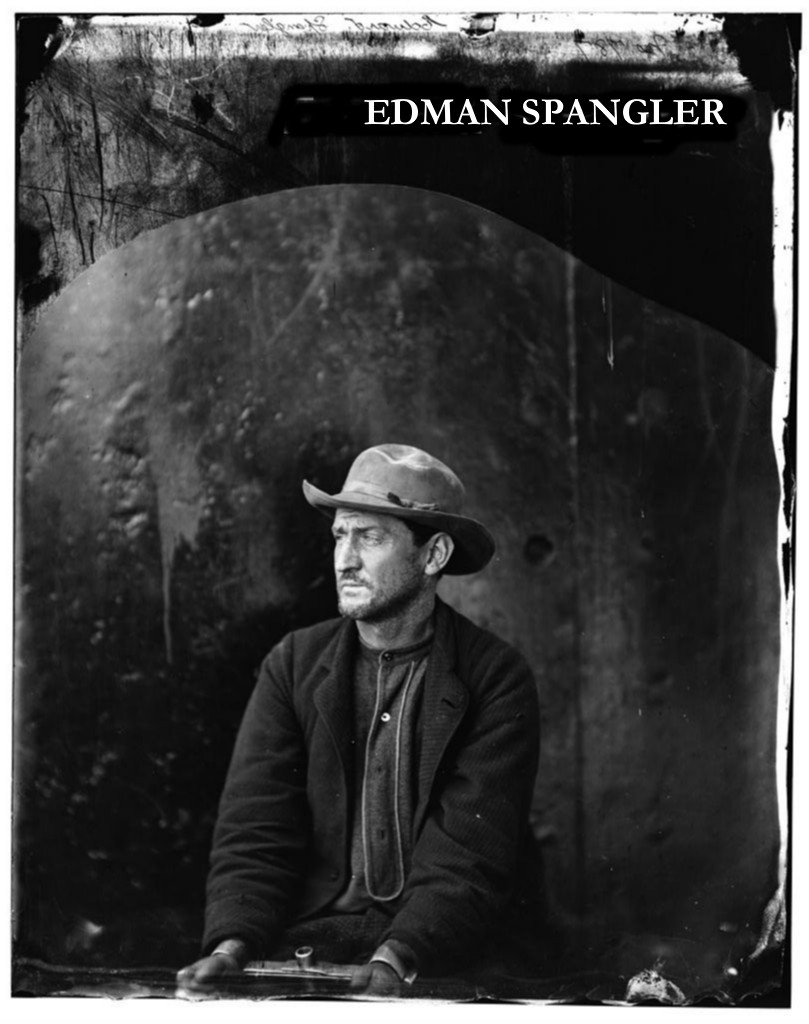
He says he is innocent of the crime and tells of his capture, imprisonment and cruelty during his time in the ordeal.
Edman Spangler, who was tried and sentenced by a military commission in May, I865, on a charge of being engaged in a plot to assassinate President Lincoln, and pardoned by President Jonson, has prepared the following statement, asserting his innocence of all knowledge of the crime, and detailing the cruelties practiced on prisoners before and after conviction. Spangler was a scene-shifter and was on the stage when John Wilkes Booth shot Mr. Lincoln and jumped from the box. He also at times took care of Booth's horse. The evidence against him was of the flimsiest character, not being even circumstantial, for it did not appear in that trial, or in the subsequent civil trial of Surratt, that Spangler had any connection whatever with any of the so called conspirators. Most everybody believed him innocent then, and the Military Commission doubted his guilt by sentencing him to six years in Dry Tortugas and giving the others a life term.
The Military Commission was organized to convict, and it convicted. Abundant testimony is now at hand to show the vast amount of perjury of that trial – perjury exacted by fear and dictated by malice. Spangler's allusion to the witness Weichman being in the abduction plot is important. Weichman's testimony, it will be remembered, hung Mrs. Surratt-
I have deemed it due to truth to prepare for publication the following statement--at a time when I hope the temper of the people will give me a patient hearing---of my arrest, trial and imprisonment, for alleged complicity in the plot to assassinate the late President Lincoln. I have suffered much, but I solemnly assert now, as I always have' since I was arraigned for trial at the Washington Arsenal, that I am entirely innocent of any fore or after knowledge of the crime which John Wilkes Booth committed-save what I knew in common with everybody after it took place. I further solemnly assert that John Wilkes Booth, or any other person, never mentioned to me any plot, or intimation of a plot, for the abduction or assassination of President Lincoln; that I did not know, when Booth leaped from the box to the stage at the theatre, that he had shot Mr. Lincoln; and that I did not, in any way, so help me God, assist in his escape; and I further declare that I am entirely innocent of any and all charges made against me in that connection.
I never knew either Surratt, Payne, Atzerodt, Arnold or Harold, or any of the so-called conspirators, nor did I see any of them until they appeared in custody. While imprisoned with Atzerodt, Payne and Harold, and after their trial was over, I was allowed a few minutes' exercise in the prison yard. I heard the three unite in asserting Mrs. Surratt's entire innocence, acknowledging their own guilt, confining the crime, as they did, entirely to themselves, but implicating the witness Weichman in knowledge of the original plot to abduct, and with furnishing information front the Commissary of Prisoners Department, where Weichman was clerk.
I was arrested on the morning of the 10th of April, 1865, and with Ritterspaugh (also a scene-shifter) taken to the police station on E street, between Ninth and Tenth. The sergeant after questioning me closely, went with two policemen to search for Peanut John (the name of the boy who held Booth's horse the night before) and made to accompany us to the headquarters of the police on Tenth street, where he and I were locked up, and Ritterspaugh was released. After four hours' confinement, I was released and brought before Judges Olm and Bingham, and told them of Booth bringing his horse to the theatre on the afternoon of the 14th of April, 1865. After this investigation I said: "What is to be done with me ?" and they replied: "We know where to find you if wanted," and ordered my release. I returned to the theatre, where I remained until Saturday, when the soldiers took possession of it; but as the officer of the guard gave an attaché and myself a pass to sleep there, we retired at 10 P.M., and at 1 P. M. a guard was placed over me, who remained until 9 A.M. Sunday morning, when I was released. I did not leave the theatre until Sunday evening, and on our return the attaché (Carnal by name) and myself were arrested by Detective Larner.
Instead of taking us into the guard-house, he said he would accompany us home to sleep there, but we all went to police headquarters on Tenth Street, and when Carland asked if he were wanted, an officer sharply said, "No." I returned to the theatre that night and remained the next day till I went to dinner, corner Seventh and G streets. That over, I remained a few minutes, when Ritterspaugh (who worked at the theatre with me) came, and meeting me, said, "I have given my evidence and would like now to get some of the reward."
I walked out with Ritterspaugh for half an hour, and on returning to lie down, left word' that if any one called for me to tell them that I was lying down. Two hours after I was called down stairs to see two gentlemen who had called for me. They said that I was wanted down stairs. On reaching the sidewalk, they placed me in a hack, and drove rapidly to Carroll prison, where I was confined for a week. Three days afterward; Detective or Colonel Baker came to say room and questioned me about the sale of a horse and buggy, (which belonged to Booth) and I told him all about it freely and readily. On the day following, I was called into the office of the prison in order to be recognized by Sergeant L Dye, who merely nodded his head as I entered, and then left. (Dye subsequently testified that he was sitting on the steps of the theatre just before Booth fired the shot, and to seeing mysterious persons about.) I was allowed on the fourth day of my imprisonment to walk the prison yard, but from that evening I was closely confined and guarded until the next Saturday night, when I was again taken to the office to see a detective, who said : "Come, Spangler, I've some jewelry for you," he handcuffed me with my arms behind my back, and guarding me to a hack I was placed in it and driven to the navy yard, where my legs were manacled and a pair of Lillie handcuffs placed on my wrists. I was put on a boat and rowed to a monitor, where I was taken on board, and thrown into a small, dirty room, between two water-closets, and on a bed of filthy life-preservers and blankets, with two soldiers guarding the door. I was kept there for three days. I had been thus confined three days on the vessel when Captain Monroe came to me, and said: "Spangler, I've something that must be told, but you must not be frightened. We have orders from the Secretary of War, who must be obeyed, to put a bag on your head." Then two men came in and tied up my head so securely that I could not see daylight. I had plenty of food but could not eat with my face so muffled up. True, there was a small hole in the bag, near my mouth, but I could not reach that, as my hands were wedged down by the iron. At last, two kind-hearted soldiers took compassion on me, and while one watched the other fed me. On Saturday night, a man came to me, and after drawing the bag so tight as nearly to suffocate me, said to the guard: "Don't let him go to sleep, as we will carry him out to hang him, directly." I heard them go upon the deck, when there was a great rattling of chains and other noises and while I was trying to imagine what was going on, and what they intended to do. I was dragged out by two men, who both pulled me at times in opposite directions. We, however, reached a boat, in which I was placed, and were rowed a short distance. I could not say then where we stopped, for my face was still covered. After leaving the boat I was forced to walk some distance with the heavy irons on my legs. I was then suddenly stopped and made to ascend three or four flights of stairs, and as I stood at the top waiting, some one struck me a severe blow on the top of the head, which stunned and half threw me over, when I was pushed into a small room, where I remained in an unconscious condition for several hours. The next morning some one came with bread and coffee. I remained here for several days, suffering torture from the bag or padded hood over my face. It was on Sunday when it was removed, and I was shaven.
________________________________________________________________________________________________
Prison Hoods
On April 14, 1865 John Wilkes Booth entered the presidential box at Ford Theatre, pointed a derringer pistol at the back of the President Abraham Lincoln’s head and fired. John Wilkes Booth’s attack on Lincoln was part of a larger plot to assassinate national leaders and throw the North into turmoil. The conspirators also planned to murder Vice President Andrew Johnson and Secretary of State William Seward. Besides Booth, eight individuals were charged. Because the plot was considered an act of war, the military assumed control of the proceedings. In a vengeful act against the accused, Secretary of War Edwin Stanton ordered that the imprisoned conspirators wear hoods at all times. These canvas hoods with rope ties were made for this purpose. The accused wore the hoods in their cells and on their way to trial. The court sentenced four suspects, Lewis Powell, David Herold, George Atzerodt, and Mary Surratt, to be hanged, and Dr. Samuel Mudd, Michael O’Laughlin, Samuel Arnold, and Edman Spangler to prison in 1904 the War Department transferred to the Smithsonian the hoods, shackles, and prison keys associated with the imprisonment of Lincoln’s assassins. They did not record which prisoners wore which hoods.
Transfer from the War Department, 1904.
____________________________________________________________________________________________________________________________________________
Some hours after General Hartrufft came and read to me several charges; that I was engaged in a plot to assassinate the President, and the day following I was carried into a Military Court, and still hooded, before all of its members. I remained here but a short time, when I was returned to my cell for another night and day, and then again presented to this Court. Mr. Bingham Assistant Judge Advocate, read the charges against me, and asked I me if I had any objection to the Court, and I replied "No," and made the plead of "Not Guilty." They then wished to know if I desired counsel, and, when I answered affirmatively, General Hunter, the President of the Court, insisted that I should not be allowed counsel.
He was, however, overruled, but it was several days before I was permitted legal aid, the Court in the meantime taking evidence with closed doors. On every adjournment of the Court, if only for an hour, I was returned to my cell and the closely fitting hood placed over my head. This continued till June 10, 1865, when I was relieved from the tortures of the bag, but my hands and limbs remained heavily manacled. On one Sunday, while I was confined at this place (the Washington Arsenal) I was visited by a gentleman of middle stature, rather stout, with full beard, and gold framed spectacles. He noticed my manacles and padded head.
I afterward learned that he was Mr. Stanton, the Secretary of War: It is proper to state that, when the hood was placed on me, Captain Monroe said it was by order of the Secretary of War. My first thought was that I was to be hung without trial, and the hood was preparatory to that act.
The first time I ever saw Mrs. Surrat was in the Carroll Prison yard on Capitol Hill. I did not see her again until we were taken into Court the first day at the Arsenal. My cell was on the same corridor with hers, and I had to pass it every time l was taken into Court. I frequently looked into her cell), a small room, about four feet wide by seven long.
_____________________________________________________________________________________________
Once captured, the Lincoln conspirators were closely and constantly guarded.
During their trial, iron keys locked their prison cells.
___________________________________________________________________________________________________
The only things in her cell were an old mattress, laid on the brick, and an army blanket; I could see the irons on her feet, as she I was generally lying on the mattress, I and was the last one brought into Court. She occupied a seat in Court near the prison door. The seat was twelve inches high.
The chains between the irons on her feet were so short that she always had to be assisted to her seat.
She was so sick at one time that the Court' was compelled to adjourn.
_________________________________________________________________________________________________________________________
These ankle shackles (Lilly/Lily/Lillie) confined the Lincoln conspirators. (From the Smithsonian Institute)
Emotions were so strong that the defendants were bound—with the exception of Mary Surratt, the only woman—even during the trial.
(This is a contradiction, according to Spangler's account.)
___________________________________________________________________________________________________________
On the 17th of July, about midnight. I was conveyed to a steamboat, and arrived the next day at Fortress Monroe, and was thence taken to the gunboat, Florida. The irons on my arms were temporarily removed, but Captain Dutton, in charge of the guard, ordered heavy Lillie irons to be placed on me. When General Dodd, chief officer in charge, more humanely countermanded his order, and had the irons again removed from my arms. I was placed for security in the lower hold of the vessel and compelled to descend to it by a ladder. The rounds were far apart, and, as the irons on my feet were chained but a few inches apart, my legs were bruised and lacerated fearfully.
____________________________________________________________________________________________________________
These Wrist Irons (Lilly/Lily/Lillie) confined the Lincoln conspirators. (From the Smithsonian Institute)
Emotions were so strong that the defendants were bound—with the exception of Mary Surratt, the only woman—even during the trial.
(This is a contradiction, according to Spangler's account.)
_________________________________________________________________________________________________________
The hold where I was confined was close and dirty, but, after two or three days, I was allowed on deck in the day times but was closely guarded. I was allowed to speak to no one of the crew, we arrived at Fort Jefferson, on the Dry Tortugas and were handed over to Colonel Hamilton, commanding, who placed me until the next day in a casemate. The next day, I was brought before Colonel II, who informed me that he had no more stringent orders concerning me than other prisoners confined there.
I managed to get along comfortably for a while, though to some of the prisoners, the officers were very cruel. One man by the name of Dunn, while helping in unloading a government transport, got hold of some liquor and imbibed too freely; for which he was taken to the guard-house and tied up to the window-fame by his thumbs for two hours. General Hill then ordered him to be taken down and be made to carry a 32-pound ball, but as the hanging had deprived him of the use of his thumbs, he was unable to obey. The officers however, put two 24-pound balls in a knapsack and compelled him to carry them until the sack gave way from the weight of the iron. He was then tied up by the wrists and gagged in the mouth by a bayonet from 8 P.M. till the next morning. He was then taken down and thrown into the guard house, but was so exhausted that he had to be removed to the hospital, it was decided to amputate three of his fingers, but this was reconsidered. He lost, however, the use of his thumb and two fingers. This punishment was inflicted by Major McConnell, officer of the day, and carried out by Sergeant Edward Donnelly. Another poor prisoner, named Brown, was once excused by the Doctor from work on the plea of illness, but the Provost Marshal insisted, and, finding him too ill and lacking strength, made him carry a 32 pound ball. He staggered under the weight and was compelled from weakness to put it down. He was then taken to the wharf, and with his legs tied together and his hands tied behind him a rope was placed around him, and he was thrown into the water and then dragged out.
This was done three or four times, he begged for mercy most piteously. He was finally jerked out of the water and ordered to return to his ordinary work.
The poor wretch crept off, apparently thankful for escape from such torments. Captain Joseph Rittenhouse was officer of the day; and his orders were carried out by Corporal Spear.
During the latter part of last October, I was placed in irons and compelled to work with an armed sentinel over me. I did not know the reason for this, for I was unconscious of having given offence. and had conformed to every regulation. I was then closely confined and allowed to communicate with no one for four months. The pretense for this, I afterward learned, sprang from an attempt of Mr. Mudd to escape. Col. St. George Leger Grenfel, aged 65 years, was taken sick, and went to the doctor to get excused from work. The doctor declined to excuse him. He then applied to the provost marshal, who said that he could not excuse him if the doctor couldn't, Grenfel then tried to work, and failed. They then took him to the guardhouse, tied him up for half a day, and then took him to the wharf, tied his hands behind him, tied his legs, tied a rope around his waist. There were three officers, heavily armed, who drove spectators from the wharf; I could see and hear from my window. The Colonel asked if they were going to throw him into the water and they answered "Yes".
He then jumped in and because he could not sink, they drew him out and tied about forty pounds of iron to him and threw him into the water again, and then compelled him to go to work.
The officers who had him in hand were Lieutenant Robinson, Lieutenant Pike and Captain George W. Crabb, assisted by Sergeant Michael Gleason and Assistant Military Storekeeper G.T. Jackson, who tied the iron' on his legs. Captain Samuel Peebles tied up Grenfel for saying that "he was capable of doing anything.", Colonel Grenfel was forced to scrub and do other menial work when he proved he was so ill to have refused to eat his rations for a week. All of the officers hated Grenfel on account of a letter which appeared in a New York paper; which they said Grenfel wrote; about tying up the prisoner Dunn, which letter was truthful, as others and myself were witness to the details it related.
One very stormy night, Grenfel with four others, escaped in a small boat and was evidently drowned near the fort. His escape was discovered; the storm was so severe that it was deemed too dangerous to pursue them, although a steamer was at the wharf. Grenfel frequently declared his intention of running any risk to escape, rather than, to use his own words, "to be tortured to death at the fort." These are only two or three instances of the many acts of cruelty practiced at the fort.
These are only two or three instances of the many acts of cruelty practiced at the fort. During my imprisonment at Port Jefferson, I worked very hard at carpentering and wood ornamental wort, making a great
many fancy boxes, out of the peculiar wood found on the adjacent islands; the greater portion of this work was made for officers. By my industry in that direction, I won some favor in their eyes.
I was released in March of the present year by excusive clemency.
Signed -- EDMAN SPANGLER
*******************************************************************************
Pictures and text from Smithsonian Institute
I had to look up some definitions on a few of the words used in the above. I never heard of the usage for the word "Hack" or "scene-shifter" used like this before.
hack noun
: restriction to quarters as punishment for naval officers —usually used in the phrase "under hack"
hack noun
(1) a: a horse let out for common hire
(2): a horse used in all kinds of work
b: a horse worn out in service :
c: a light easy saddle horse
especially : a three-gaited saddle horse
d: a ride on a horse
Slang : a guard especially at a prison
hack verb
hacked; hacking; hacks
intransitive verb
1: to ride or drive at an ordinary pace or over the roads especially as distinguished from racing or hunting
scene-shifter noun
: a worker who moves the scenes in a theater.
case·mate noun
historical
- a small room in the thickness of the wall of a fortress, with embrasures from which guns or missiles can be fired.
- an armored enclosure for guns on a warship.