Mark Lyons O--O Cuffs
#1Gathering info about this famous and iconic family was a difficult task. Much of what information I could find is conflicting and much of it very hard to locate since the name is a common one.
Reading and quoting what other authors previously wrote along with historical sites, I believe what I have written here is accurate at this time.
German born Michael Rickard lived his life as a whitesmith. He made locks, hardware, guns, and small implements of unforged metal. I have searched very hard for any guns that Michael may have made but found nothing so far. A few biographies indicate that he did, but I can't substantiate that fact at all.
The term "whitesmith" refers to what is today, called a locksmith. The forging process for wrought iron, heating the iron and cooling it with water, left a very dark, almost black, surface oxidation on the metal; hence the term "blacksmith." The lockmaker, however, worked the iron cold, sawing and filing his creations into final form, thereby removing the black surface oxidation and leaving the metal "white." A whitesmith is also known as a "tinsmith" and works with more delicate metals not associated with iron material that the blacksmith would use.
He is credited for inventing the screw lock, a peculiar caliper shaped lock which can only be opened by screwing a key which pulls back a bolt, unlocking the lock.
For many years these locks were used by the B&O Railroad as switch locks. These locks are said to be the very first railroad locks to be marked as such. The locking concept was eventually carried over to larger locks and formed handcuffs and leg irons by his son, Elijah in later years. The Darby handcuff also used a similar design and the also produced "end locks" which were basically screw key padlocks, so why is Rickard credited for this style lock?
Perhaps his credit was for American made padlocks.
The Rickard Home --
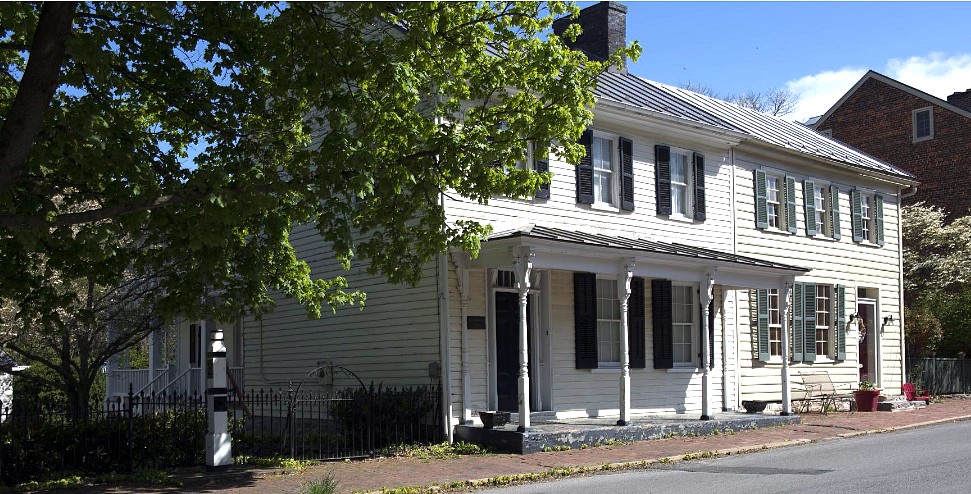
In 1782, Abram Shepherd sold Lot 7 for two Virginia pounds to John Blackburn on the condition that he build a dwelling house on the property 20 feet long by 16 feet wide.
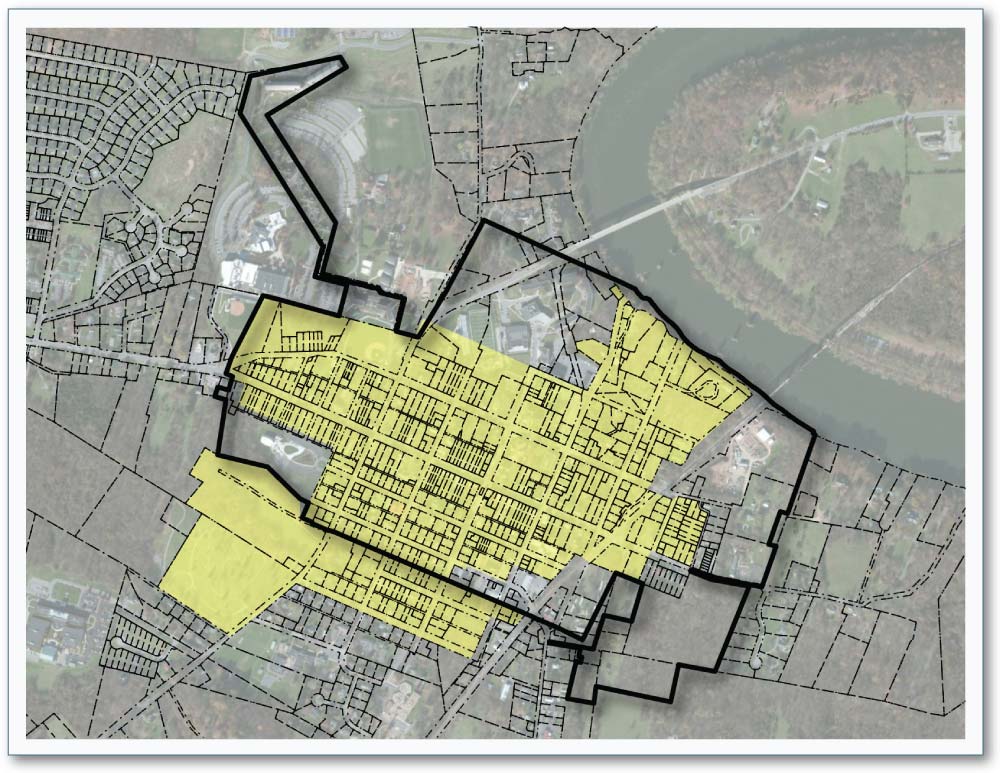
The property was located close to the Potomac River in Shepardstown Virgina (which became West Virginia on June 20, 1863).
In 1785 Blackburn sold the property to Conrad Boyer, a whitesmith, for 20 pounds. Boyer built a house on the property and an adjoining workshop.
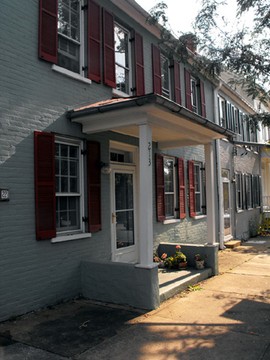
The address with the adjacent building was listed as 211 and 213 West German St.
The town is now part of the historic district.
Michael Rickard purchased the property from Conrad Boyer’s widow in 1810 for 285 pounds.
Rickard occupied the house and set up his foundry in the shop building.
The shop used the 213 address and had a basement where a large, raised fireplace was used to forge his work. 211 was on the west side of this two-story structure and it provided the residential quarters for the family. The street was located in an area where many German artisans settled in the l8th century.
It was here that his padlocks were invented, and where the restraints were eventually produced.
The Rickard Family was in good company with some notable neighbors. One notable next-door neighbor resided at 215 W German St. In 1800 John Baker, a local attorney, purchased this house. He served in Congress and the Virginia legislature as a Federalist.
Another neighbor who lived up on the same street was Conrad Shindler. He was a coppersmith in the late 1790's. Like Rickards, he had a small foundry in the basement too. While he was not well known at the time, his direct descendant was a well-known actress, and she purchased the property many years later. She gifted it to the Sheperd College Foundation in honor of her dad and dedicated the home under the name of "The George Tyler Moore Center for the Study of the Civil War". Her name was Mary Tyler Moore.
Upon Michael’s death on Oct. 28, 1821, the property passed to his widow and his son, Elijah (1795 -1879), who took over the locksmith business. Elijah is who we admire most in this family as cuff collectors.
Elijah left the property to his son James (1828-1909) who, childless, left the property to his last remaining sister, “Miss Maria,” who then rented out the house until her death in 1920.
In December of 1909, the workshop and its contents were put up for auction. These items included an “iron lathe, foot power, bellows, 2 anvils, hammers, shears, tongs, augers, brace and bits, and sundry tools, and also a lot of junk, iron and brass, and desk and stove.”
According to the auction announcement, the property is “desirably located and readily convertible into a dwelling.” The workshop was purchased by W.P. Licklider for $1,220 and converted into a residence.
Upon Maria’s death, the residence also sold at public auction for $2,000.
The Family --
On June 2, 1797, Michael married Elizabeth Shindler (aka Elizabeth Shindler Jackman, daughter of Conrad Shindler). She was married to a man named Jackman, but she apparently was widowed before marrying Michael.
Michael adopted her son Elijah, who continued the family business. Elijah is said to have crafted John Brown's handcuffs in 1859. (more in part 3)
Three generations of Rickard locksmiths lived and worked at 213 for well over a century. If previous tenant Conrad Boyer is added to the timeline of the home/workshop, there is a very substantial history of lock and other items being manufactured at this location.
The Michael Rickard Family had at least 4 children:
• Elijah Jackman Rickard b. 27 Mar 1795 (adopted by Michael when he married Elijah's mother)
• Mary Elizabeth (Polly) Rickard b. 1798
• Nancy (Ann) Rickard b. 1803
• Eliza Rickard b. 1808
• and there may have been others
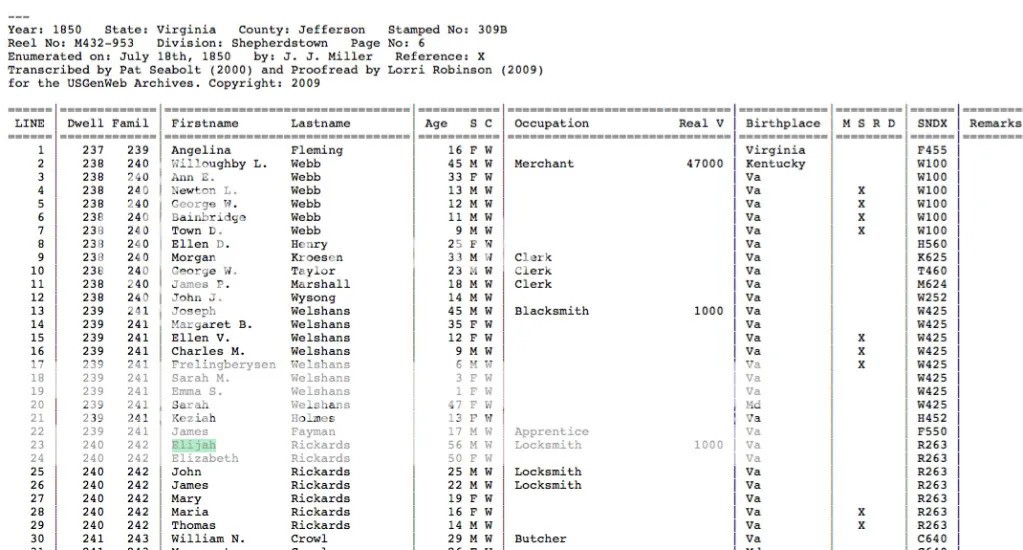
We do not know how John or Thomas fits into the family. It seems that they are their children, but I see no mention of them anywhere but here.
It is interesting that this 1850 census report spells the Rickard" name as Rickards.
I will continue searching when and where the Americanized name of "Richards" first appears.
Michael worked and lived at the Shepardtown location for just shy of a dozen years.
We know him for his lock making, but he is known for a wide variety of other hardware designs and manufacturing.
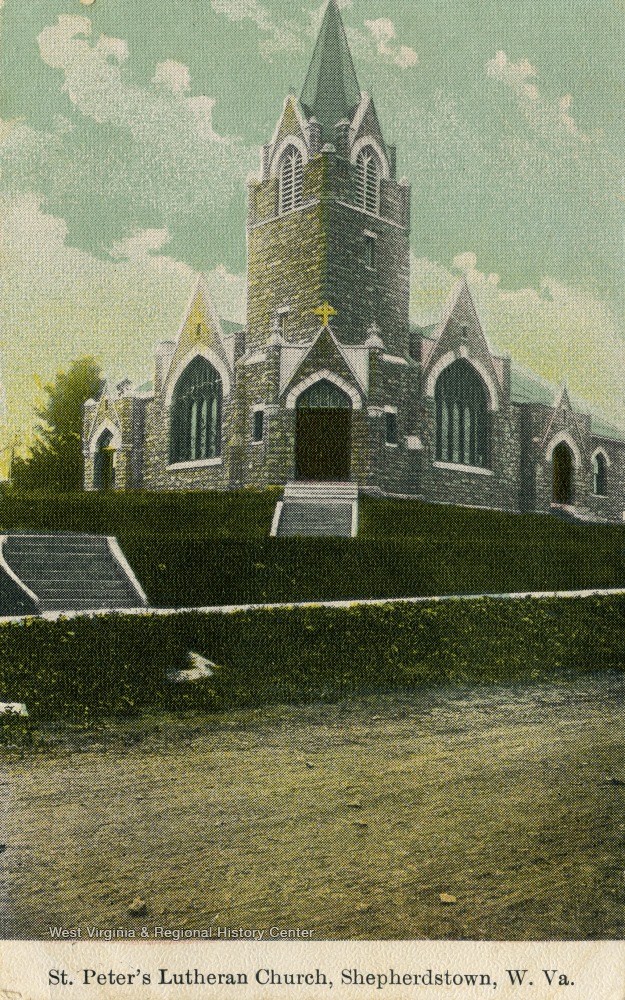
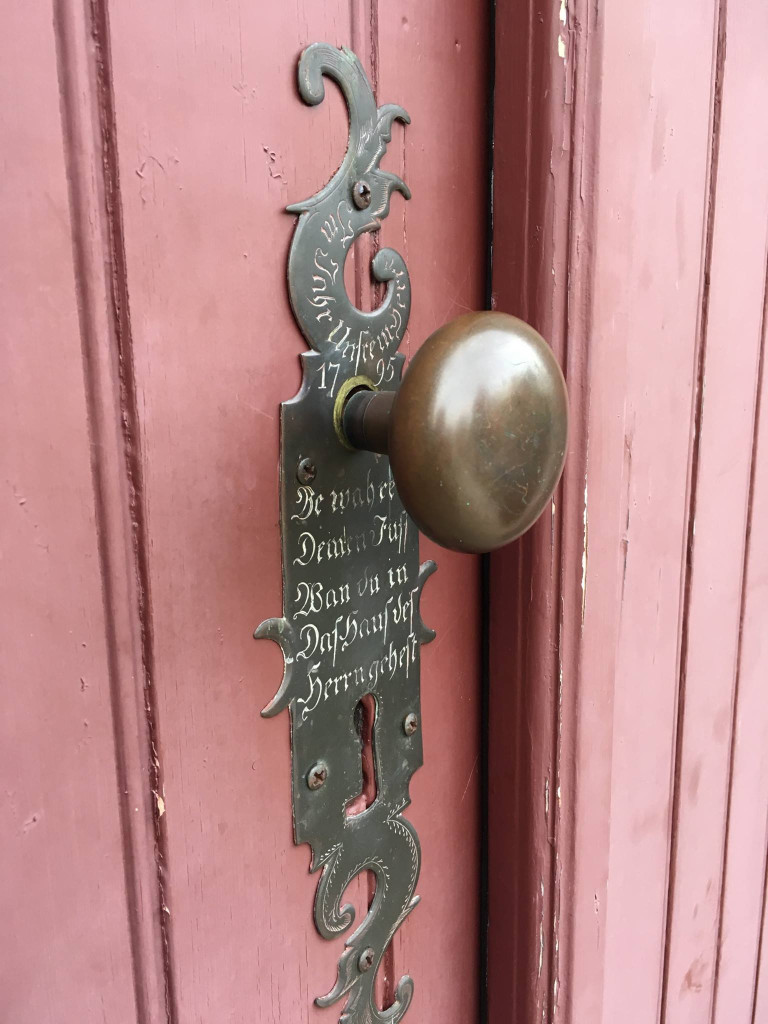
Besides focusing on utilitarian items, in 1796, Michael created the beautiful escutcheon plate that was installed on the main door to the first St. Peter's Lutheran Church on the north side of Garman Street which stood until 1908 and is currently found on the current church doors, southwest corner of King and High streets.
It reads "Bewahre deinen Fuss wan du in das Haus des Herrn gehest" (from Ecclesiastes 5:1 - "Guard your steps when you go to the house of God" in the New International version).
This item is a local treasure for those living or visiting Shepordstown.
On Oct. 28, 1821, Michael died, and his adopted son Elijah Jackman Rickard (March 27, 1795-1879) became the successor to the business and worked here for most of his life.
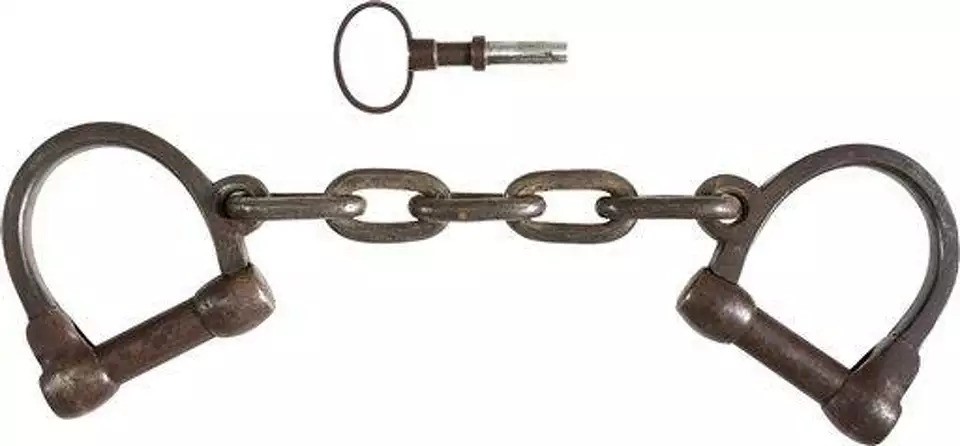
Of particular importance to handcuff collectors, is his contribution of making the famous lock design from his father at a larger scale, creating the first American restraints, the handcuffs and leg iron.
It is claimed that at least 1 example of a neck collar was produced. I have never seen a picture of it or met the collector who had it in his collection, but I think it the item was made by Elijah Rickard. He is also noted for making the handcuffs which abolitionist John Brown wore when he was accused and hung for his part in the raid at Harpers Ferry on December 2, 1859.
Part 3 of this report will discuss this topic in further detail.
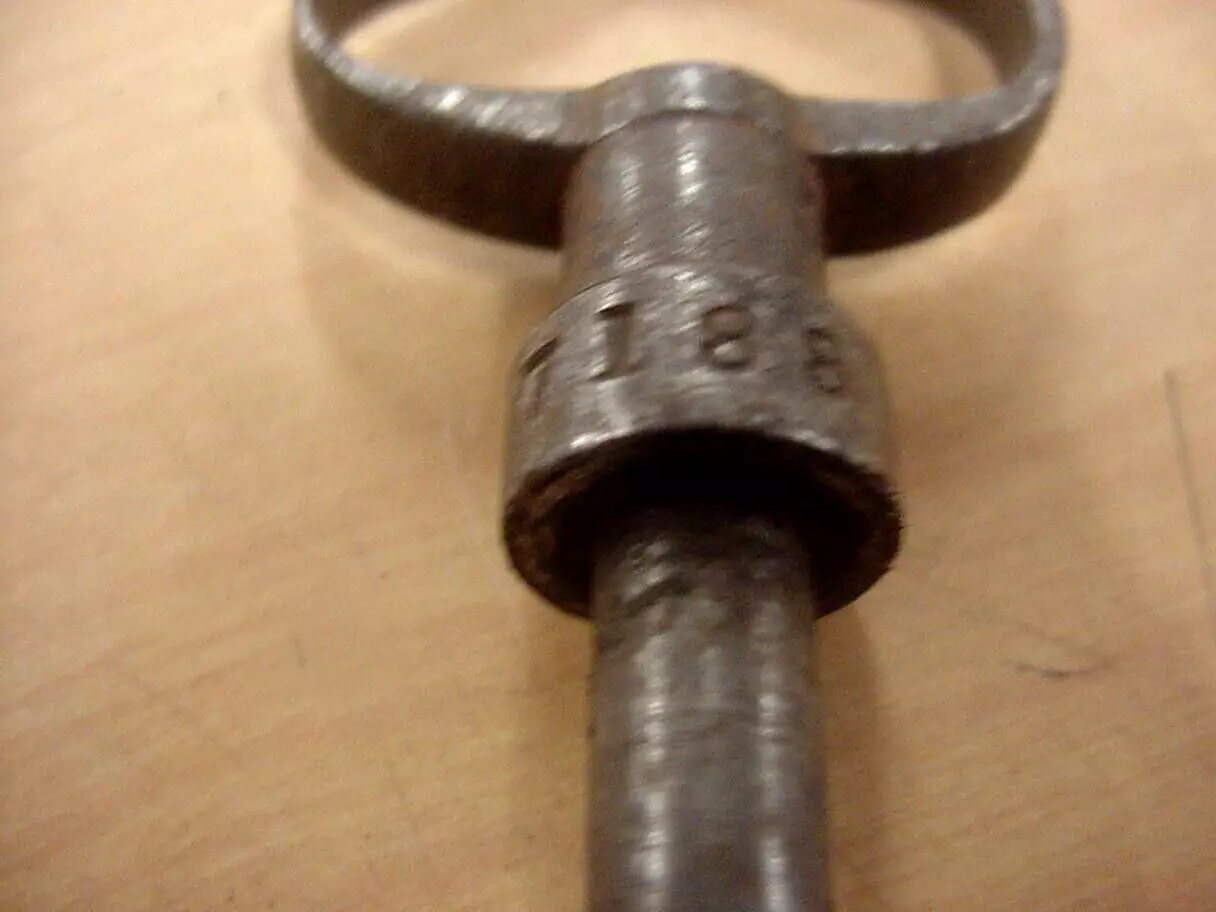
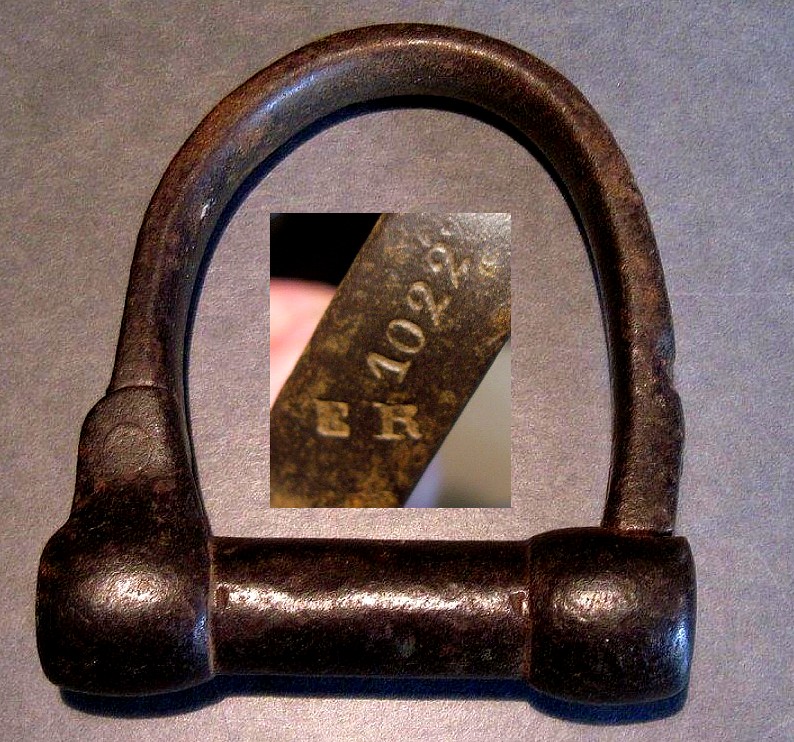
Rickard restraints all seem to be marked with the familiar "ER" markings. I have never seen or heard of an unmarked example or even any with "MR branding.
I would conclude that unless one or more examples are ever found, Elijah should be known as the exclusive maker of any and all Rickard restraints.
Being that the family produced locks that are no different than any of the restraints made, other than the size, it would be logical to assume that production started with the father, but then again, maybe they simply did not think about restraints until Elijah realized a need for them.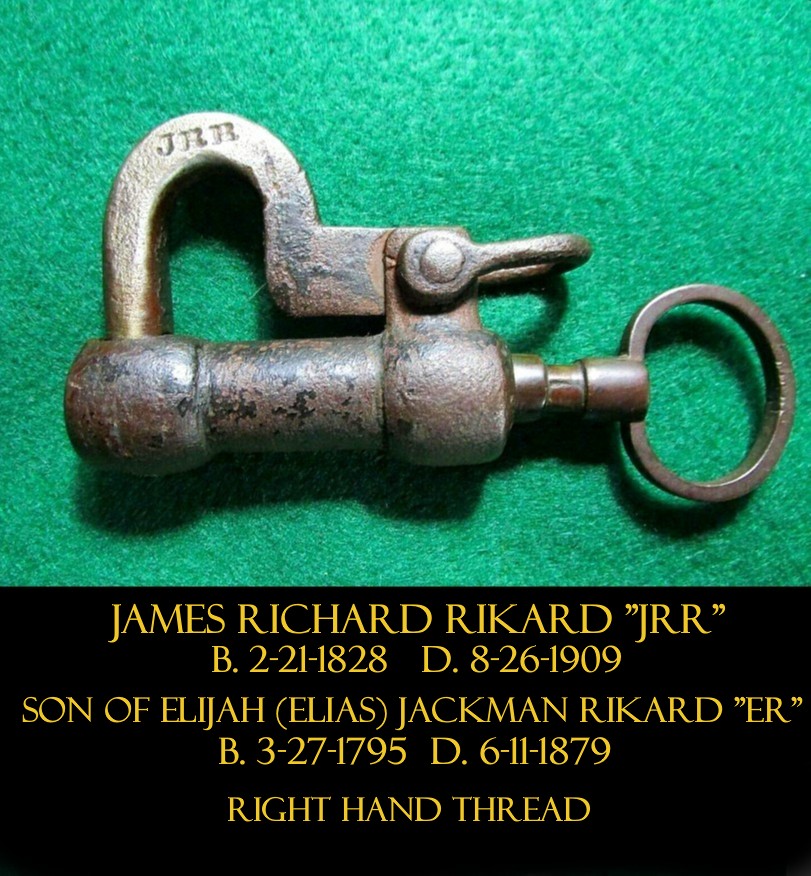
Reading and quoting what other authors previously wrote along with historical sites, I believe what I have written here is accurate at this time.
German born Michael Rickard lived his life as a whitesmith. He made locks, hardware, guns, and small implements of unforged metal. I have searched very hard for any guns that Michael may have made but found nothing so far. A few biographies indicate that he did, but I can't substantiate that fact at all.
The term "whitesmith" refers to what is today, called a locksmith. The forging process for wrought iron, heating the iron and cooling it with water, left a very dark, almost black, surface oxidation on the metal; hence the term "blacksmith." The lockmaker, however, worked the iron cold, sawing and filing his creations into final form, thereby removing the black surface oxidation and leaving the metal "white." A whitesmith is also known as a "tinsmith" and works with more delicate metals not associated with iron material that the blacksmith would use.
He is credited for inventing the screw lock, a peculiar caliper shaped lock which can only be opened by screwing a key which pulls back a bolt, unlocking the lock.
For many years these locks were used by the B&O Railroad as switch locks. These locks are said to be the very first railroad locks to be marked as such. The locking concept was eventually carried over to larger locks and formed handcuffs and leg irons by his son, Elijah in later years. The Darby handcuff also used a similar design and the also produced "end locks" which were basically screw key padlocks, so why is Rickard credited for this style lock?
Perhaps his credit was for American made padlocks.
The Rickard Home --
In 1782, Abram Shepherd sold Lot 7 for two Virginia pounds to John Blackburn on the condition that he build a dwelling house on the property 20 feet long by 16 feet wide.
The property was located close to the Potomac River in Shepardstown Virgina (which became West Virginia on June 20, 1863).
In 1785 Blackburn sold the property to Conrad Boyer, a whitesmith, for 20 pounds. Boyer built a house on the property and an adjoining workshop.
The address with the adjacent building was listed as 211 and 213 West German St.
The town is now part of the historic district.
Michael Rickard purchased the property from Conrad Boyer’s widow in 1810 for 285 pounds.
Rickard occupied the house and set up his foundry in the shop building.
The shop used the 213 address and had a basement where a large, raised fireplace was used to forge his work. 211 was on the west side of this two-story structure and it provided the residential quarters for the family. The street was located in an area where many German artisans settled in the l8th century.
It was here that his padlocks were invented, and where the restraints were eventually produced.
The Rickard Family was in good company with some notable neighbors. One notable next-door neighbor resided at 215 W German St. In 1800 John Baker, a local attorney, purchased this house. He served in Congress and the Virginia legislature as a Federalist.
Another neighbor who lived up on the same street was Conrad Shindler. He was a coppersmith in the late 1790's. Like Rickards, he had a small foundry in the basement too. While he was not well known at the time, his direct descendant was a well-known actress, and she purchased the property many years later. She gifted it to the Sheperd College Foundation in honor of her dad and dedicated the home under the name of "The George Tyler Moore Center for the Study of the Civil War". Her name was Mary Tyler Moore.
Upon Michael’s death on Oct. 28, 1821, the property passed to his widow and his son, Elijah (1795 -1879), who took over the locksmith business. Elijah is who we admire most in this family as cuff collectors.
Elijah left the property to his son James (1828-1909) who, childless, left the property to his last remaining sister, “Miss Maria,” who then rented out the house until her death in 1920.
In December of 1909, the workshop and its contents were put up for auction. These items included an “iron lathe, foot power, bellows, 2 anvils, hammers, shears, tongs, augers, brace and bits, and sundry tools, and also a lot of junk, iron and brass, and desk and stove.”
According to the auction announcement, the property is “desirably located and readily convertible into a dwelling.” The workshop was purchased by W.P. Licklider for $1,220 and converted into a residence.
Upon Maria’s death, the residence also sold at public auction for $2,000.
The Family --
On June 2, 1797, Michael married Elizabeth Shindler (aka Elizabeth Shindler Jackman, daughter of Conrad Shindler). She was married to a man named Jackman, but she apparently was widowed before marrying Michael.
Michael adopted her son Elijah, who continued the family business. Elijah is said to have crafted John Brown's handcuffs in 1859. (more in part 3)
Three generations of Rickard locksmiths lived and worked at 213 for well over a century. If previous tenant Conrad Boyer is added to the timeline of the home/workshop, there is a very substantial history of lock and other items being manufactured at this location.
The Michael Rickard Family had at least 4 children:
• Elijah Jackman Rickard b. 27 Mar 1795 (adopted by Michael when he married Elijah's mother)
• Mary Elizabeth (Polly) Rickard b. 1798
• Nancy (Ann) Rickard b. 1803
• Eliza Rickard b. 1808
• and there may have been others
We do not know how John or Thomas fits into the family. It seems that they are their children, but I see no mention of them anywhere but here.
It is interesting that this 1850 census report spells the Rickard" name as Rickards.
I will continue searching when and where the Americanized name of "Richards" first appears.
Michael worked and lived at the Shepardtown location for just shy of a dozen years.
We know him for his lock making, but he is known for a wide variety of other hardware designs and manufacturing.
Besides focusing on utilitarian items, in 1796, Michael created the beautiful escutcheon plate that was installed on the main door to the first St. Peter's Lutheran Church on the north side of Garman Street which stood until 1908 and is currently found on the current church doors, southwest corner of King and High streets.
It reads "Bewahre deinen Fuss wan du in das Haus des Herrn gehest" (from Ecclesiastes 5:1 - "Guard your steps when you go to the house of God" in the New International version).
This item is a local treasure for those living or visiting Shepordstown.
On Oct. 28, 1821, Michael died, and his adopted son Elijah Jackman Rickard (March 27, 1795-1879) became the successor to the business and worked here for most of his life.
Of particular importance to handcuff collectors, is his contribution of making the famous lock design from his father at a larger scale, creating the first American restraints, the handcuffs and leg iron.
It is claimed that at least 1 example of a neck collar was produced. I have never seen a picture of it or met the collector who had it in his collection, but I think it the item was made by Elijah Rickard. He is also noted for making the handcuffs which abolitionist John Brown wore when he was accused and hung for his part in the raid at Harpers Ferry on December 2, 1859.
Part 3 of this report will discuss this topic in further detail.
Rickard restraints all seem to be marked with the familiar "ER" markings. I have never seen or heard of an unmarked example or even any with "MR branding.
I would conclude that unless one or more examples are ever found, Elijah should be known as the exclusive maker of any and all Rickard restraints.
Being that the family produced locks that are no different than any of the restraints made, other than the size, it would be logical to assume that production started with the father, but then again, maybe they simply did not think about restraints until Elijah realized a need for them.